Treadmill and fitness equipment repair software
For technicians who fix treadmills, ellipticals, exercise bikes and strength machines: on-site calls with address, technician and due date, estimates approved before a motor controller is ordered, belts and brushes in stock, and gyms kept as one account with balances and service reports.
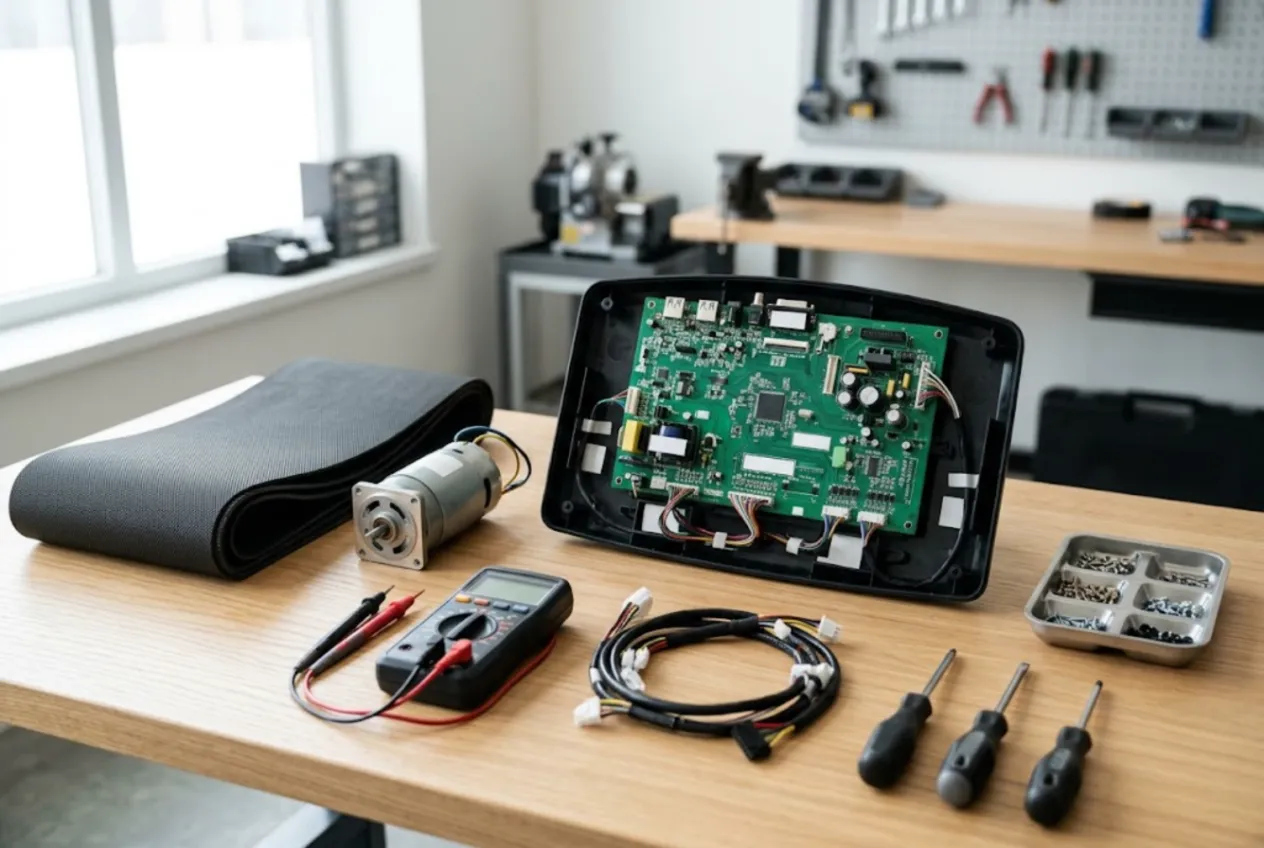
ServiceCenterSoft is job-tracking software for fitness equipment service: treadmills, ellipticals, upright and spin bikes, rowers and home gyms. On-site calls are ordinary jobs with the customer’s address, the assigned technician and a due date. Motor controllers are ordered only after the customer approves the estimate, running belts and motor brushes have reorder levels, and every gym or health club is one account with all its machines and what it owes. It runs in the browser — on the shop PC and on your phone while you are kneeling next to a treadmill.
Who it is for
Most fitness equipment gets fixed where it stands. Nobody hauls a 220-pound treadmill across town for a brush replacement, and a cable machine bolted to a gym floor is not going anywhere. So a fitness repair business usually runs two kinds of work. Home owners call with “the belt hesitates under load” or “it beeps and stops after a minute”. Gyms, hotels, apartment buildings and corporate fitness rooms have a dozen or fifty machines, a service agreement and a front desk that wants to know when the third treadmill from the window will be back.
Where things fall through the cracks:
- the address was on a sticky note, and the tech showed up on the wrong day;
- a club asks how many times you have serviced its treadmills this year, and the only record is your memory;
- a motor control board was ordered before the owner agreed — and they had already decided to buy a new machine;
- you are out of the running belt size you use most, with three customers waiting;
- the gym paid part now and “the rest later”, and a month on nobody knows the balance;
- the same treadmill is back with the same drive motor, and no one knows what was done last time.
On-site calls, as they actually work
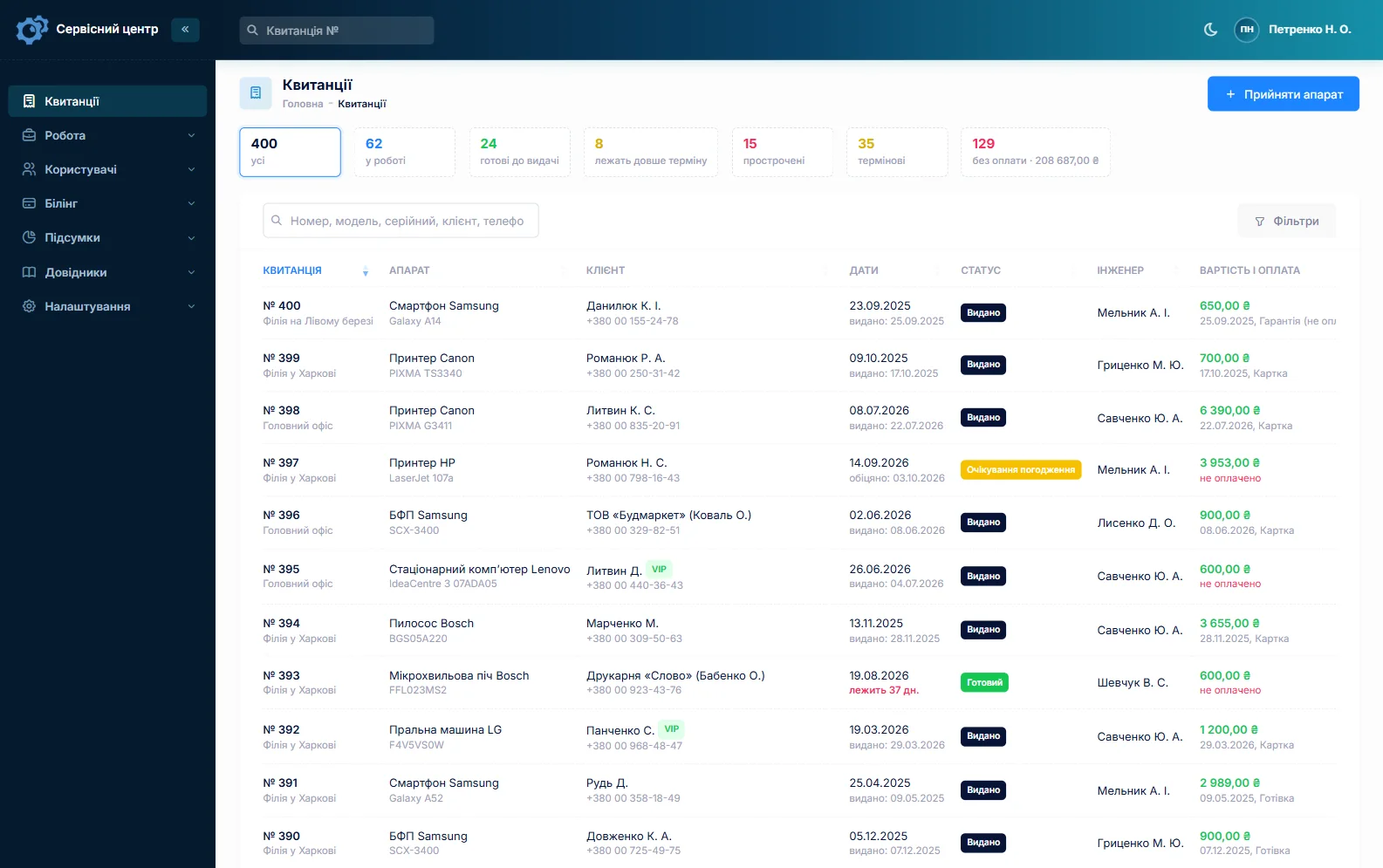
To be upfront: there is no dispatch board, map or route planner. An on-site call is a regular job, and that is enough to keep track. The customer record holds the address, city and two phone numbers, so the tech opens the job on a phone and knows where to go. Add a repair type called “On-site” in your list of repair types, and the job list filters by that type, by technician or by date range.
Every job has a promised date: once it passes, the row turns red and the “overdue” filter pulls those jobs together. “Only after 6 p.m.” or “gate code 45” goes into “Notes for the technician”, which the customer never sees. If the fix fails on site and the machine comes back to the shop, it stays the same job — change the status, and the history shows the whole trip. There is more on how on-site work looks in the software on the appliance service page.
Check-in: model, serial, symptom
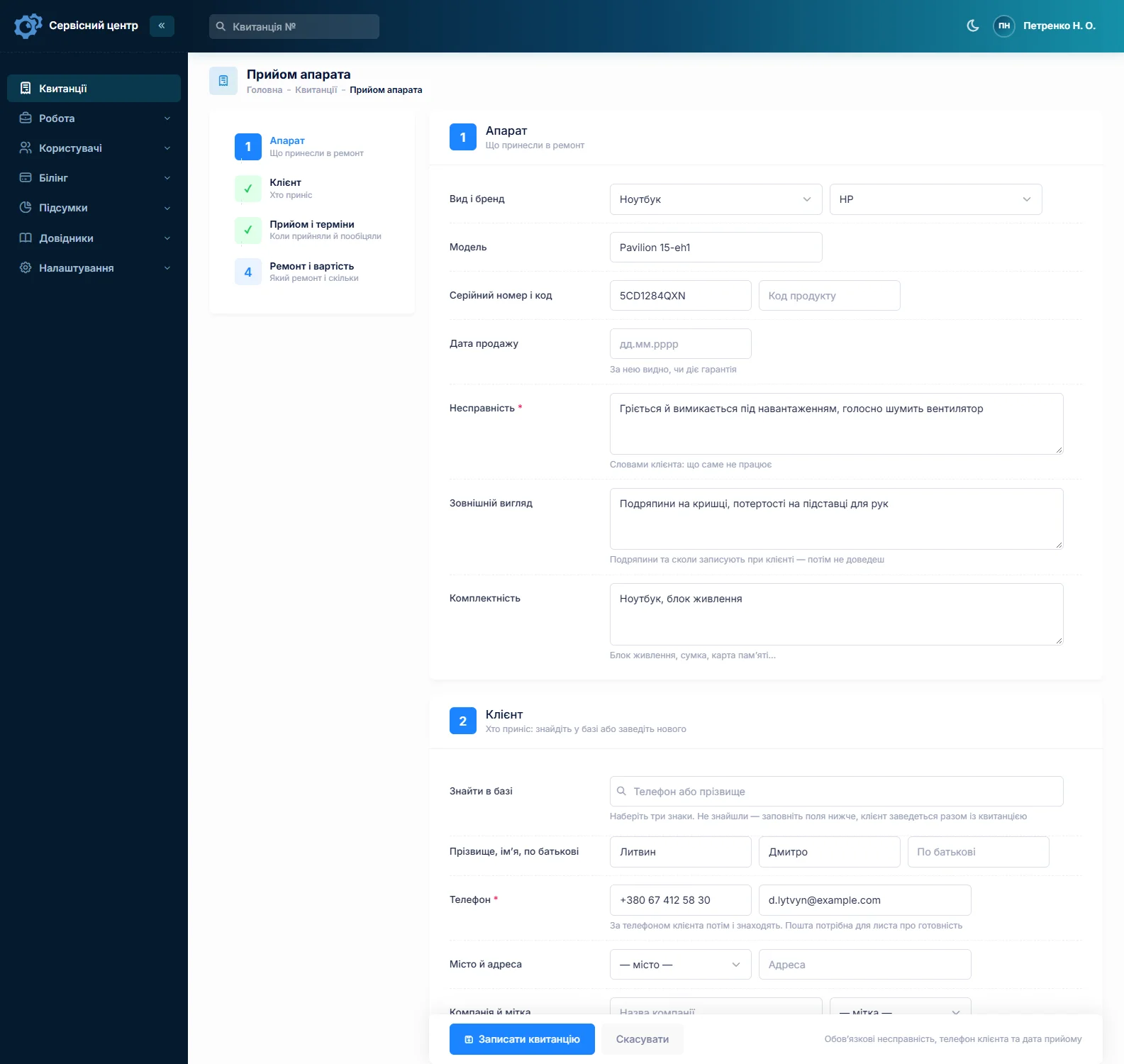
The serial plate is usually near the motor hood or under the console. Model and serial number are separate fields, both searchable straight from the job list, so a repeat visit turns up in seconds. Write the symptom the way the customer says it: “surges at 6 mph”, “belt drifts to the left”, “console is dead”, “error code, then it stops”, “incline doesn’t move”, “thumping under the deck”. Advanced search in “text” mode finds it a year later.
The condition field covers cracked shrouds, a worn walking belt, scratched frame rails; the accessories field lists the safety key, remote, power cord and chest strap. Both print on the job sheet the customer signs, which settles “we definitely gave you the safety key” before it starts.
Motor controller, drive motor, belt: estimate first
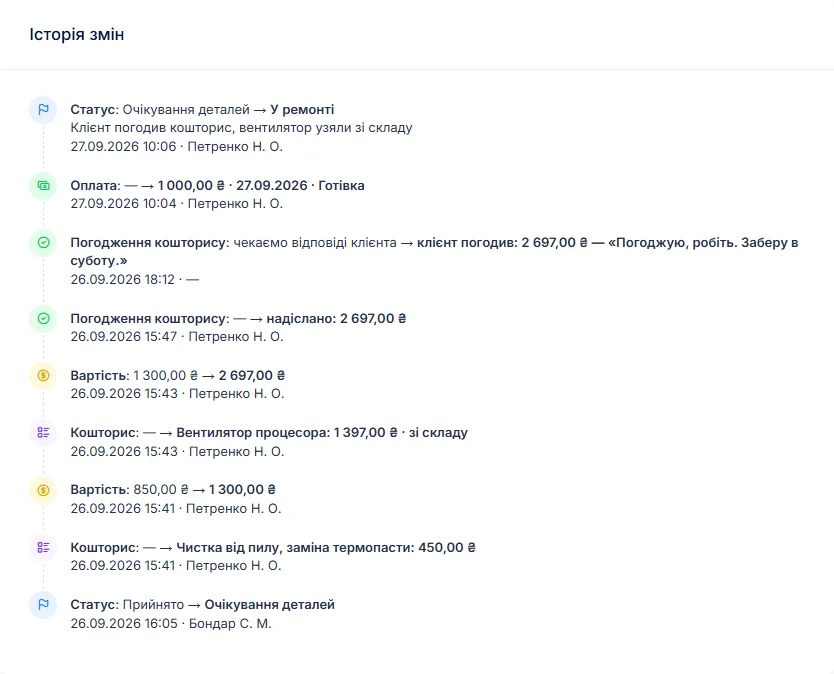
The expensive treadmill repairs are the motor control board and the drive motor itself; on budget models a new controller can be a real slice of the price of a new machine. That call belongs to the owner. So diagnose, log the finding — “blown output stage on the motor controller, motor tests fine, brushes half worn” — and build the estimate line by line from your labour list or from stock. A button on the job sends it by email or Telegram; the customer sees each line and the total and taps “I agree” or “I decline”. The answer and date go into the job history.
Declined? “Repair refused” closes the job. Not worth fixing? “Beyond repair”. If you charge for the call-out or diagnosis, set a diagnostics price for the device type and it appears on the job from day one. If you repair boards or motors in-house, see industrial electronics repair and electric motor repair.
Running belts, drive belts and brushes in stock
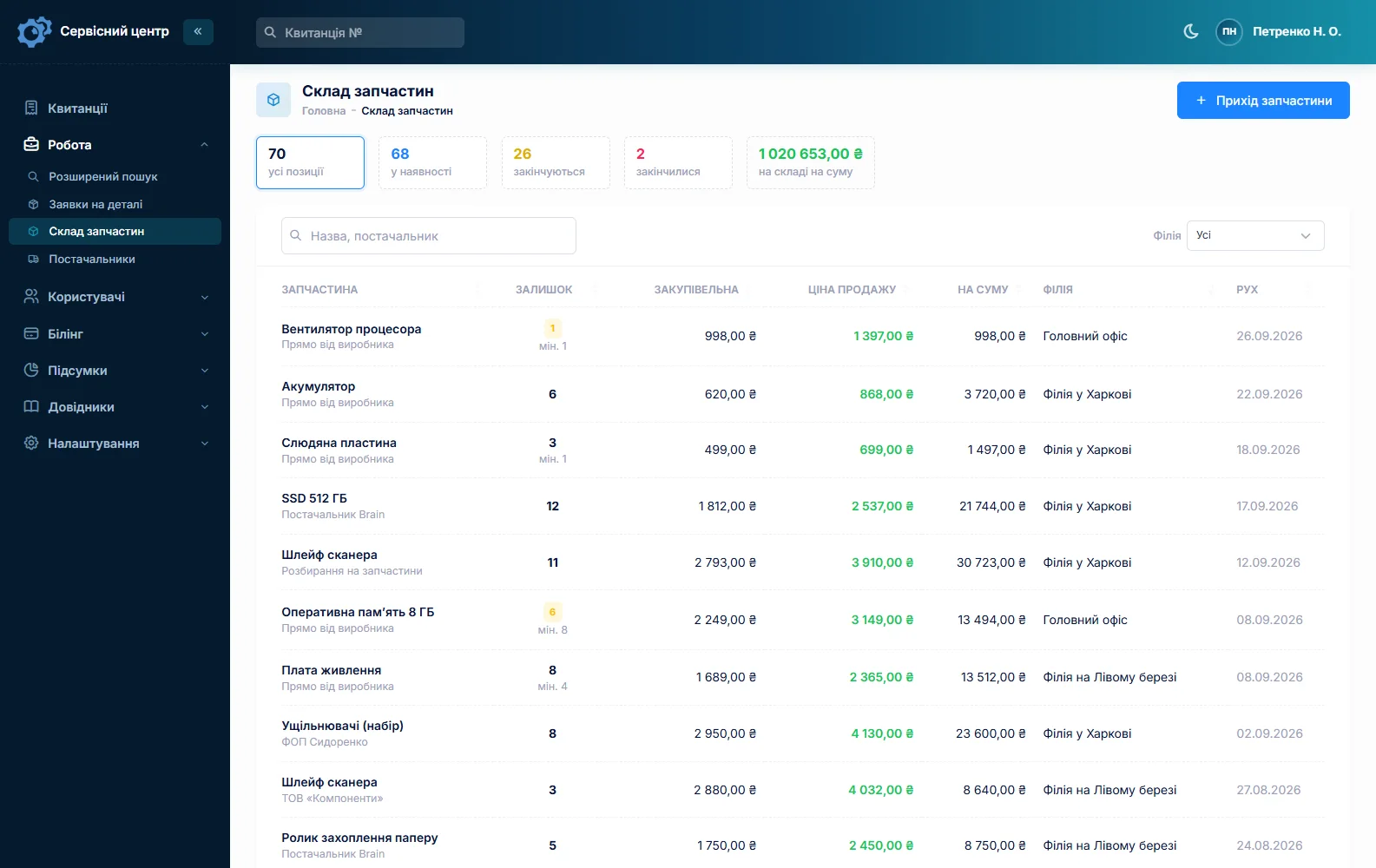
A fitness repair van carries the same parts again and again: walking belts in your common sizes, drive belts, DC motor brushes, incline motors, speed sensors, safety keys, rollers, decks, silicone lubricant, bike pedals and belts, cables and pulleys for strength machines. Stock is a movement log: goods in with cost and supplier, used on a job as an estimate line, returned, adjusted at stock-take. A part picked from stock on an estimate lowers the balance by itself.
Set a minimum level per item, and the “running low” tile tells you to reorder belts before customers wait for them. A controller for a specific model is ordered from the job: the request is emailed to the supplier, and the job sits in “waiting for parts”. More on spare parts tracking.
Gyms and health clubs
Customers have a “Company” field, so a club is one customer whoever calls. Its record shows every job, the total and the balance across unpaid jobs. After a walk-through of the gym floor, each machine gets its own job: fill in the first, copy it for the rest and type in each serial number. Put the club’s asset tag in the notes, and a text search finds the job by that too.
The service agreement itself is your document — the software does not track contracts or schedule preventive maintenance. What it does track is payments: several per job, such as a deposit for a belt and the rest by transfer later. It shows what is still owed, and the “unpaid” filter gathers jobs handed over but not paid. A machine back after your repair gets the “Repeat repair” type, and its serial brings up the earlier job. “Recommendations for the customer” — “lubricate the deck every three months”, “use a mat, not carpet” — prints on the completion report with the estimate lines, the work log and the amount due. More on the completion report.
Done — tell them straight away
For machines brought into the shop, the customer gets an email or a Telegram message when the job is ready (they subscribe with a QR code on the job sheet). Each finished unit shows how many days it has been waiting, and the counter turns red when the free storage period in your settings runs out — which matters when a single treadmill eats half the back room.
A treadmill is an electrical appliance someone runs on at speed. Which checks are required after a repair, and what applies to equipment in commercial gyms, depends on local rules — check with a qualified source before you promise anything.
What repairs typically cost
As a rough guide only — prices vary with region, model and parts: call-out and diagnosis €50–120, deck lubrication and belt adjustment €50–120, walking belt replacement €80–180 labour plus the belt, drive belt replacement €50–120, motor brush replacement €50–110, motor control board repair €150–450, incline motor repair €100–300, console repair or sensor replacement €60–250, bike or elliptical repair (bearings, magnetic resistance) €60–250. You set your own prices: per device type and as estimate lines.
What it does not do
- dispatch with a map or route planning — only the repair type, address, technician and dates;
- service contracts or scheduled preventive maintenance;
- invoices and contracts for companies, or one combined report for the month;
- photos or file attachments on jobs;
- SMS, a mobile app, online payment by the customer;
- supplier integrations.
What it costs
One price for the whole business — no extra charge for technicians or branches.
Monthly
Paid every month, cancel whenever you like.
Yearly
Cheaper than paying monthly. Invoice or card payment.
Custom work
Changes tailored to the way you work — hourly, by agreement.
Off-the-shelf not enough — your own forms, roles, reports or workflow? We will build a program for you. How it works
Try it without signing up in the demo: book in a treadmill with its serial number and safety key, set a due date and send an estimate for a motor controller.

We are very happy working with servicecentersoft.com: they built everything we asked for, even though our request was unusual, since we deal with medical devices. Everything was done precisely and on the agreed schedule. Thank you for the cooperation — we keep working together.

I tried the ServiceCenterSoft demo and came away with a good impression. The program is simple and easy to understand, yet it has everything you need for the job: customers, repairs, devices, spare parts, statuses and statistics.
I especially liked the dark theme and the responsive design — working from a phone is perfectly comfortable. Another plus is the instant search that works as you type, so you don't have to press a separate "Search" button every time.
You can tell the program was built specifically for service centers rather than being a generic CRM adapted for the repair business. The interface has no unnecessary frills; everything is logical and to the point.
A good, practical tool for the day-to-day work of a service center.

I liked that you get a free 14-day trial and that they are willing to handle my special requests — setting things up exactly the way I need them.
I also liked how payment works. You can simply pay the monthly fee by card online — basically the same as a regular Spotify subscription or any other service. No separate contracts to sign and no invoices to pay manually.
And there's no feeling of strict limits on the number of employees. One service center is one account, and inside it you can organize the work of your technicians and run several branches.
For me this is far more convenient than plans where you have to pay for every single user or keep counting how many employees are working today.

My business is fairly specific, so the program's standard features weren't enough — I needed my own custom fields, my own sorting options and search by additional parameters. The work completion certificate and the printed repair receipt also needed some changes to fit the way we work.
I contacted technical support. To be honest, I expected changes like these to take a long time, but everything was done within a single day. The team quickly understood exactly what we needed, suggested the right solution and did everything properly.
I'd especially like to mention the support: they get straight to the point, with no unnecessary bureaucracy, and they genuinely help instead of just sending you off to read the documentation.
For me this is a big advantage of the program: it isn't just sold "as is" — it can be adapted to how you actually work. Thanks to the team for the quick response and for treating the customer right.
Highly recommended!
In short
- On-site calls as jobs with address, technician, due date and red overdue rows.
- Serial number and the customer’s own words — a machine’s history in seconds.
- An itemised estimate approved by link before a controller or motor is ordered.
- Walking belts, drive belts, brushes and sensors in stock with minimum levels.
- Gyms and clubs: company field, copied jobs, balances, deposits, completion report.
- €20 a month for the whole business.
See also
Commercial kitchen equipment repair software
For service companies that fix combi ovens, commercial dishwashers, reach-in and display refrigeration, fryers and ranges: urgent calls and due dates everyone can see, site visits on record, elements and thermostats in stock, and restaurant accounts with balances and service reports.
Read moreOutboard motor repair software
For marine engine service shops working on gas and electric outboards: winterization and winter storage, the spring commissioning rush with due dates, engine hours and service in the work log, lower units and water pump impellers through approved estimates, and special-order parts.
Read moreStarting your own repair shop: where to begin
For people who can fix phones and laptops and want to work for themselves: what a small repair business needs on day one, the paperwork that protects you from the first customer, and how to run a shop in a country whose language is not your own.
Read moreSee how it works
The demo is open — go in and try it. Ask us anything by email, Telegram or the form on this site.