Outboard motor repair software
For marine engine service shops working on gas and electric outboards: winterization and winter storage, the spring commissioning rush with due dates, engine hours and service in the work log, lower units and water pump impellers through approved estimates, and special-order parts.
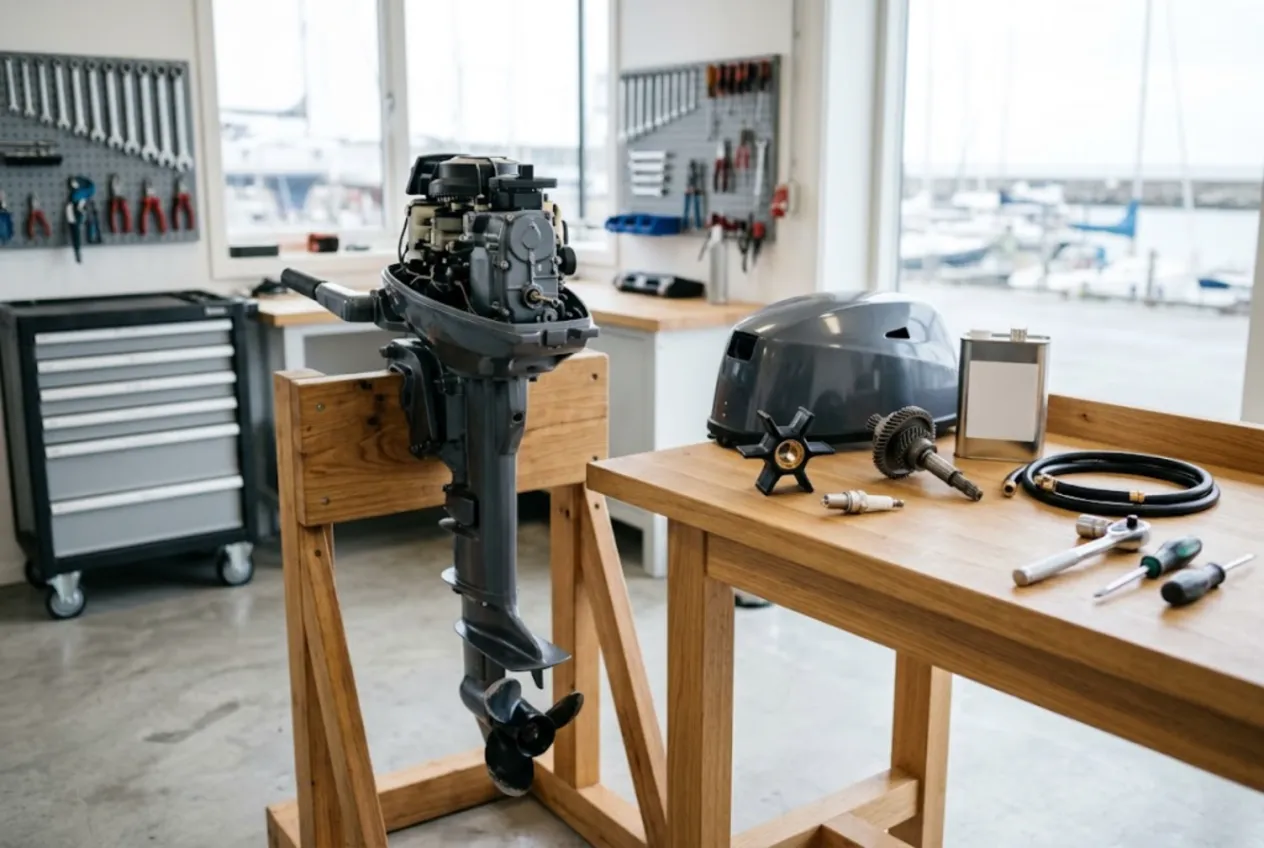
ServiceCenterSoft is job-tracking software for marine engine service shops that repair outboards: two-stroke and four-stroke gas outboards from small kickers to 150 hp, and electric trolling and outboard motors. Winterization and winter storage, the spring commissioning rush with due dates everyone can see, engine hours and service in the work log, lower unit repairs and impeller jobs through estimates the customer approves. It runs in the browser — on the shop PC and on your phone down at the dock.
Who it is for
Independent outboard shops, marina service departments, rental fleets, fishing clubs. The year has the same shape for all of them: haul-out and winterization in the fall, motors stored over the winter, then every customer wants to be on the water the same weekend in spring.
Where it usually goes wrong:
- thirty motors in winter storage, and which one belongs to whom lives in a notebook or one person’s head;
- everyone was promised “ready for opening weekend”, and the order of work is set by who calls most;
- the lower unit drains milky, and the customer who came in for a tune-up does not believe the new number;
- water pump kits for your most common motor run out mid-April;
- nobody can say when the impeller on a regular customer’s motor was last changed.
Check-in: hours, the fuel tank and the prop
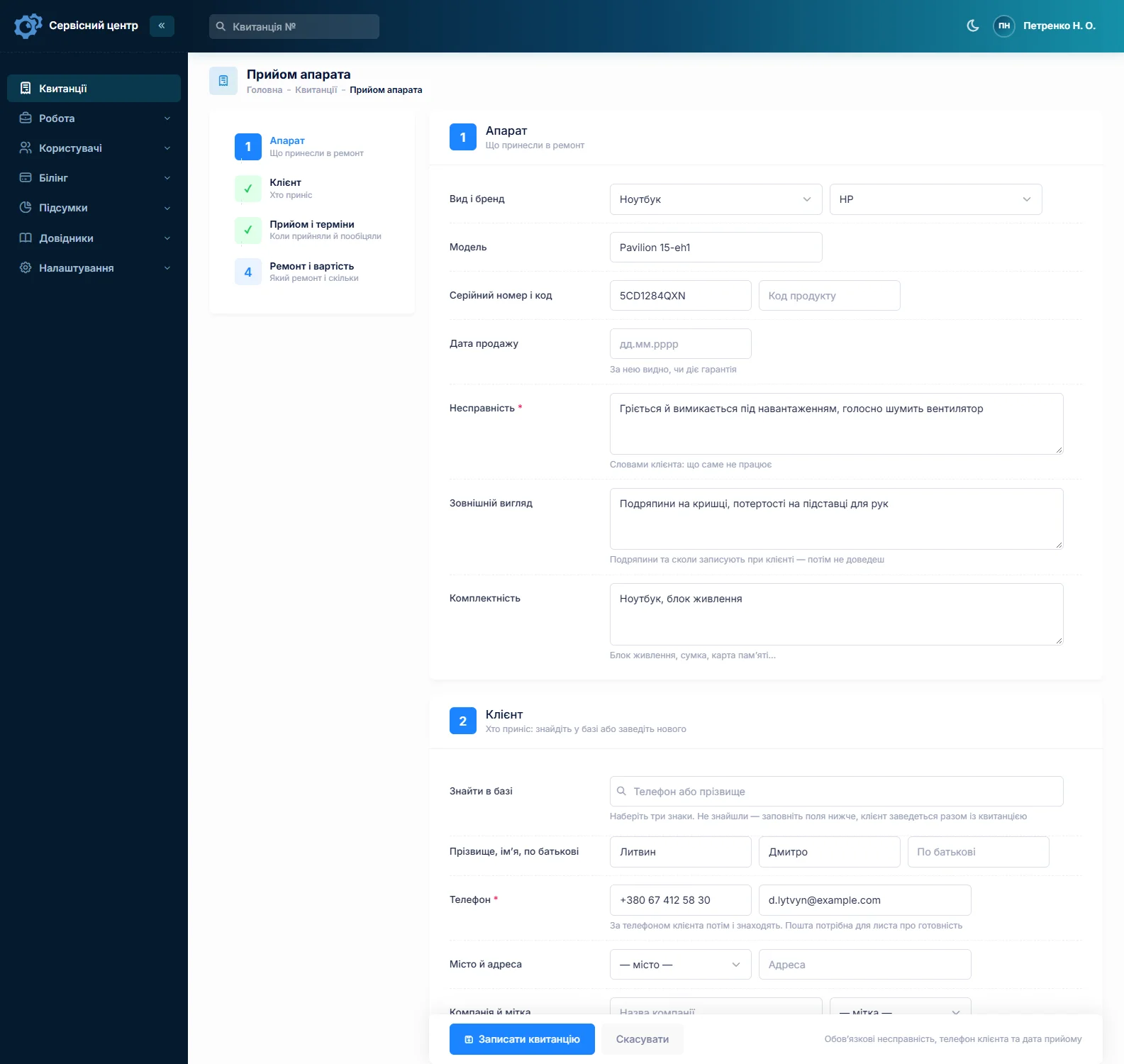
Each job has the device type, model, serial number and date of sale. Put horsepower and shaft length in the model: “9.9 hp four-stroke, 20-inch shaft” or “electric, 55 lb thrust, 12 V”. The serial is searchable from the job list, so next season the motor’s history comes up in seconds.
There is no dedicated engine-hours field. Read the hour meter at check-in and put it in “Notes for the technician”: “212 hrs, fuel left in the tank, run in salt water.” The customer does not see this field, and text search finds it a year later.
The accessories field is filled in with the customer present and printed on the job sheet they sign: “prop, 6-gallon tank with fuel line and primer bulb, kill-switch lanyard, no cowling”. Condition covers gouges on the skeg, bent prop blades and corrosion on the clamp brackets. An electric motor’s battery and charger go on the accessories line too.
Winter storage without a storage module
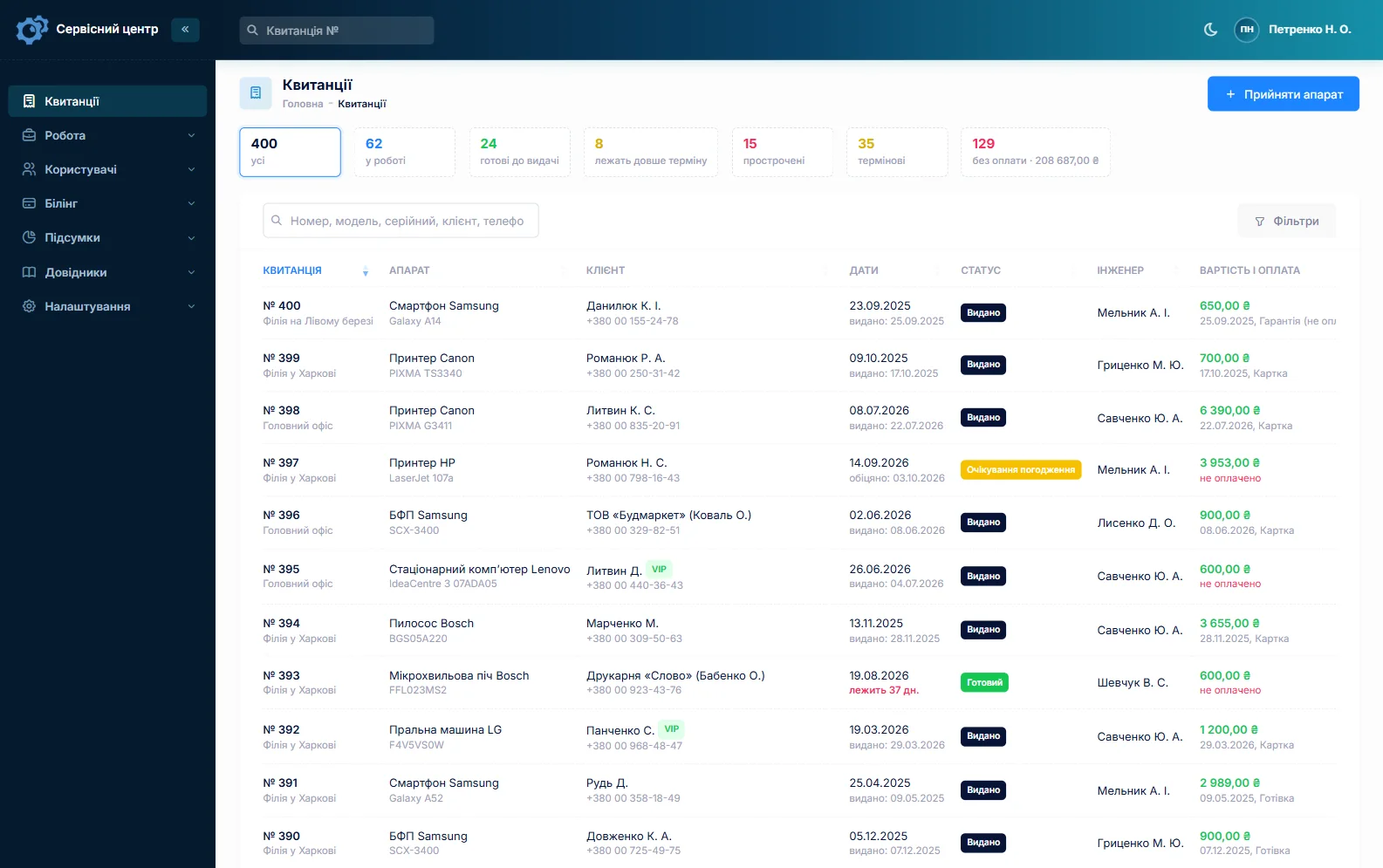
To be straight: there is no storage module or rack map. Create your own status, “Winter storage”, with its own colour and a tile above the list — one click shows every motor you are storing and how many. Put the rack position in the technician notes (“Rack B, slot 7”), and a text search finds a motor by location.
Set up storage as a labour item — “Storage, per month” with a price — and add it to the estimate with the number of months. A job takes several payments, so the customer can pay for winterization in the fall and the storage balance at pickup; the software shows what is still owed.
Winterization itself — flushing, fogging, draining the float bowl, gear oil — is another labour item with a price per device type. More on seasonal work in small engine repair software.
Spring commissioning: a date on every job
Every job has a promised date. Once it passes, the row turns red and the “overdue” filter gathers those jobs in one list. The “Urgent” flag — for the rental fleet with fifteen boats and no motors on Saturday — shows in the list.
Add your own statuses, such as “De-winterizing” or “Tank test”, each with its own colour. A motor that wintered with you and now goes through spring service does not need to be keyed in again: copy last year’s job, and the customer, device type and model carry over while you enter the serial.
Engine hours, impellers and lower units
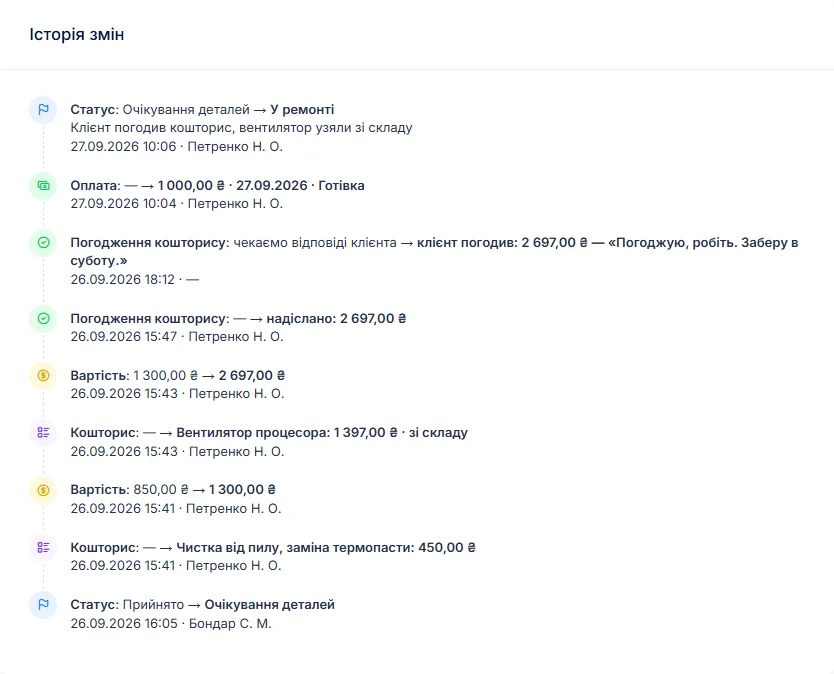
Outboard maintenance runs on hours and seasons: engine oil and filter, gear lube, plugs, fuel filter and water separator, anodes, the water pump impeller. Set up “100-hour service” or “annual service” in the labour list with a price per device type, and it goes onto an estimate as one line. What was done and at what hours goes in the work log: “100-hr service: oil and filter, gear lube, plugs, impeller, anodes; 236 hrs.” Same approach as on the generator repair page.
The next impeller change goes into “Recommendations for the customer”: “impeller — next spring or at 100 hours; flush with fresh water after every salt-water trip.” Recommendations print on the completion report the customer takes with the motor. The software does not send service reminders on a schedule.
Water in the gear lube means seals; if the motor ran like that all season, bearings and gears may be next. Log what you found, move the job to “waiting for approval”, and build an itemised estimate — seals from stock, labour, a gear on order. A button sends it by email or Telegram; the customer sees each line and the total and presses “I agree” or “I decline”, and the answer is stored with the date. Declined? “Repair refused” closes the job, or “beyond repair”. Paid diagnosis is a price on the device type.
Electric outboards and trolling motors
Electric motors fail differently: a controller after water got in, corroded connectors, a leaking shaft seal, worn brushes, a bent shaft after a grounding. Give them a device type of their own with its own diagnostics price and labour items.
Parts in stock and parts on order
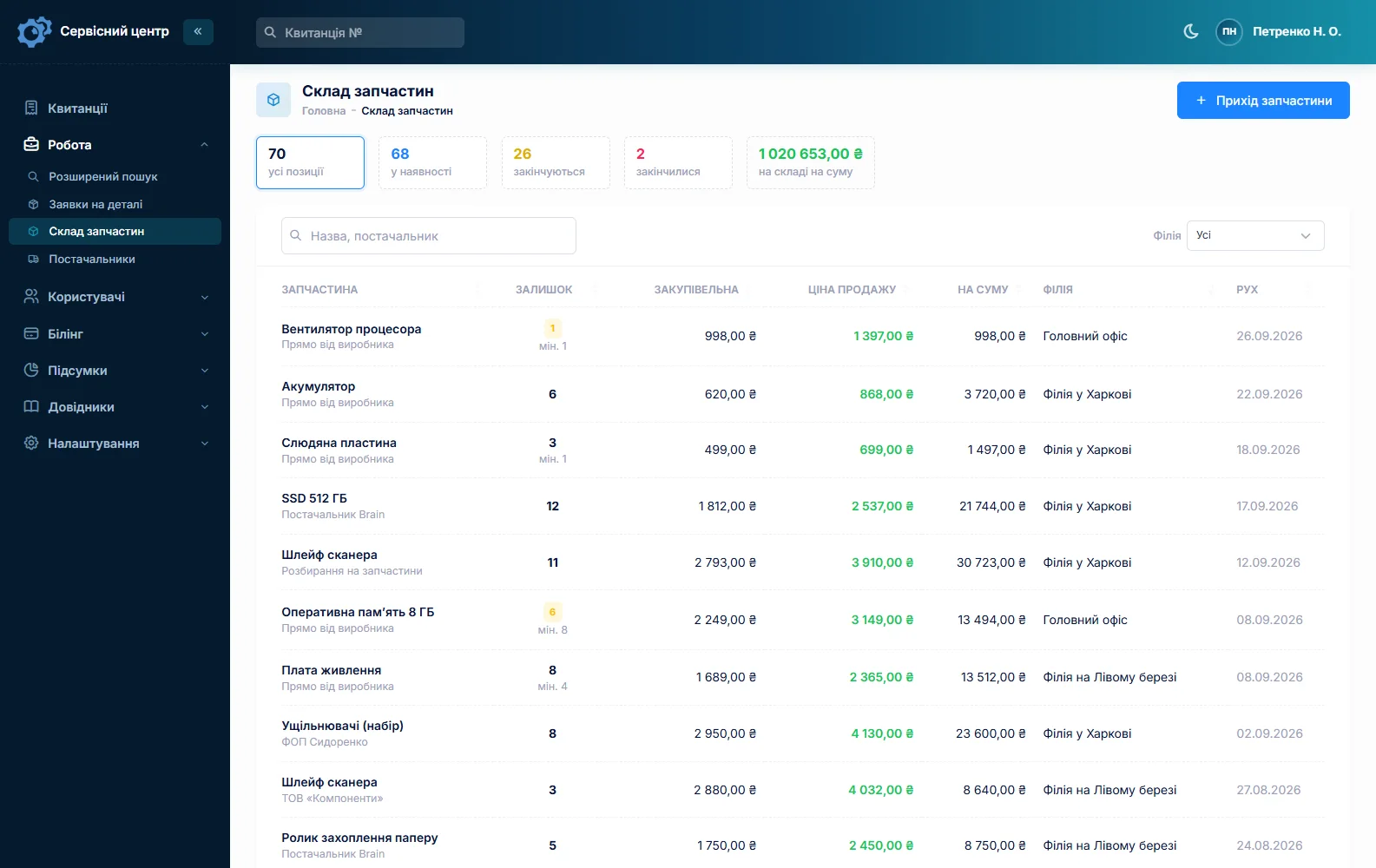
Stock is a movement log: goods in with cost price and supplier, used on a job as an estimate line, returned, adjusted at stock-take. A part picked from stock reduces the balance automatically. A typical shelf: impellers and water pump kits, lower unit seal kits, plugs, fuel filters and water separators, anodes, prop shear pins and cotter pins, gear lube in tubes. Quantities are whole numbers, so count gear lube and oil by tube and bottle.
Minimum levels and the “running low” tile get you reordering in winter, not mid-rush. A part for an older motor is ordered from the job: the request is emailed to your supplier, the job sits in “waiting for parts”. More on spare parts tracking.
Rental fleets, marinas and clubs
The “Company” field makes a rental fleet or club one customer, whoever drops the motor off. The customer record shows every job and the balance owed. Six identical rental motors? Fill in one job, copy it for the rest and enter each serial. A motor back after your repair gets the “Repeat repair” type, and its serial brings up the earlier job. The completion report lists estimate lines, the work log, recommendations and the amount due.
Ready — the customer knows right away
When the job is done the customer gets an email or a Telegram message (they subscribe with a QR code on the job sheet). Every finished motor shows how many days it has been waiting, and once the free storage period from your settings runs out the counter turns red. More on customer notifications.
What stays outside the software
Boat and motor registration, operator licensing and engine requirements depend on your country and the waters you are on — those belong with the relevant authorities. Dispose of used oil and old fuel under local rules.
What repairs typically cost
As a rough guide only — prices vary with region, horsepower and condition: diagnosis €40–90, annual service on a motor under 10 hp €80–180, service on a 40–115 hp motor €200–450 plus parts, impeller replacement €80–200 labour plus the kit, gear lube change €35–70, carburettor cleaning €60–160, winterization €80–250, lower unit repair with seals and gears €250–1,100 including parts, electric motor controller repair €80–300. You set your own prices: per device type, in the labour list and as estimate lines.
What it does not do
- a storage module or rack map — only a status of your own and the location in notes;
- scheduled reminders for service or winterization, or a dedicated hours field;
- photos or file attachments on jobs;
- SMS, a mobile app, online payment by the customer;
- supplier integrations or parts catalogues;
- a scheduler for dockside or mobile calls.
What it costs
One price for the whole shop — no extra charge for staff or branches.
Monthly
Paid every month, cancel whenever you like.
Yearly
Cheaper than paying monthly. Invoice or card payment.
Custom work
Changes tailored to the way you work — hourly, by agreement.
Off-the-shelf not enough — your own forms, roles, reports or workflow? We will build a program for you. How it works
Try it without signing up in the demo: check in an outboard, note the hours, add a “Winter storage” status and send the estimate to the customer.

We are very happy working with servicecentersoft.com: they built everything we asked for, even though our request was unusual, since we deal with medical devices. Everything was done precisely and on the agreed schedule. Thank you for the cooperation — we keep working together.

I tried the ServiceCenterSoft demo and came away with a good impression. The program is simple and easy to understand, yet it has everything you need for the job: customers, repairs, devices, spare parts, statuses and statistics.
I especially liked the dark theme and the responsive design — working from a phone is perfectly comfortable. Another plus is the instant search that works as you type, so you don't have to press a separate "Search" button every time.
You can tell the program was built specifically for service centers rather than being a generic CRM adapted for the repair business. The interface has no unnecessary frills; everything is logical and to the point.
A good, practical tool for the day-to-day work of a service center.

I liked that you get a free 14-day trial and that they are willing to handle my special requests — setting things up exactly the way I need them.
I also liked how payment works. You can simply pay the monthly fee by card online — basically the same as a regular Spotify subscription or any other service. No separate contracts to sign and no invoices to pay manually.
And there's no feeling of strict limits on the number of employees. One service center is one account, and inside it you can organize the work of your technicians and run several branches.
For me this is far more convenient than plans where you have to pay for every single user or keep counting how many employees are working today.

My business is fairly specific, so the program's standard features weren't enough — I needed my own custom fields, my own sorting options and search by additional parameters. The work completion certificate and the printed repair receipt also needed some changes to fit the way we work.
I contacted technical support. To be honest, I expected changes like these to take a long time, but everything was done within a single day. The team quickly understood exactly what we needed, suggested the right solution and did everything properly.
I'd especially like to mention the support: they get straight to the point, with no unnecessary bureaucracy, and they genuinely help instead of just sending you off to read the documentation.
For me this is a big advantage of the program: it isn't just sold "as is" — it can be adapted to how you actually work. Thanks to the team for the quick response and for treating the customer right.
Highly recommended!
In short
- Winter storage as a status with a tile; rack position found by text search.
- Spring commissioning: due dates, overdue and urgent jobs in plain sight.
- Hours at check-in, service in the work log, the next impeller change on the completion report.
- Lower unit work only after the customer clicks “I agree”.
- Impellers and seal kits in stock with minimum levels; rare parts ordered from the job.
- Rental fleets and clubs: company field, copied jobs, deposits, balances, completion report.
- €20 a month for the whole shop.
See also
Starting your own repair shop: where to begin
For people who can fix phones and laptops and want to work for themselves: what a small repair business needs on day one, the paperwork that protects you from the first customer, and how to run a shop in a country whose language is not your own.
Read moreSoftware for home appliance service
Contents recorded at intake, warranty at the brand price list, callouts, slow parts and partner shops.
Read morePhone repair shop software
Intake in a minute, screens and batteries tracked, a ready-for-pickup email, output per technician.
Read moreSee how it works
The demo is open — go in and try it. Ask us anything by email, Telegram or the form on this site.