3D printer repair software
For 3D printer repair shops and plotter service benches: FDM and resin printers, vinyl cutters and wide-format printers. Print defects written down properly, calibration values in the work log, estimates the customer accepts before you order a print head, nozzles and thermistors in stock, print farms and schools by the batch.
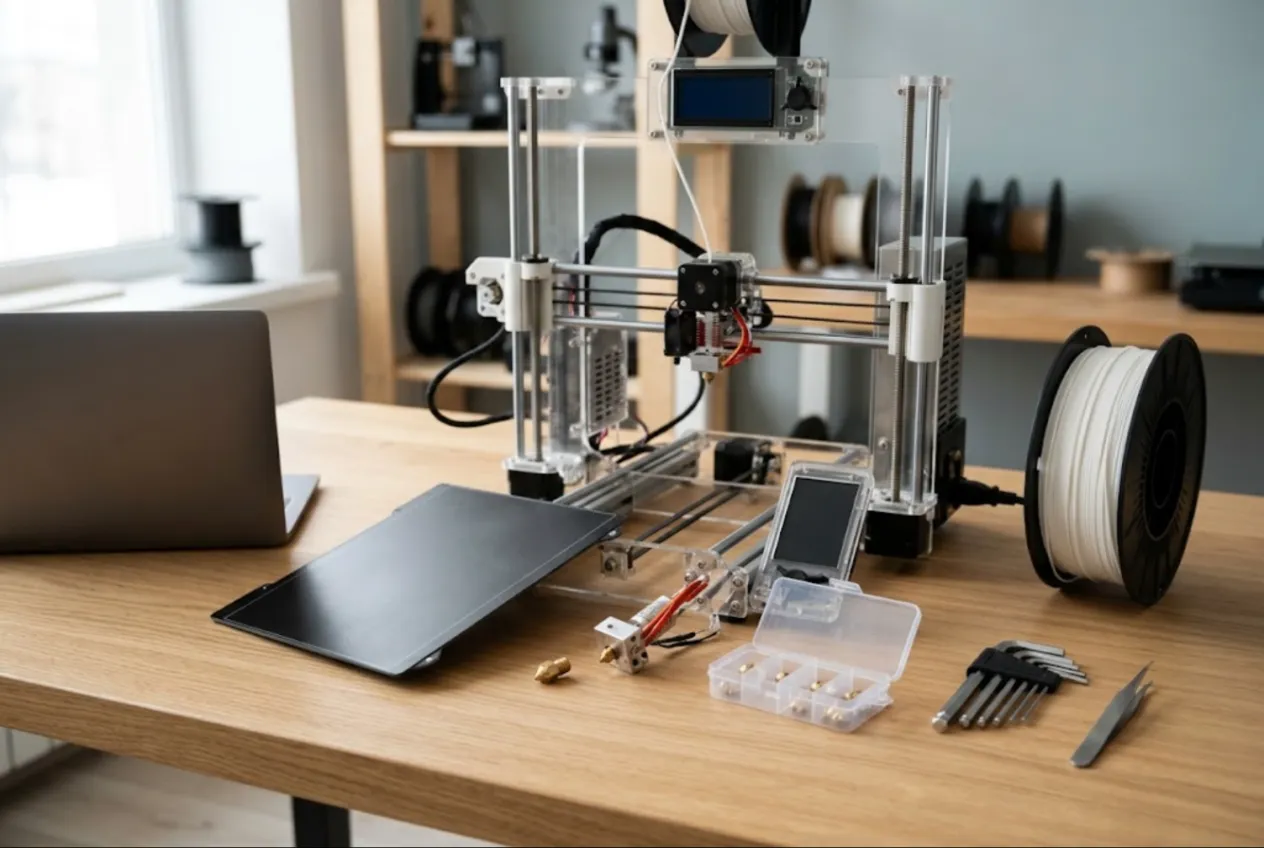
ServiceCenterSoft is job-tracking software for 3D printer repair shops — and for benches that also look after vinyl cutters and wide-format printers. FDM machines, resin printers, cutting plotters and large-format inkjets all go through one check-in form, one job list and one parts stock. It runs in the browser, on the shop PC and on your phone.
Who it is for
A 3D printer repair bench sees a wide mix. The hobbyist who fought under-extrusion for a week and gave up. The school or makerspace with five identical printers at the end of the year. The print farm, where every idle machine means orders that ship late. The sign shop whose vinyl cutter no longer holds registration and whose wide-format printer is banding the day before a job is due.
Most of these printers are not dead — they just print badly, and the cause can be anywhere. Where it usually goes wrong:
- the customer said “it prints wonky” and nobody wrote down whether that meant layer shifts, warping or stringing;
- you tuned the Z offset and PID, the printer comes back six months later — and the numbers are gone;
- a print head for a wide-format printer was ordered, and the customer saw the total and bought a new machine instead;
- a box full of 0.4 mm nozzles, but no 0.6 mm or hardened steel — and a farm printer sits waiting;
- at pickup: “there was a glass bed”, “I left a spool in it”, “the blade holder came with it”;
- the makerspace asks what it owes, and nobody can say quickly.
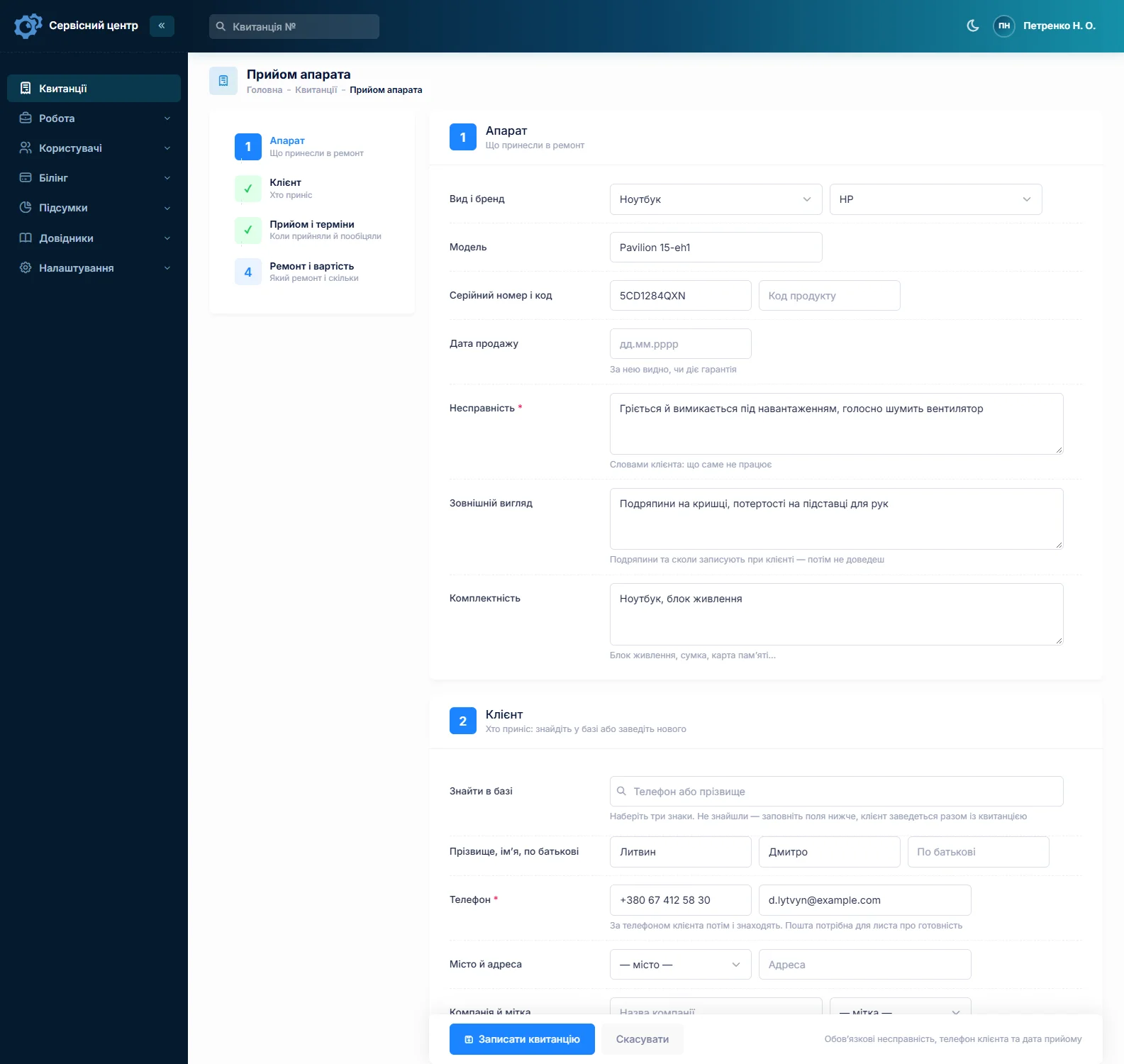
Check-in: the print defect, and everything that came with the printer
Write the fault the way the customer describes it, with detail: “layer shift at 30 mm, always on Y”, “first layer lifts at the bed edges”, “extruder clicks on PETG”, “resin prints stick to the FEP, not the plate”, “cutter doesn’t cut all the way through the vinyl”, “wide-format prints light bands”. That is half the diagnosis already, and a year later advanced search in “text” mode will find it again.
A printer rarely arrives bare: build plate, a half-used spool, power brick, USB stick; a cutter comes with its blade holder. The accessories field is filled in with the customer present and printed on the job sheet they sign: “PEI sheet, PLA spool partly used, PSU, USB stick — yes, glass bed — no”. The condition field covers cracked panels, a bent frame, cured resin on the lid.
Model and serial number are separate fields, and both are searchable. A print farm with twenty identical machines can tell which one is back, and a repeat repair turns up in seconds.
Calibration you can find again
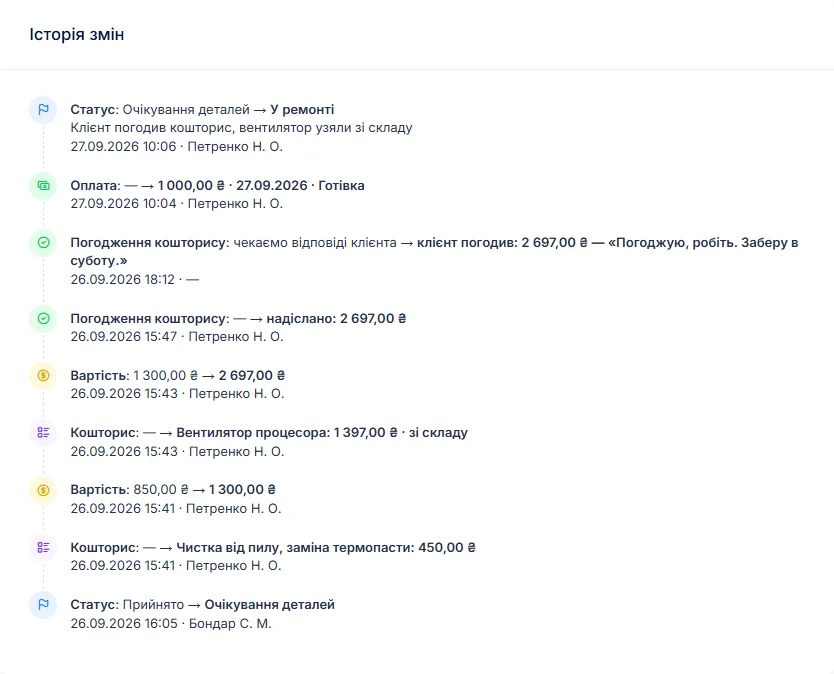
Almost every 3D printer repair ends in tuning: Z offset, hotend and bed PID, extruder steps (e-steps), belt tension, firmware version. Put those values in the job’s work log along with what was done: “thermistor and heater cartridge replaced, PID re-tuned, Z offset −1.42, firmware updated”. When the printer comes back it gets the “Repeat repair” type, its serial number brings up the earlier job, and you can see what was replaced and which settings it left with.
Statuses are a list you control. Add your own with their own colour — “Test print” before a printer goes back, “Test cut” for a vinyl cutter — and the answer to “how’s my printer?” is in the job list.
Due dates for customers whose printers are production
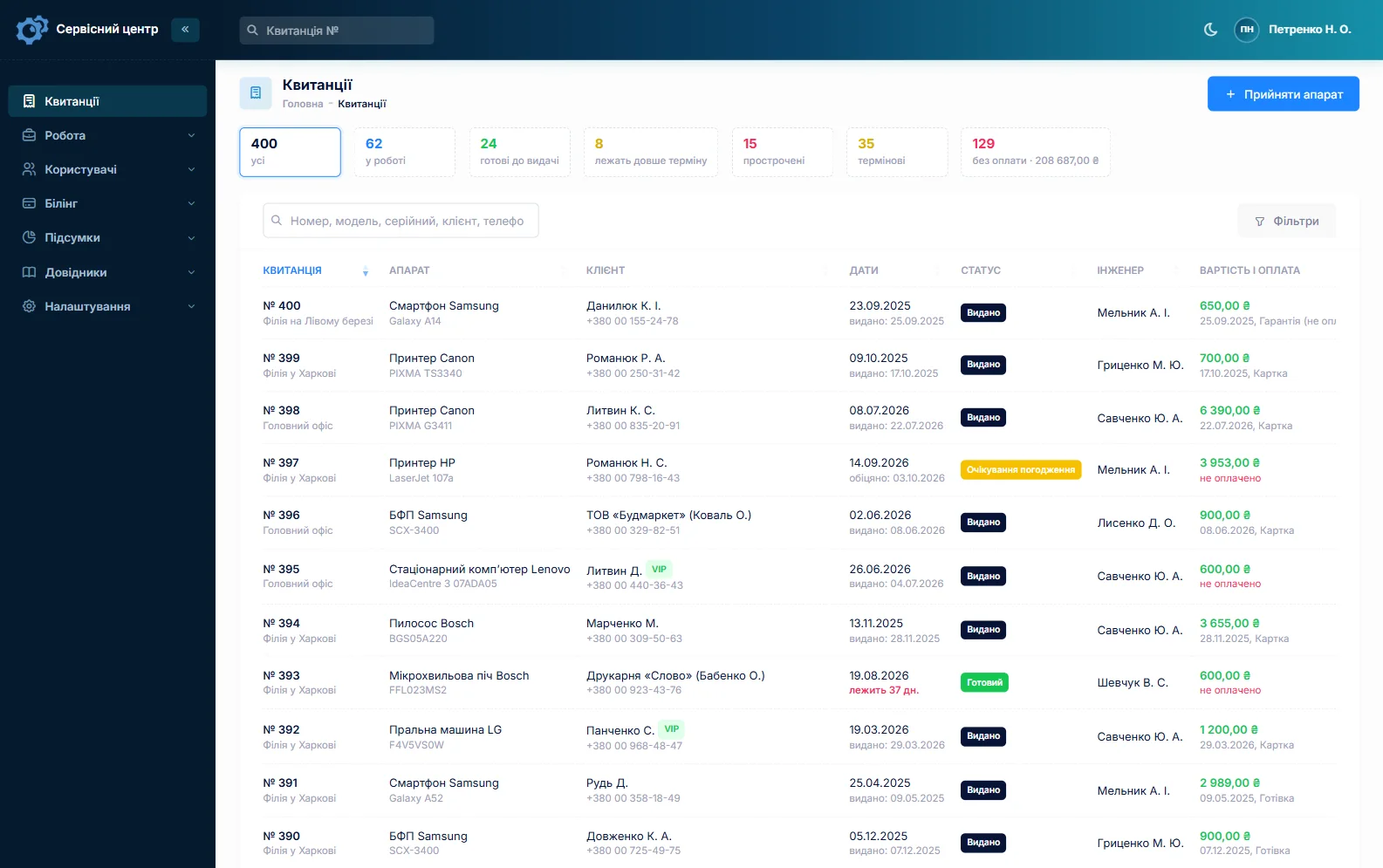
For a print farm or a sign shop, downtime costs money every day. Every job has a promised date: once it passes, the row turns red and the “overdue” filter gathers those jobs in one list. “Urgent” is visible at a glance, and the tile above the list shows how many urgent jobs there are right now. If you move a date, the change stays in the job history.
Print head, mainboard, LCD screen: estimate first
A wide-format print head, a mainboard or a resin printer’s LCD raises the question “repair or replace?”. So: diagnose, write the findings in the work log, and build the estimate line by line — from your labour list or from stock — with quantity and price. A button on the job sends it by email or Telegram. The customer opens the link, sees each line and the total, and presses “I agree” or “I decline”. The answer and date land in the job history.
If the customer decides it is not worth it, “repair refused” closes the job; if it cannot be saved, “beyond repair”. If you charge a bench fee, set a diagnostics price for that device type and it sits on the job from day one.
Nozzles, thermistors, belts and blades in stock
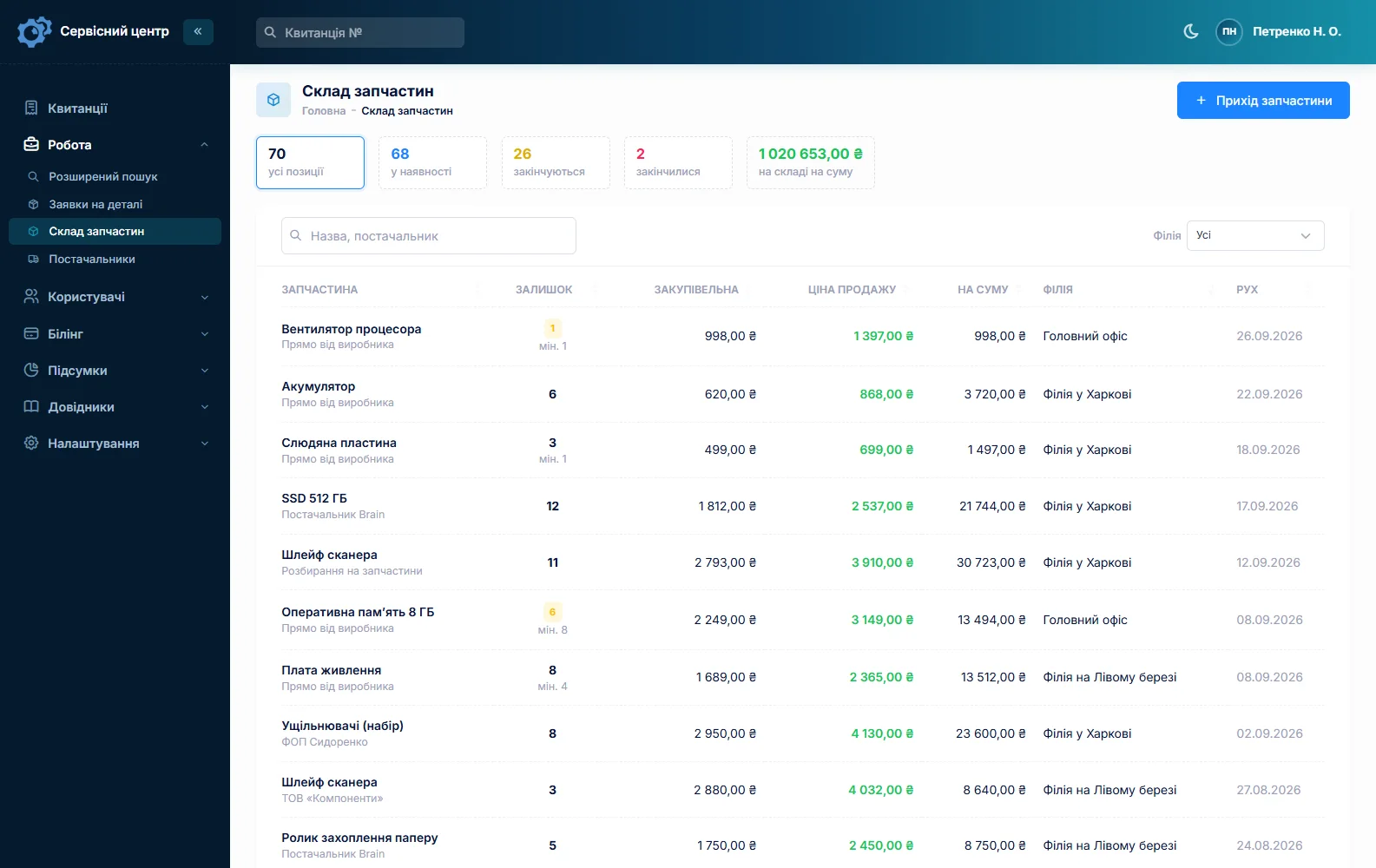
A 3D printer repair shop runs on a familiar set of parts: nozzles, thermistors, heater cartridges, heat breaks, PTFE tubing, belts, stepper drivers, build plates, FEP film; for plotters — blades, cutting strip, ink dampers. Stock is a movement log: goods in with cost price and supplier, used on a job as an estimate line, returned, adjusted at stock-take. A part picked from stock on an estimate reduces the balance automatically.
Quantities are whole numbers, so 0.4 mm, 0.6 mm and hardened nozzles work best as separate items, each with its own minimum level. The “running low” tile tells you to reorder before a farm printer stops for want of one nozzle. A board or head for one specific model is ordered from the job: the parts request is emailed to the supplier, and the job sits in “waiting for parts”. More on spare parts tracking.
Print farms, schools, makerspaces, sign shops
Customers have a “Company” field: a farm, a school or a sign shop is one customer, however many different people bring in its machines. The record shows every job, the total and the balance owed. Five identical printers? Fill in the first job, copy it for the rest and type in each serial number. More on the customer database for a repair shop.
A job can take several payments — a deposit when the print head is ordered, the rest at pickup or by bank transfer later. The software shows what is still owed, and the “unpaid” filter gathers jobs handed over but not paid. The “Recommendations” field is for advice: “dry your filament before printing”, “abrasive filament only with a hardened nozzle”, “clean the cutting strip monthly”. It prints on the completion report together with the estimate lines, the work log and the amount due. More on the completion report.
Ready — and still on your shelf
When the job is done the customer gets an email or a Telegram message (they subscribe with a QR code on the job sheet). Every finished machine shows how many days it has been waiting, and once the free storage period from your settings runs out, the counter turns red. More on customer notifications.
What you may do with equipment that is never collected depends on your country and on what was agreed at check-in. Put your storage terms on the job sheet, and check the details with a lawyer.
If you also repair office printers and copiers or refill toner cartridges, there is a separate page on printer repair shop software.
What repairs typically cost
As a rough guide only — prices vary with region, model and parts: bench fee or diagnosis €30–70, nozzle clean or swap €20–60 plus the nozzle, hotend repair with a new thermistor or heater €40–120, stepper driver or board repair €60–200, full service with calibration €80–220, FEP film replacement on a resin printer €30–70, vinyl cutter set-up with a new blade €30–100, wide-format head cleaning €80–250, print head replacement from €400 to €3,000 and more including the part. You set your own prices: per device type and as estimate lines.
What it does not do
- photos, videos or file attachments on jobs — no pictures of failed prints, no models or G-code; keep them on your own drive;
- connect to the printers themselves — it does not monitor them or control printing;
- SMS, a mobile app, online payment by the customer;
- supplier integrations or barcodes.
What it costs
One price for the whole shop — no extra charge for staff or branches.
Monthly
Paid every month, cancel whenever you like.
Yearly
Cheaper than paying monthly. Invoice or card payment.
Custom work
Changes tailored to the way you work — hourly, by agreement.
Off-the-shelf not enough — your own forms, roles, reports or workflow? We will build a program for you. How it works
Try it without signing up in the demo: check in a printer with its build plate and spool, describe the print defect and send the estimate to the customer.

We are very happy working with servicecentersoft.com: they built everything we asked for, even though our request was unusual, since we deal with medical devices. Everything was done precisely and on the agreed schedule. Thank you for the cooperation — we keep working together.

I tried the ServiceCenterSoft demo and came away with a good impression. The program is simple and easy to understand, yet it has everything you need for the job: customers, repairs, devices, spare parts, statuses and statistics.
I especially liked the dark theme and the responsive design — working from a phone is perfectly comfortable. Another plus is the instant search that works as you type, so you don't have to press a separate "Search" button every time.
You can tell the program was built specifically for service centers rather than being a generic CRM adapted for the repair business. The interface has no unnecessary frills; everything is logical and to the point.
A good, practical tool for the day-to-day work of a service center.

I liked that you get a free 14-day trial and that they are willing to handle my special requests — setting things up exactly the way I need them.
I also liked how payment works. You can simply pay the monthly fee by card online — basically the same as a regular Spotify subscription or any other service. No separate contracts to sign and no invoices to pay manually.
And there's no feeling of strict limits on the number of employees. One service center is one account, and inside it you can organize the work of your technicians and run several branches.
For me this is far more convenient than plans where you have to pay for every single user or keep counting how many employees are working today.

My business is fairly specific, so the program's standard features weren't enough — I needed my own custom fields, my own sorting options and search by additional parameters. The work completion certificate and the printed repair receipt also needed some changes to fit the way we work.
I contacted technical support. To be honest, I expected changes like these to take a long time, but everything was done within a single day. The team quickly understood exactly what we needed, suggested the right solution and did everything properly.
I'd especially like to mention the support: they get straight to the point, with no unnecessary bureaucracy, and they genuinely help instead of just sending you off to read the documentation.
For me this is a big advantage of the program: it isn't just sold "as is" — it can be adapted to how you actually work. Thanks to the team for the quick response and for treating the customer right.
Highly recommended!
In short
- The print defect in the customer’s words and every accessory on a job sheet they sign.
- Calibration values and firmware in the work log; repeat repairs found by serial number.
- An itemised estimate the customer accepts by link before you order a head or board.
- Nozzles, thermistors, belts and blades in stock with minimum levels.
- Print farms, schools and sign shops: company field, copied jobs, balances, deposits, completion report.
- Due dates, “urgent” and a “days waiting” counter.
- €20 a month for the whole shop.
See also
Projector repair software
For projector and interactive display repair shops: classroom and meeting-room units in batches, lamps in stock with reorder levels, estimates approved before a DMD chip is ordered, on-site removal as its own job type, balances and completion reports for schools and offices.
Read morePOS repair software
For shops that repair cash registers, POS terminals, receipt printers, barcode scanners and retail scales: rush jobs and due dates everyone can see, print heads and cutters in stock, loaner units on record, and retail and restaurant customers with balances and completion reports.
Read moreStarting your own repair shop: where to begin
For people who can fix phones and laptops and want to work for themselves: what a small repair business needs on day one, the paperwork that protects you from the first customer, and how to run a shop in a country whose language is not your own.
Read moreSee how it works
The demo is open — go in and try it. Ask us anything by email, Telegram or the form on this site.