Medical equipment repair software
Job tracking for biomedical repair shops serving clinics, dental practices and labs, plus home medical devices: company customers, per-device history by serial number, estimates approved by link, a completion report with itemized work.
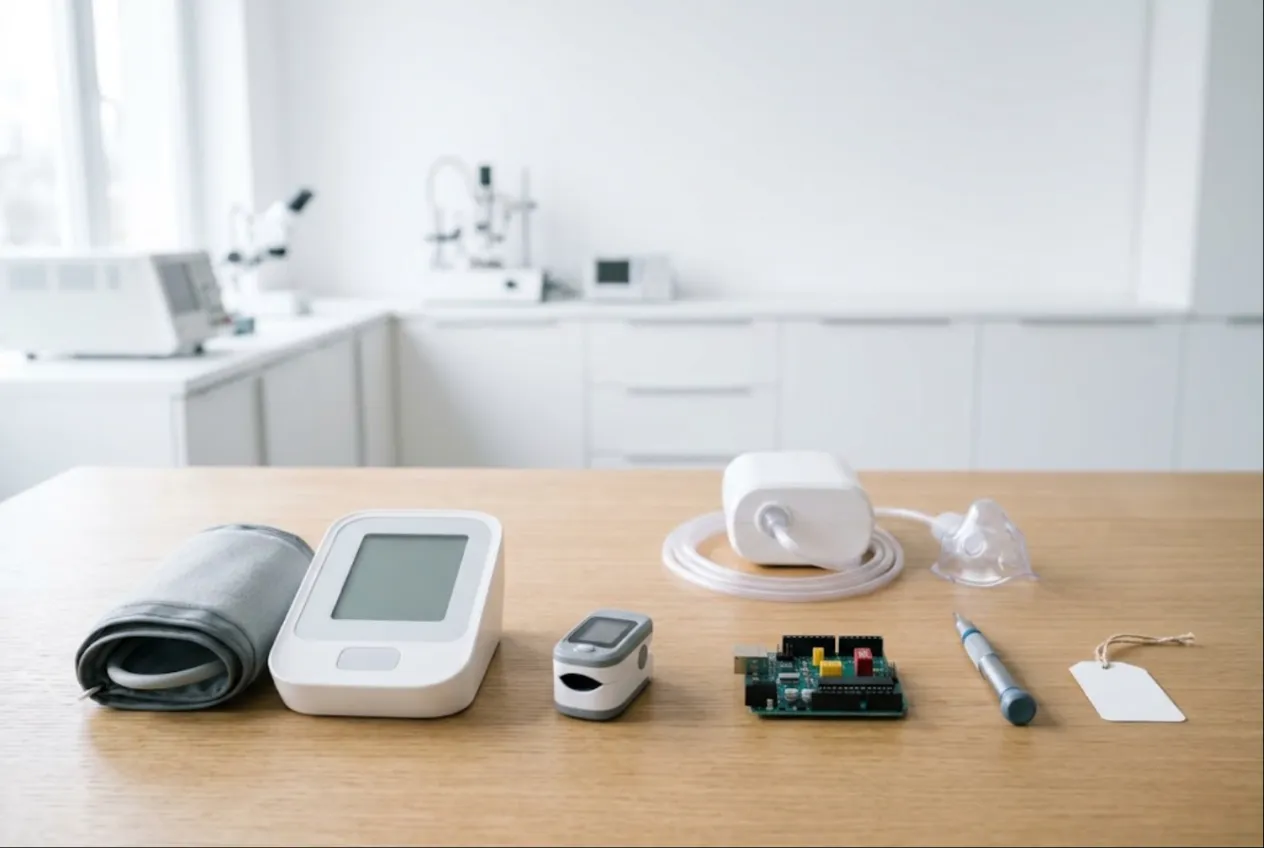
ServiceCenterSoft is job-tracking software for independent medical equipment repair shops — dental handpieces and compressors, oxygen concentrators, basic ECG and ultrasound units, lab centrifuges, and home devices such as blood pressure monitors and nebulizers. Check in each device by serial number, see everything you have done to it before, get estimates approved by the person who pays, and hand the clinic an itemized completion report. It runs in the browser, with nothing to install.
Who it is for
A small biomedical repair shop, often a few technicians who also go out to customers. Most of the work comes from businesses: private clinics, dental practices, small labs, pharmacies that send in monitors under warranty, sometimes a rental company with a fleet of concentrators. Alongside them come private customers with a nebulizer for a child or a concentrator for an elderly parent.
What tends to go wrong when the work lives in a notebook and a chat app:
- a dental practice sends three handpieces, and a month later nobody can say which one was already rebuilt and with what;
- the clinic asks for paperwork for its own records, and you piece it together from texts and memory;
- the front desk agreed a price by phone, and the practice owner disputes the bill;
- a concentrator part has been on back order for three weeks and you hear about it from an annoyed customer.
Business customers, not just names
Every customer has a company field. Whoever drops the device off — a driver, a nurse, the dentist — the clinic is one customer, and its card lists every job, the total and what is still owed. The company name prints next to the contact name on the job ticket and the completion report, and the job list search finds all of a clinic’s devices by company name.
Businesses rarely pay at the counter. A job can take several payments — a deposit for a part, the balance by bank transfer later — and the software shows the balance due, while the “unpaid” filter lists jobs still waiting for money. It does not issue invoices: what it prints is the check-in ticket and the completion report.
One serial number, the whole history
Medical equipment stays in service for years and keeps coming back. The serial number has its own field, and search finds a job even by part of the number — which pulls up every earlier repair of that device: dates, work done, parts fitted, advice given.
The condition and accessories fields record the state of the device and what came with it: nebulizer mask and tubing, the cuff, power supply, foot pedal, carrying case. If you have agreed with the customer that devices are cleaned before they are handed over, note it on the job — the arrangement then sits on the ticket.
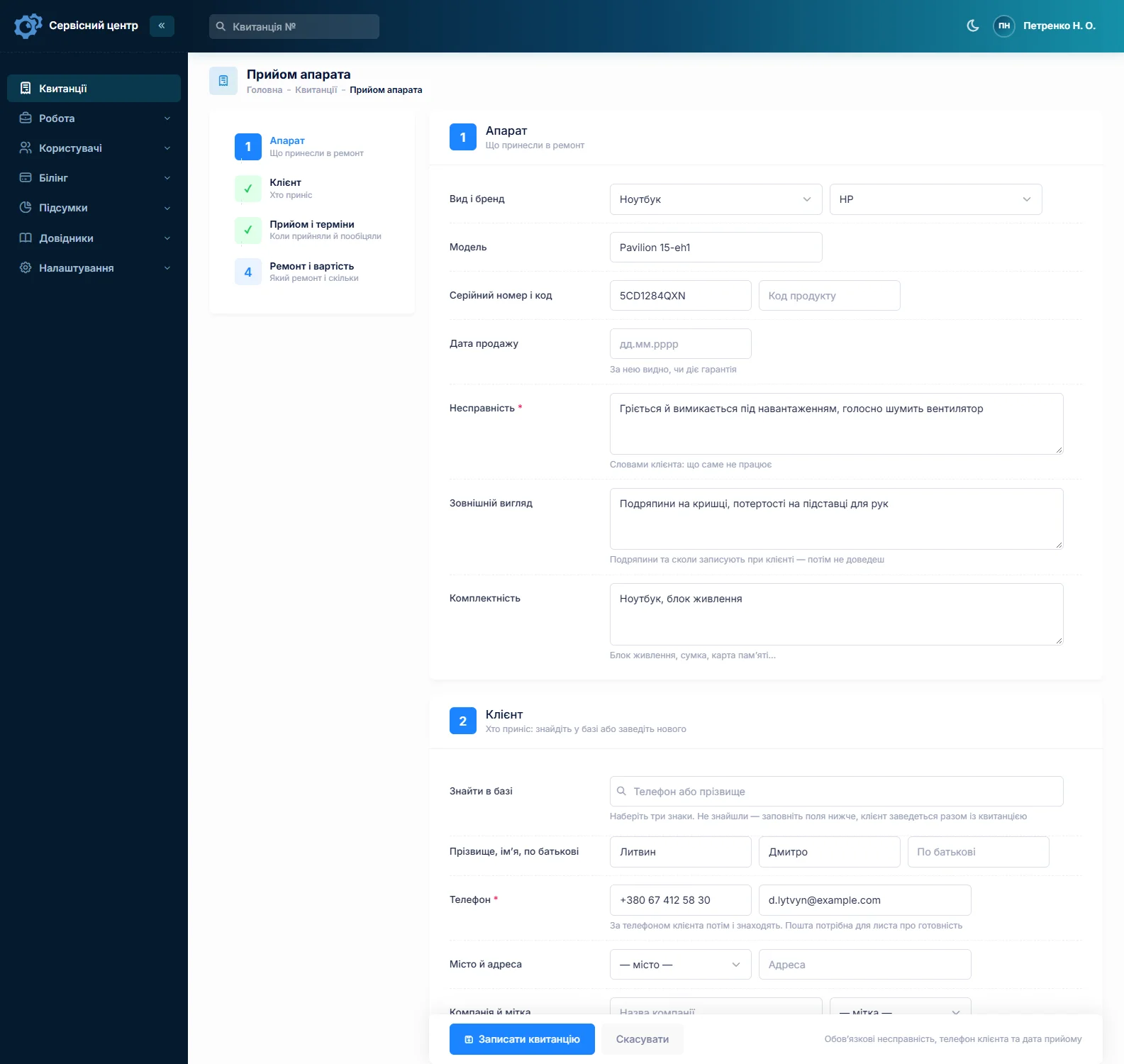
Five identical blood pressure monitors from one pharmacy? Fill in the first job and copy it for the rest — customer, device type, fault and notes carry over, and you enter each serial number.
Estimates go to whoever signs off
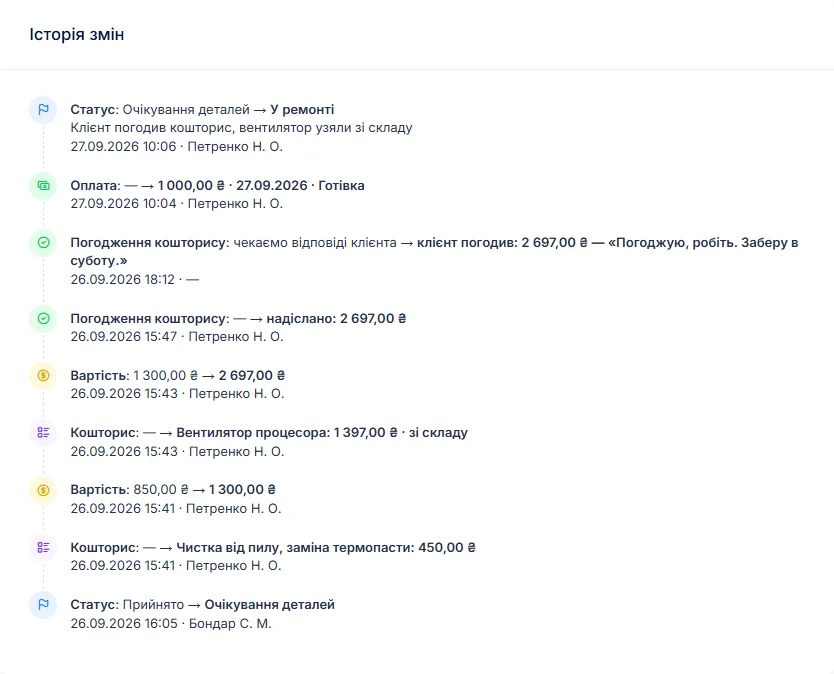
In a clinic the person who calls you is often not the person who approves spending. After diagnosis the technician writes up the findings in the work log and builds the estimate line by line — labor and parts with quantity and price. One click emails it or sends it via Telegram to the contact on the customer record. The recipient opens the link, sees every line and the total, clicks “I agree” or “I decline” and can add a comment. The answer is saved with the date in the job history.
If the repair makes no sense — the board is discontinued or costs as much as a new unit — the “repair refused” and “beyond repair” statuses close the job and the reason stays in the log.
An itemized completion report
For a clinic, the completion report is part of its own records. The standard report shows the customer with the company name, the device, model and serial number, the estimate as a table, the work log, recommendations and the amount still due after payments. You edit the letterhead, logo and warranty terms yourself. More on the completion certificate.
The recommendations field is for what the customer should know afterwards — “replace the inlet filter every N months”, “do not run the humidifier dry”. It prints on the report and stays in the device history.
Turnaround and parts
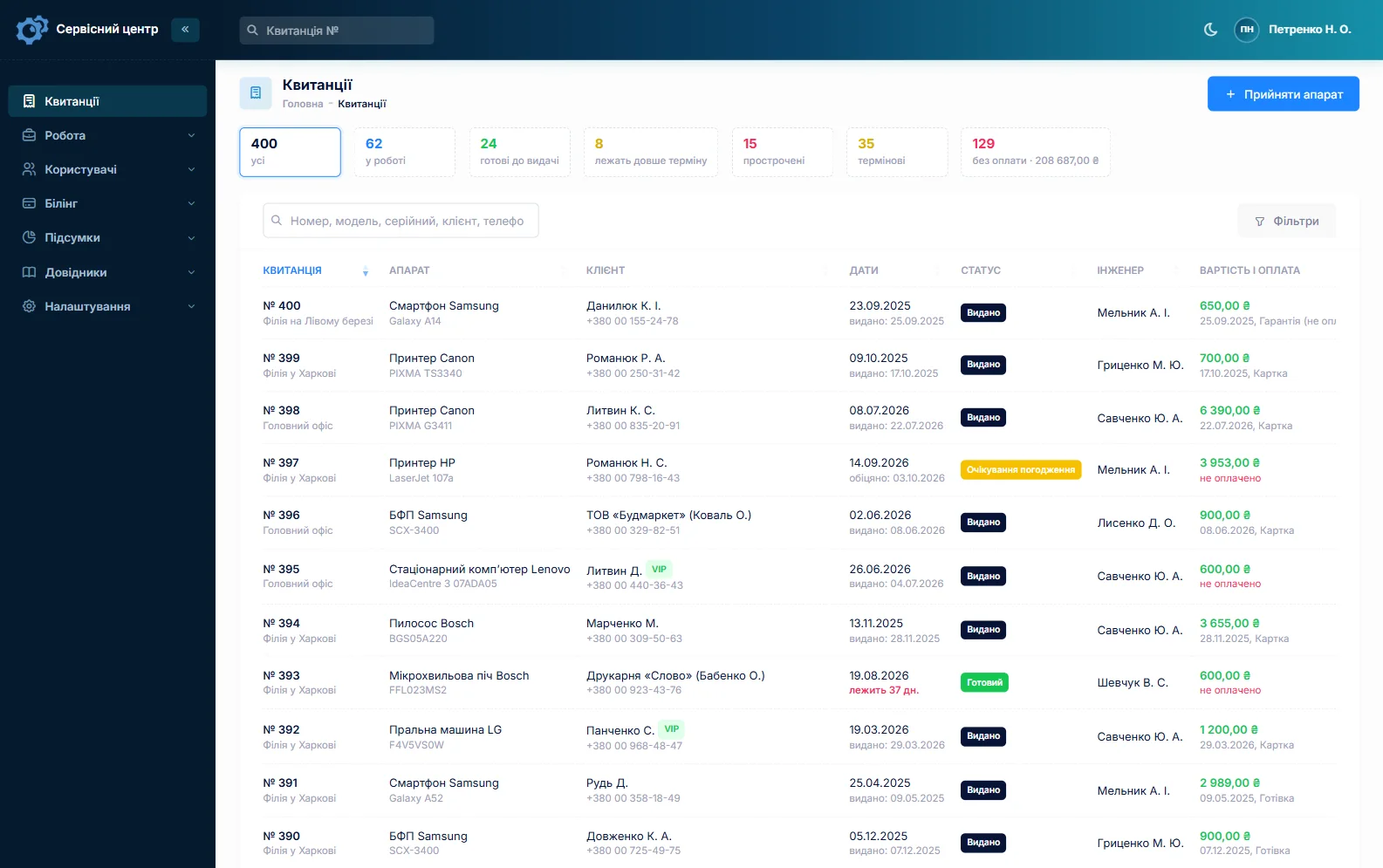
A dental practice without a handpiece runs one chair short; a lab without its centrifuge simply waits. Every job has a promised date. Once it passes, the row turns red and the “overdue” filter gathers those jobs; a “rush” flag stands out in the list.
Turbine bearings, compressor diaphragms, sensors and boards are often ordered per model. A parts request is created from the job and emailed to your supplier, the job sits in “waiting for parts”, and any change to the promised date stays in the history. Inventory is a movement log with minimum levels and a “running low” tile. See spare parts tracking.
When the device is ready, the customer gets an email or a Telegram message (they subscribe via the QR code on the ticket) — see customer notifications. If you are a manufacturer’s authorised service partner, warranty work priced from the maker’s list is covered on the authorised service page.
A word on regulations
ServiceCenterSoft tracks repairs; it is not a medical equipment management system. It does not schedule preventive maintenance, does not remind you about inspections or calibration, does not keep regulatory logs and does not make you compliant with anything. What servicing and documentation a particular device requires depends on the country and the type of device — check with a specialist.
What repairs typically cost
A rough guide only — prices vary by region, model and parts: blood pressure monitor €25–60, compressor nebulizer €40–100, turbine handpiece bearing replacement €80–250, dental unit compressor €150–600, oxygen concentrator €120–450, basic ECG unit €150–500 with parts. You set your own prices per device type and as estimate lines.
What it does not do
- no preventive maintenance schedule or inspection reminders, no separate register of a customer’s equipment fleet;
- no invoices — the ticket and the completion report only;
- no photos or file attachments, no SMS, no mobile app, no online payment by the customer;
- no barcodes, no supplier catalog integrations.
What it costs
One price for the whole shop — no per-user or per-location fees.
Monthly
Paid every month, cancel whenever you like.
Yearly
Cheaper than paying monthly. Invoice or card payment.
Custom work
Changes tailored to the way you work — hourly, by agreement.
Off-the-shelf not enough — your own forms, roles, reports or workflow? We will build a program for you. How it works
Try it without signing up in the demo: check in a device with its serial number, build an estimate and print the completion report.

We are very happy working with servicecentersoft.com: they built everything we asked for, even though our request was unusual, since we deal with medical devices. Everything was done precisely and on the agreed schedule. Thank you for the cooperation — we keep working together.

I tried the ServiceCenterSoft demo and came away with a good impression. The program is simple and easy to understand, yet it has everything you need for the job: customers, repairs, devices, spare parts, statuses and statistics.
I especially liked the dark theme and the responsive design — working from a phone is perfectly comfortable. Another plus is the instant search that works as you type, so you don't have to press a separate "Search" button every time.
You can tell the program was built specifically for service centers rather than being a generic CRM adapted for the repair business. The interface has no unnecessary frills; everything is logical and to the point.
A good, practical tool for the day-to-day work of a service center.

I liked that you get a free 14-day trial and that they are willing to handle my special requests — setting things up exactly the way I need them.
I also liked how payment works. You can simply pay the monthly fee by card online — basically the same as a regular Spotify subscription or any other service. No separate contracts to sign and no invoices to pay manually.
And there's no feeling of strict limits on the number of employees. One service center is one account, and inside it you can organize the work of your technicians and run several branches.
For me this is far more convenient than plans where you have to pay for every single user or keep counting how many employees are working today.

My business is fairly specific, so the program's standard features weren't enough — I needed my own custom fields, my own sorting options and search by additional parameters. The work completion certificate and the printed repair receipt also needed some changes to fit the way we work.
I contacted technical support. To be honest, I expected changes like these to take a long time, but everything was done within a single day. The team quickly understood exactly what we needed, suggested the right solution and did everything properly.
I'd especially like to mention the support: they get straight to the point, with no unnecessary bureaucracy, and they genuinely help instead of just sending you off to read the documentation.
For me this is a big advantage of the program: it isn't just sold "as is" — it can be adapted to how you actually work. Thanks to the team for the quick response and for treating the customer right.
Highly recommended!
In short
- Clinics and dental practices as company customers, on documents and in search.
- Full device history by serial number.
- Estimates approved by link; itemized completion reports with recommendations.
- Promised dates, overdue and rush jobs in one list.
- Several payments per job and the balance owed per customer.
- Repair tracking — not a compliance system.
- €20 a month for the whole shop.
See also
Boiler repair and heating service software
For heating engineers servicing gas and electric boilers, water heaters and heat pumps: the call-out and the board on the bench in one job, the autumn rush, annual services on the same boilers, and quotes for expensive parts.
Read moreElectric motor repair shop software
For motor rewind shops and one-person motor repairers: inspection and an approved estimate before rewinding, winding data in the work log and searchable, copper and bearings in stock, and each motor’s history by serial number.
Read moreStarting your own repair shop: where to begin
For people who can fix phones and laptops and want to work for themselves: what a small repair business needs on day one, the paperwork that protects you from the first customer, and how to run a shop in a country whose language is not your own.
Read moreSee how it works
The demo is open — go in and try it. Ask us anything by email, Telegram or the form on this site.