Lawn mower and small engine repair shop software
Outdoor power equipment repair software for small shops: mowers, robotic mowers, trimmers, chainsaws, tillers and blowers. Get through the spring rush, sell winterization, and quote engine work before you start.
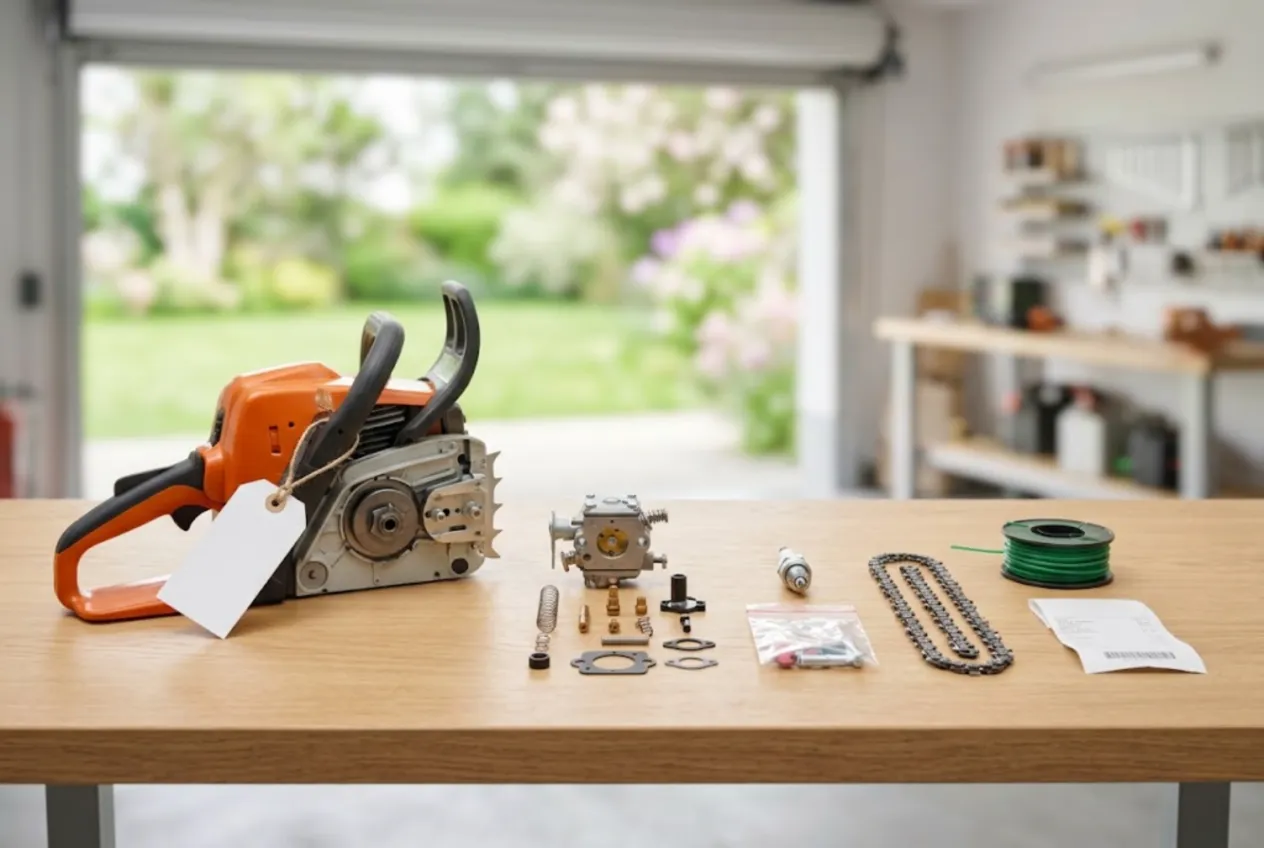
ServiceCenterSoft is job-tracking software for small engine and outdoor power equipment repair shops: push and self-propelled mowers, battery mowers and robotic mowers, string trimmers and brush cutters, chainsaws, tillers and leaf blowers. Intake with condition notes, line-item quotes approved by the customer, parts stock, and every customer’s history. It runs in the browser — on the counter PC and on a phone in the shop.
Who this is for
A one- to five-bench shop that lives by the season. From March to May everybody wants their mower back “before the weekend”. In autumn come the chainsaws and the customers who winterize properly. In January the phone barely rings. Your customers are homeowners, plus a few landscaping crews who lose money every day a trimmer sits on your shelf.
Where it goes wrong is rarely the engine:
- by mid-April nobody knows which mower was promised for which day;
- finished machines fill the floor because owners take their time picking them up;
- spark plugs and carb kits run out in the busiest week of the year;
- at pickup the customer insists the grass bag was not torn when they dropped it off.
If most of your work is corded and cordless power tools rather than engines, see power tool repair software.
The spring rush, under control
Every job has a promised date. Once it passes, the row turns red and an “overdue” tile collects those jobs in one place — the morning call list writes itself. An “urgent” flag marks the landscaper whose only trimmer is down, or the farmer with a tiller mid-planting.
You define the statuses: “Checked in”, “Diagnosing”, “Awaiting approval”, “Waiting for parts”, “Ready”, “Picked up”, and “Winter storage” if you offer it. Any status can be pinned as a tile above the job list with a count, so one click shows how many machines are waiting on carb kits.
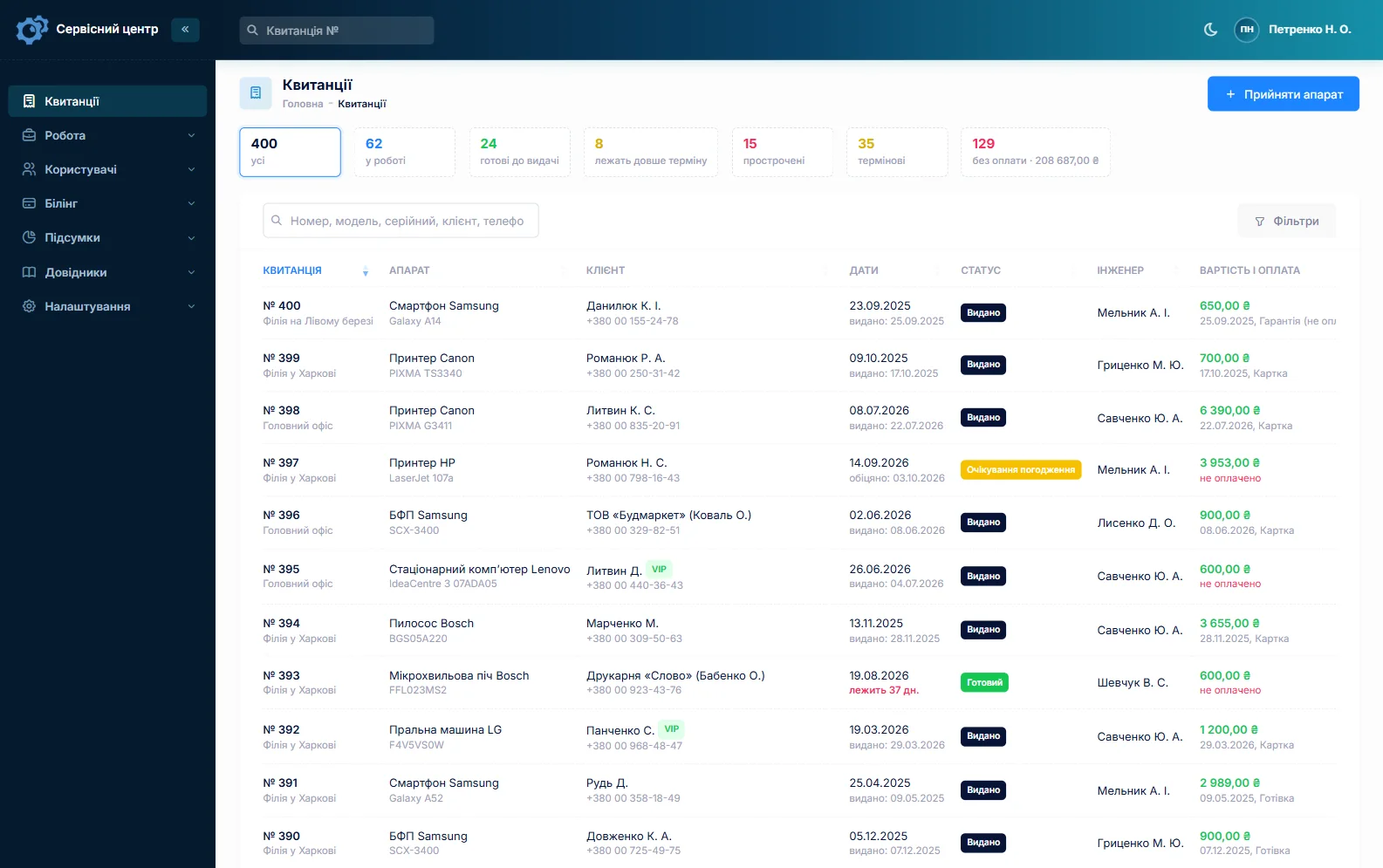
When the same customer calls for the third time, search by phone number brings up their job and status straight away.
Check-in: write down what came through the door
Lawn equipment arrives with grass caked under the deck and every machine has different bits. The intake form has “condition” and “accessories” fields for exactly this: blade and grass bag, bar and chain, trimmer head or blade, battery and charger for cordless kit. A robotic mower usually comes in with its docking station, while the boundary wire stays in the customer’s lawn — worth writing down. It all prints on the ticket the customer signs.
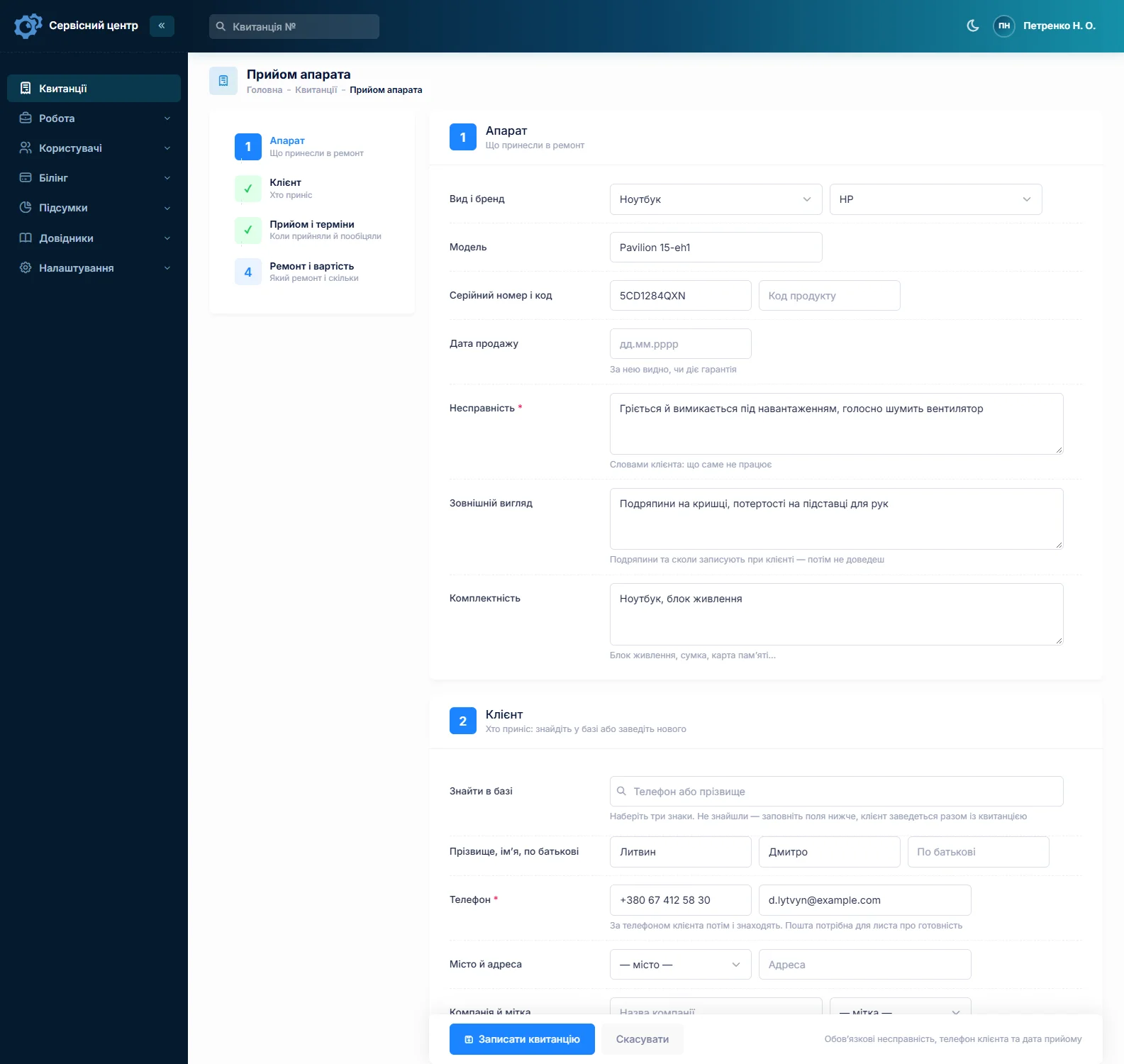
Put what the customer says about fuel into the fault description: “sat all winter with gas in it”, “mixed the oil by eye”. With ethanol-blended fuel that one line often explains the whole repair. The serial number and purchase date show whether the machine is still under warranty. Engine hours go in the notes — there is no separate field for them.
Being upfront about photos: you cannot attach a picture to a job. If you photograph a cracked deck, keep the photo on your phone or drive and note on the job that you took one.
Engine work: diagnose, quote, then repair
Most spring jobs are cheap — a gummed-up carburettor, a plug, an air filter. Some are not: a scored piston from a bad fuel mix, a bent crankshaft after the blade hit a rock, a tiller gearbox. And a new entry-level trimmer is not expensive, so the customer deserves to see the price first.
So you diagnose, then build a quote line by line — “carb rebuild kit”, “piston and rings”, “labour” — and send it from the job by email or Telegram. The customer opens the link, sees each line and the total, and clicks “I agree” or “I decline”. The answer, date and amount are saved in the job history.
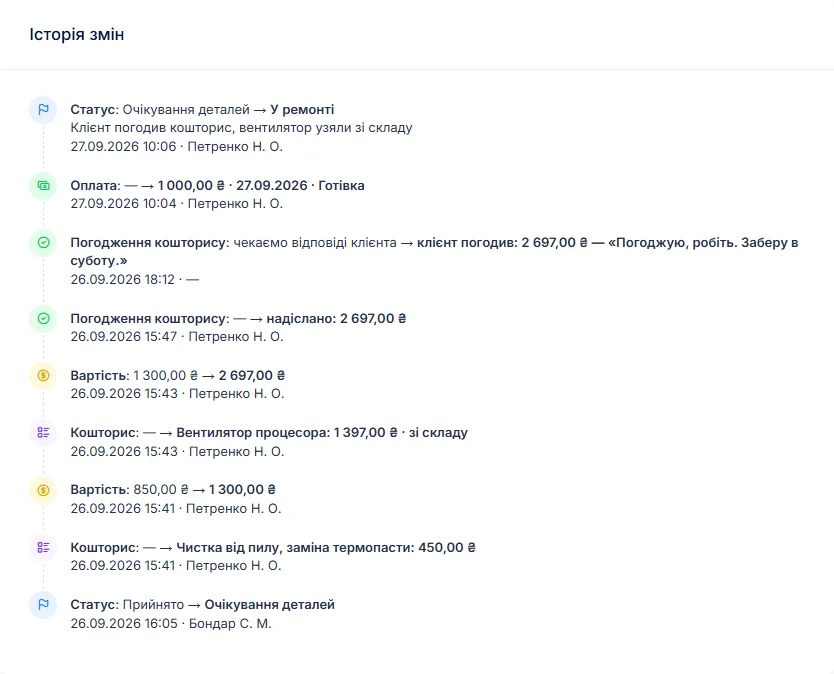
If the repair is not worth it, close the job as “repair refused” or “beyond repair”; the statistics show those separately. Charge for diagnosis by giving each device type its own diagnostic price and switching the job to “diagnostics only”.
Tune-ups and winterization as packages
The best cure for the spring rush is moving work into autumn. A winterization service — drain the fuel or run the carb dry, change the oil, clean the deck, sharpen the blade, check plug and filter; for cordless and robotic mowers, bring the battery to storage charge and store it somewhere warm.
Set these up in the list of works as packages — “Spring tune-up, push mower”, “Winterization, trimmer”, “Robotic mower winter service” — with a price per device type. On a quote the package is picked as one line, not retyped. If machines stay with you over winter, a “Winter storage” status tile shows what is in the back room. The bike repair shop page goes through storage as a paid service in more detail.
What it does not do: it does not send tune-up reminders and it does not send text messages. But the customer record lists every past job, and a new job can be copied from last year’s — customer, machine, job type and notes carry over.
Plugs, filters and carb kits — bought in February
Stock is a movement log: receipts with price and supplier, parts used on a job as a quote line, write-offs, stock counts. The balance is calculated. Set a minimum for plugs, air filters, carb kits and chains, and the “running low” tile becomes your pre-season order list.
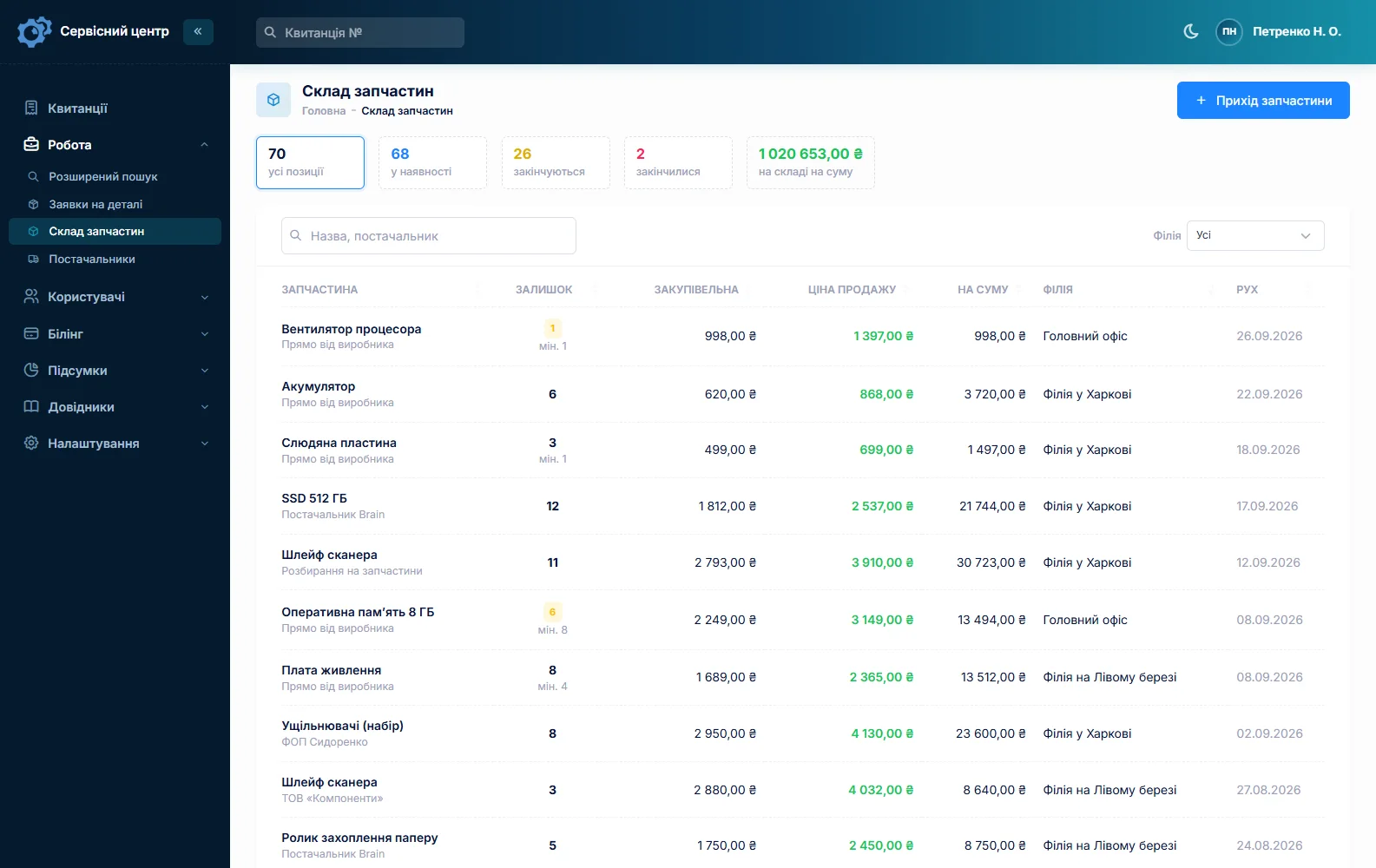
Quantities are whole numbers, so trimmer line is tracked by the spool or by cut length and oil by the bottle. A part for a specific job — a recoil starter, a crankshaft, a robot mower board — is ordered from the job and emailed to the supplier from the software. There are no barcodes and no link to supplier catalogues. More on spare parts tracking.
Finished machines and getting paid
A self-propelled mower does not fit in a drawer. “Ready for pickup” lists everything finished with a day counter; after the free storage period from your settings it turns red and a “past free storage” tile gathers those jobs. The customer gets a ready email or a Telegram message (they subscribe with the QR code on the ticket) — see customer notifications.
A deposit for an expensive part and the balance at pickup are two payments on one job. Customers cannot pay online through the software — take the money as usual and record it.
Typical prices
As a rough guide only — it varies a lot by region and machine: a carburettor clean on a trimmer €40–90, a mower tune-up €60–120 plus parts, chain sharpening €8–15, a piston and cylinder job on a two-stroke €150–300 including parts. You set your own prices per device type, as packages or as quote lines.
Used oil, old fuel and worn-out batteries have to be disposed of under local rules — check what applies where you are. Each quote line has the technician who did it, and the report pays each one their share at their own rate, which helps when you add a seasonal mechanic. See technician pay.
What it costs
One price for the whole shop — no per-mechanic or per-location fees.
Monthly
Paid every month, cancel whenever you like.
Yearly
Cheaper than paying monthly. Invoice or card payment.
Custom work
Changes tailored to the way you work — hourly, by agreement.
Off-the-shelf not enough — your own forms, roles, reports or workflow? We will build a program for you. How it works
Try it without signing up in the demo: check in a mower, build a quote and send it for approval.

We are very happy working with servicecentersoft.com: they built everything we asked for, even though our request was unusual, since we deal with medical devices. Everything was done precisely and on the agreed schedule. Thank you for the cooperation — we keep working together.

I tried the ServiceCenterSoft demo and came away with a good impression. The program is simple and easy to understand, yet it has everything you need for the job: customers, repairs, devices, spare parts, statuses and statistics.
I especially liked the dark theme and the responsive design — working from a phone is perfectly comfortable. Another plus is the instant search that works as you type, so you don't have to press a separate "Search" button every time.
You can tell the program was built specifically for service centers rather than being a generic CRM adapted for the repair business. The interface has no unnecessary frills; everything is logical and to the point.
A good, practical tool for the day-to-day work of a service center.

I liked that you get a free 14-day trial and that they are willing to handle my special requests — setting things up exactly the way I need them.
I also liked how payment works. You can simply pay the monthly fee by card online — basically the same as a regular Spotify subscription or any other service. No separate contracts to sign and no invoices to pay manually.
And there's no feeling of strict limits on the number of employees. One service center is one account, and inside it you can organize the work of your technicians and run several branches.
For me this is far more convenient than plans where you have to pay for every single user or keep counting how many employees are working today.

My business is fairly specific, so the program's standard features weren't enough — I needed my own custom fields, my own sorting options and search by additional parameters. The work completion certificate and the printed repair receipt also needed some changes to fit the way we work.
I contacted technical support. To be honest, I expected changes like these to take a long time, but everything was done within a single day. The team quickly understood exactly what we needed, suggested the right solution and did everything properly.
I'd especially like to mention the support: they get straight to the point, with no unnecessary bureaucracy, and they genuinely help instead of just sending you off to read the documentation.
For me this is a big advantage of the program: it isn't just sold "as is" — it can be adapted to how you actually work. Thanks to the team for the quick response and for treating the customer right.
Highly recommended!
In short
- Spring rush with promised dates, red overdue rows and status tiles.
- Condition and accessories recorded at check-in, on a ticket the customer signs.
- Engine work goes through diagnosis and a quote approved by link.
- Tune-ups and winterization as priced packages; no automatic reminders.
- Plugs, filters and carb kits in stock with a reorder list.
- €20 a month for the whole shop.
See also
Welding machine repair software
Welder repair shop software for workshops fixing stick inverters, MIG/MAG, TIG and plasma cutters: promised dates and rush jobs, quotes approved before expensive parts go in, power semiconductors in stock, fabrication shops and crews as customers.
Read moreSoftware for home appliance service
Contents recorded at intake, warranty at the brand price list, callouts, slow parts and partner shops.
Read morePhone repair shop software
Intake in a minute, screens and batteries tracked, a ready-for-pickup email, output per technician.
Read moreSee how it works
The demo is open — go in and try it. Ask us anything by email, Telegram or the form on this site.