Beauty salon equipment repair software
Job tracking for shops that repair hair clippers, trimmers, hair dryers, flat irons, nail drills, UV/LED lamps and sterilizers: high-volume small repairs, blade sharpening as estimate lines with quantities, and salons and barbershops as regular accounts with balances and completion reports.
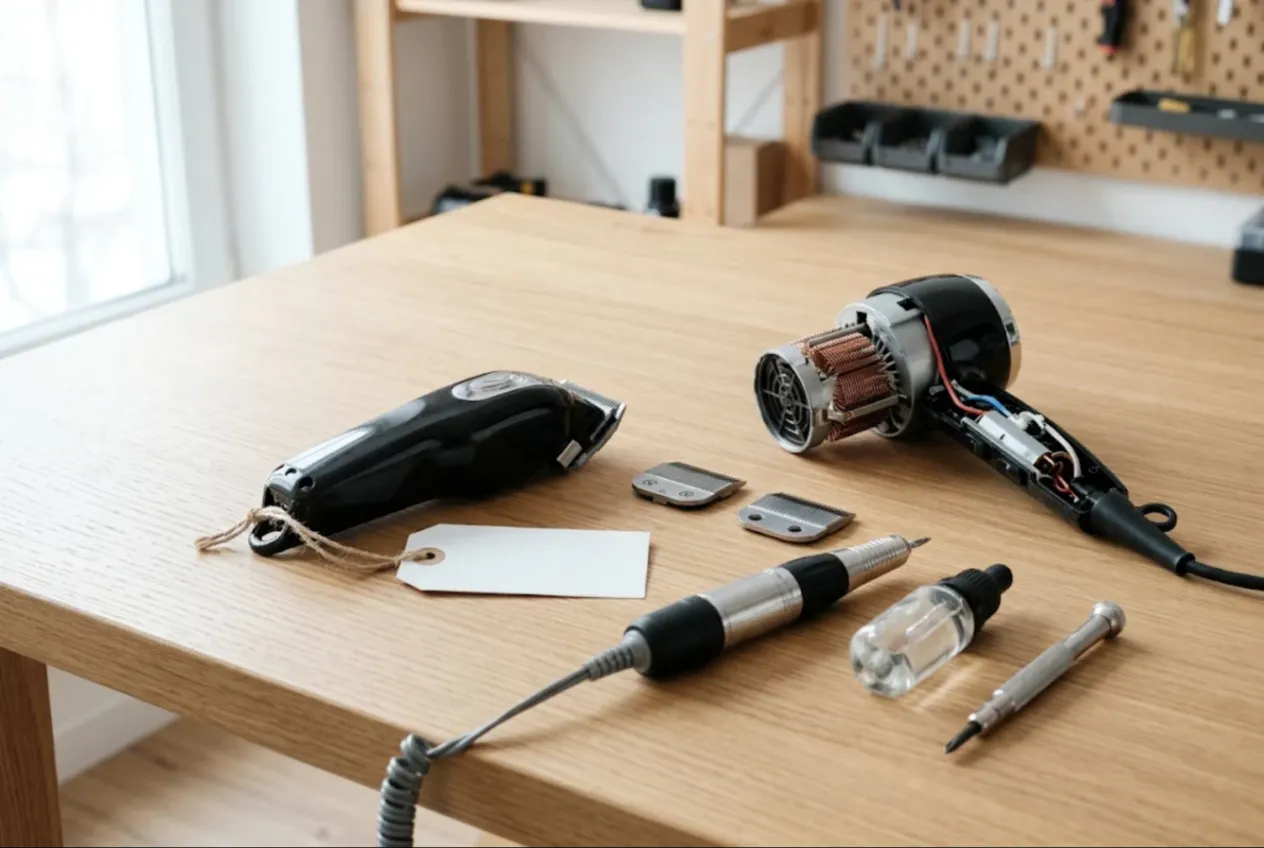
ServiceCenterSoft is repair-tracking software for shops that keep salons and barbershops working: hair clippers, trimmers and shavers, blow dryers, flat irons and curling wands, electric nail drills and pedicure units, UV/LED nail lamps, sterilizers and dry-heat cabinets, wax warmers. Lots of small jobs a day, blade sharpening, salons that drop off a box of tools every month, and barbers who need their clipper back before the next shift. It runs in the browser — on the bench PC and on your phone.
Who it is for
Clipper repair shops, blade sharpening services that have grown into full repairs, small electronics workshops with a steady salon clientele, and technicians who look after nail and beauty equipment. Your customers are barbershops, hair salons, nail bars, spas and a long tail of booth renters and mobile stylists. The tools are cheap compared with a laptop or a TV, but a barber without a clipper or a nail tech without a drill is not earning today. So every job is “tomorrow, please”, and a good salon customer comes back every few weeks.
Where it usually goes wrong:
- a barbershop dropped off seven clippers and two trimmers, and a week later nobody can say which one came back with the same rattle;
- blades were sharpened in a batch, and only half of them made it onto the invoice;
- a nail drill handpiece got new bearings without a call, and the customer expected a clean-out;
- you are out of blade sets for the most popular clipper on the day six of them are needed;
- a salon settles up once a month, and its balance lives in a notebook.
One job per tool, even when a box comes in
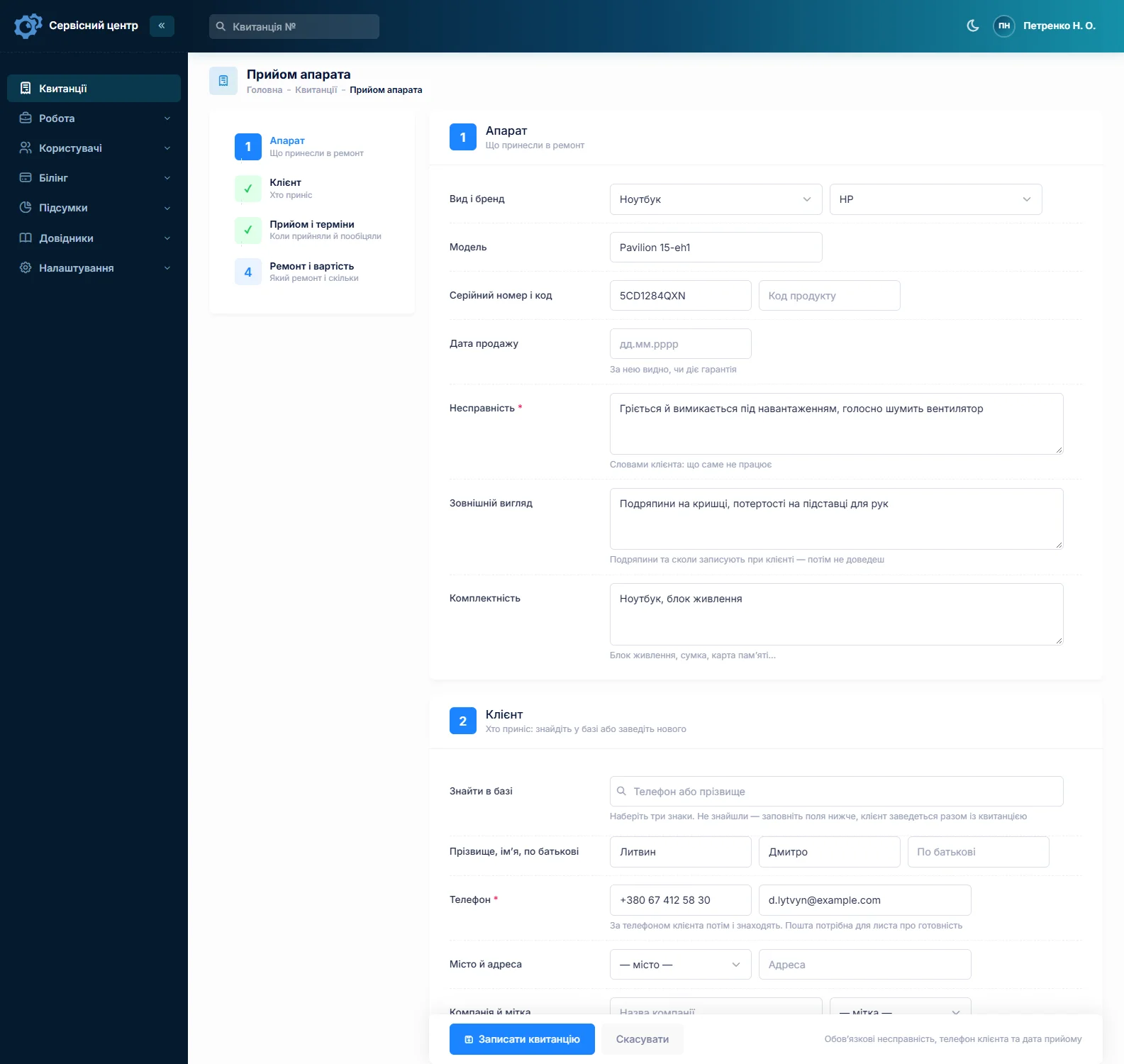
Fill in the first job completely and copy it for the rest: customer, device type, model and fault carry over, and each tool gets its own serial number. No readable serial? Use the “product code” field for the salon’s own marking — “chair 3”, “B-2”, “green tape”. Advanced search in device mode looks through model, serial and product code, so “the green tape one again” turns up with its full repair history.
Record condition and accessories in front of the customer: cracked housing, a chipped blade, a scorched dryer cord; guards, charging stand, power adapter, foot pedal, case. Both fields print on the job sheet the customer signs, so there is no argument at pickup about how many guards there were.
Sharpening as a line item, not a guess
Blade sharpening, clean and oil, cord replacement, battery replacement, switch replacement — these are entries in the labour list with a price. Prices can be set per device type: create “Hair clipper”, “Trimmer”, “Hair dryer”, “Nail drill”, “Lamp”, “Sterilizer”, each with its own labour prices and diagnostic fee.
Estimate lines have a quantity, so “Blade sharpening × 6” totals itself and all six reach the completion report. Each line also has a technician, and earnings are calculated from that technician’s own lines at their rate — see technician pay.
Urgent, because the shift starts tomorrow
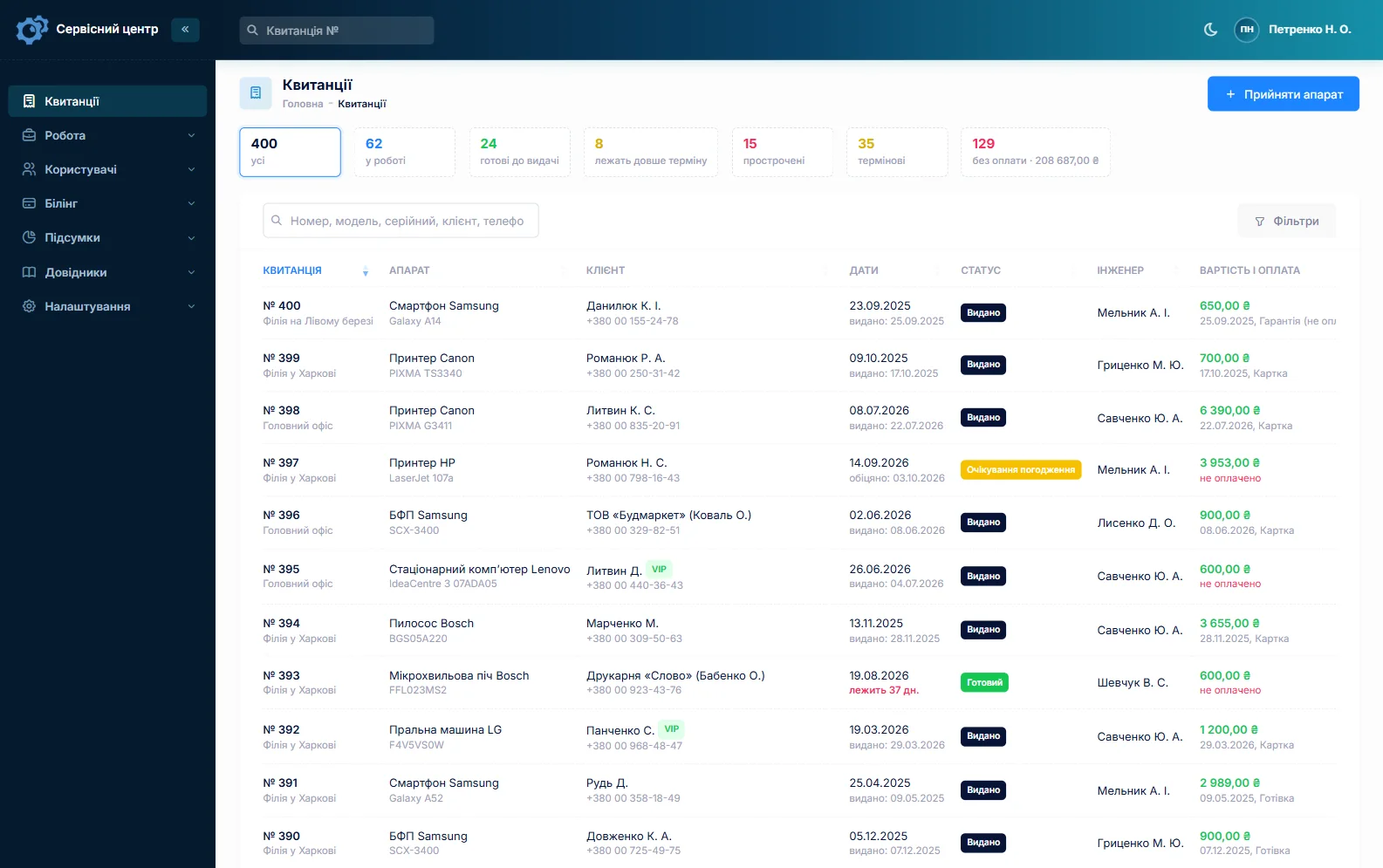
Every job has a promised date and an “Urgent” flag. The urgent tile above the list shows what must go out today; overdue rows turn red and the “overdue” filter collects them. When a tool is ready, the customer gets an email or a Telegram message — no ringing round ten barbers.
The flip side of volume is tools nobody picks up. Each finished job shows how many days it has been waiting, and once the free storage period from your settings runs out, the counter turns red.
Expensive repairs only after “I agree”
A rattling clipper may need a blade that costs little, or a motor that costs almost as much as a new entry-level clipper. On a nail drill the expensive parts are the handpiece — bearings and collet — and the control box; on a sterilizer, the thermostat and heating element. If the customer is unsure, book the job in as “diagnostics only” with that device type’s diagnostic fee, so the amount is clear from the start.
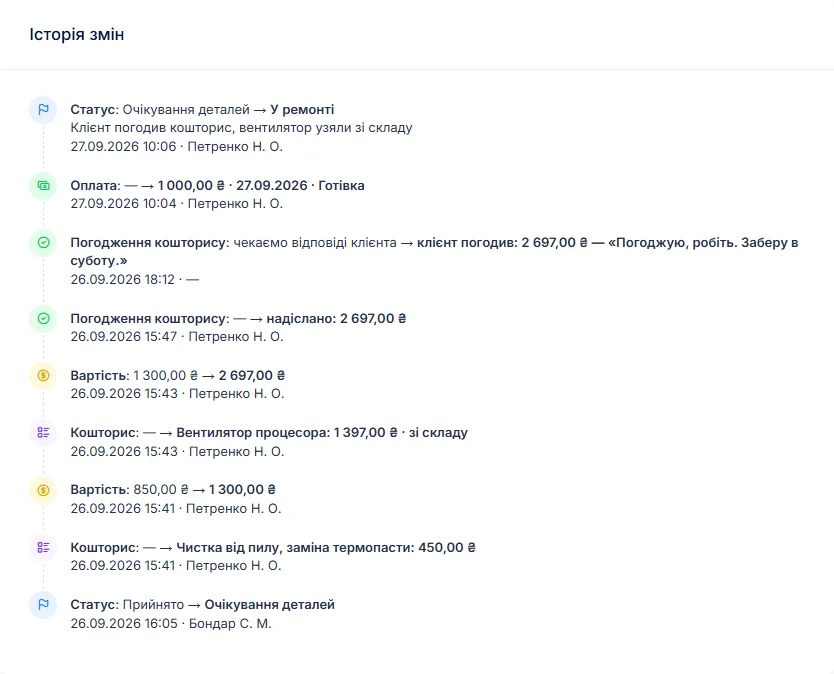
After diagnosis, log what you found and send an itemised estimate — parts from stock, labour from the list — by email or Telegram. The customer sees each line and the total and presses “I agree” or “I decline”; the answer is stored in the job history with the date. Not worth fixing? Close it as “repair refused” or “beyond repair”.
Motors, brushes and batteries in professional clippers are repaired much like cordless tools — see power tool repair.
Small parts, lots of them
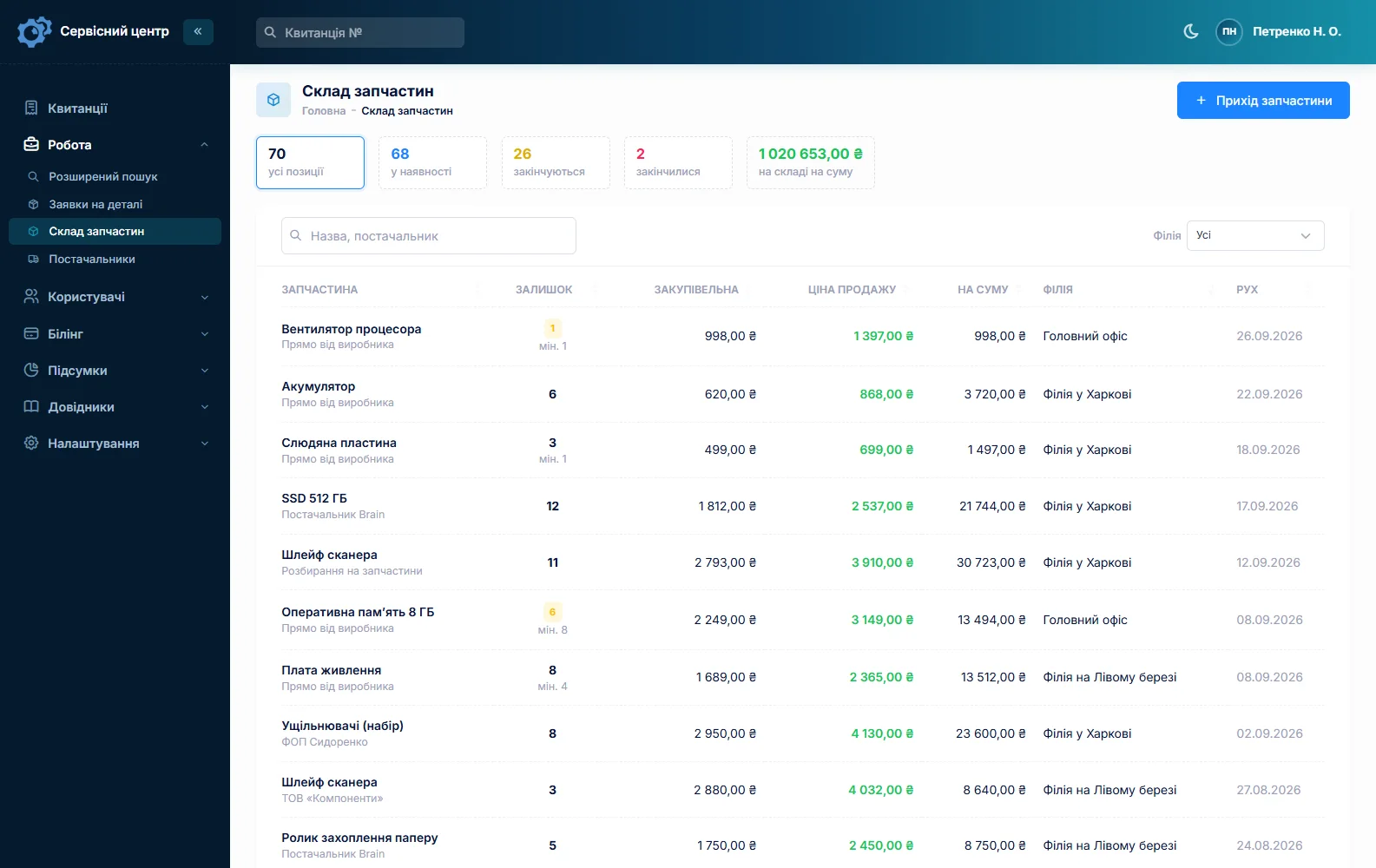
Stock is a movement log: goods in with cost and supplier, used on a job as an estimate line, returned, adjusted at stock-take. A blade picked from stock reduces the balance by itself. A typical shelf: blade sets for popular models, motors, switches, batteries, cords and plugs, dryer heating elements and thermal fuses, handpiece bearings and collets, LED boards for lamps, sterilizer thermostats. Quantities are whole numbers, so count clipper oil by the bottle.
Minimum levels and a “running low” tile tell you when to reorder. A part for a specific tool is ordered from the job: the request is emailed to the supplier and the job sits in “waiting for parts”. More on spare parts tracking.
Salons and barbershops as accounts
The “Company” field and a customer label make a barbershop one customer, whichever barber walks in with the box. Its record shows every job on every tool and the balance owed. A job can take several payments — a deposit on a motor, the rest at pickup — and the “unpaid” filter lists what has gone out without being paid, which helps when a salon pays monthly.
The completion report has estimate lines, the work log, recommendations and the amount due. Use recommendations for care advice that saves the next repair: brush and oil the blade, do not rinse the clipper under the tap. A tool back after your repair gets the “Repeat repair” type, with the earlier job one click away. Your repair warranty terms go into the job sheet conditions.
If you also service sewing machines for alterations shops, see sewing machine repair.
What stays outside the software
Hygiene rules for sterilizing salon instruments and electrical safety requirements for appliances depend on where you work. The software tracks repairs; it does not check those rules or certify that a sterilizer meets them after repair.
What repairs typically cost
As a rough guide only — prices vary with region, model and condition: diagnosis €10–25, blade sharpening €8–20 per blade, clipper repair (switch, motor, battery) €25–70 plus parts, dryer cord replacement €15–35, dryer motor or heater repair €30–80, nail drill handpiece rebuild €40–120, control box repair €35–110, sterilizer or dry-heat cabinet repair €30–90, UV/LED lamp repair €20–60. You set your own prices: per device type, in the labour list and as estimate lines.
What it does not do
- photos or file attachments on jobs;
- a loaner tool pool or salon service contracts as separate modules;
- reminders for scheduled cleaning or sharpening;
- SMS, a mobile app, online payment by the customer;
- supplier integrations or parts catalogues.
What it costs
One price for the whole shop — no extra charge for staff or branches.
Monthly
Paid every month, cancel whenever you like.
Yearly
Cheaper than paying monthly. Invoice or card payment.
Custom work
Changes tailored to the way you work — hourly, by agreement.
Off-the-shelf not enough — your own forms, roles, reports or workflow? We will build a program for you. How it works
Try it without signing up in the demo: check in a clipper, copy the job for a second one, add “Blade sharpening × 2” and send the estimate to the customer.

We are very happy working with servicecentersoft.com: they built everything we asked for, even though our request was unusual, since we deal with medical devices. Everything was done precisely and on the agreed schedule. Thank you for the cooperation — we keep working together.

I tried the ServiceCenterSoft demo and came away with a good impression. The program is simple and easy to understand, yet it has everything you need for the job: customers, repairs, devices, spare parts, statuses and statistics.
I especially liked the dark theme and the responsive design — working from a phone is perfectly comfortable. Another plus is the instant search that works as you type, so you don't have to press a separate "Search" button every time.
You can tell the program was built specifically for service centers rather than being a generic CRM adapted for the repair business. The interface has no unnecessary frills; everything is logical and to the point.
A good, practical tool for the day-to-day work of a service center.

I liked that you get a free 14-day trial and that they are willing to handle my special requests — setting things up exactly the way I need them.
I also liked how payment works. You can simply pay the monthly fee by card online — basically the same as a regular Spotify subscription or any other service. No separate contracts to sign and no invoices to pay manually.
And there's no feeling of strict limits on the number of employees. One service center is one account, and inside it you can organize the work of your technicians and run several branches.
For me this is far more convenient than plans where you have to pay for every single user or keep counting how many employees are working today.

My business is fairly specific, so the program's standard features weren't enough — I needed my own custom fields, my own sorting options and search by additional parameters. The work completion certificate and the printed repair receipt also needed some changes to fit the way we work.
I contacted technical support. To be honest, I expected changes like these to take a long time, but everything was done within a single day. The team quickly understood exactly what we needed, suggested the right solution and did everything properly.
I'd especially like to mention the support: they get straight to the point, with no unnecessary bureaucracy, and they genuinely help instead of just sending you off to read the documentation.
For me this is a big advantage of the program: it isn't just sold "as is" — it can be adapted to how you actually work. Thanks to the team for the quick response and for treating the customer right.
Highly recommended!
In short
- One job per tool by copying; the salon’s own marking in product code, searchable.
- Sharpening and routine work from the labour list, with quantities on estimate lines.
- Urgent and overdue jobs in plain sight; “ready” by email and Telegram.
- Motors, handpieces and control boxes only after the customer clicks “I agree”.
- Stock of blades, motors and cords with minimum levels.
- Salon accounts: company field, several payments, balance, completion report.
- €20 a month for the whole shop.
See also
Hydraulic repair shop software
Job tracking for hydraulic repair shops working on construction, agricultural and municipal equipment: cylinders, pumps, motors, valves and hose assemblies. One job per component, teardown and test bench results in the work log, estimates approved by link, seal kits in stock, rush jobs in plain sight, and fleet customers with balances and completion reports.
Read moreSolar inverter repair software
For shops that repair grid-tie and hybrid solar inverters and MPPT charge controllers: installers as trade customers sending units in batches, manufacturer and installer warranties, pick-up from site and reinstallation, boards and power stages through estimate approval, monthly accounts and completion reports.
Read moreStarting your own repair shop: where to begin
For people who can fix phones and laptops and want to work for themselves: what a small repair business needs on day one, the paperwork that protects you from the first customer, and how to run a shop in a country whose language is not your own.
Read moreSee how it works
The demo is open — go in and try it. Ask us anything by email, Telegram or the form on this site.