Hydraulic repair shop software
Job tracking for hydraulic repair shops working on construction, agricultural and municipal equipment: cylinders, pumps, motors, valves and hose assemblies. One job per component, teardown and test bench results in the work log, estimates approved by link, seal kits in stock, rush jobs in plain sight, and fleet customers with balances and completion reports.
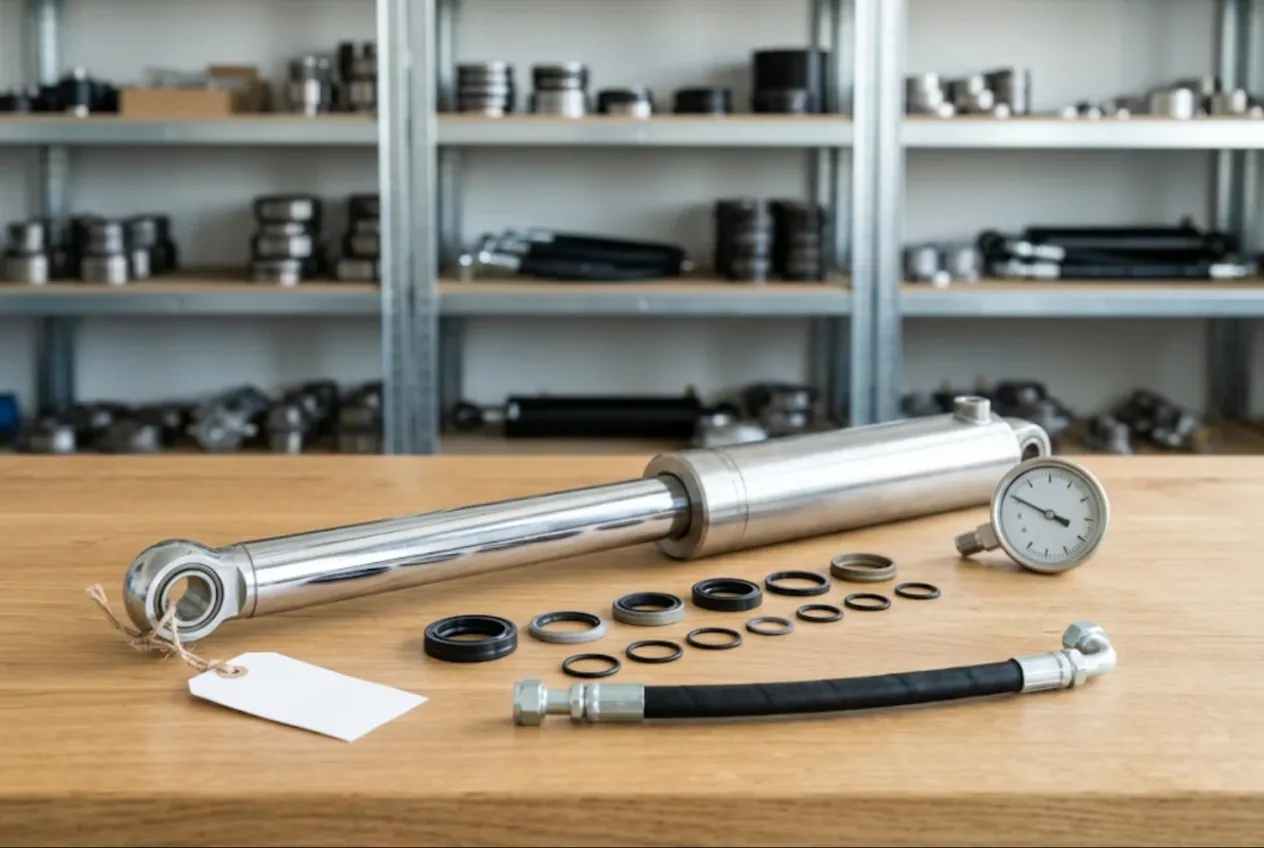
ServiceCenterSoft is job-tracking software for hydraulic repair shops: cylinder reseals and rebuilds, gear and piston pumps, drive and swing motors, control valves, and hose assemblies made while the customer waits. Each component gets its own job with teardown notes, an itemised estimate and a recorded approval; seal kits and fittings sit in stock with real quantities; and a contractor running twenty machines is one customer with one balance. It runs in the browser — on the PC next to the test bench and on your phone when you are looking at a machine on a job site.
Who it is for
Independent hydraulic shops, mobile hydraulic technicians who now have a bench, and machine shops that do cylinder work alongside machining. The customers are earthmoving and paving contractors, quarries, farms, municipal fleets, equipment rental yards and owner-operators with a single backhoe. When a boom cylinder blows a seal, a crew stands idle; during harvest, a combine with a dead drive motor is money left in the field. The repair is the easy part to explain — the downtime is what they are counting.
Where it usually goes wrong:
- three cylinders come off one excavator, and a week later nobody can say which is the bucket cylinder or what was wrong with it;
- the rod went out for re-chroming and the barrel for honing, but the invoice only shows the seal kit;
- a site foreman okayed a pump rebuild by phone, and the company’s accounts team never saw the number;
- seal kits for the most common loader cylinder run out in the middle of the season;
- a contractor’s balance is spread across a dozen jobs and added up by hand.
One job per component, found by the machine it came from
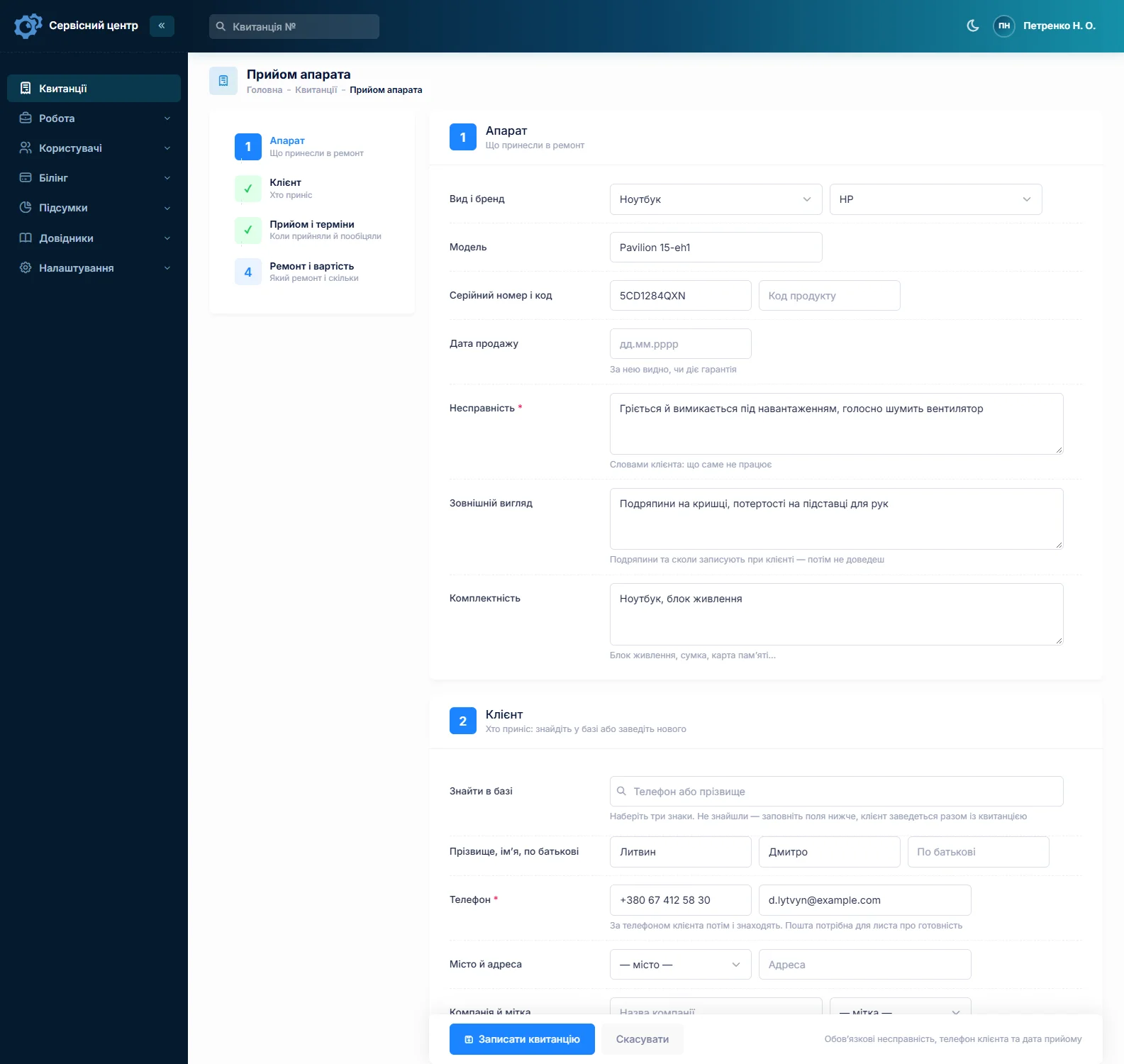
Each job has device type, model, serial number and a “product code” field. Put the component’s part number and serial in model and serial, and the machine it came off in product code — “CAT 420, unit 14, bucket cylinder”. Advanced search in device mode looks through model, serial and product code, so “the same backhoe again” turns up in seconds with its repair history.
Set up a device type for each kind of work — cylinder, pump, motor, valve, hose assembly — each with its own diagnostic price and labour list, so a piston pump rebuild never gets priced like a seal swap. Condition covers scored or pitted rods, dented barrels, damaged threads; accessories — pins, bushings, fittings, whether the ports were capped. A component back after your repair gets the “Repeat repair” type, and the serial brings up the earlier job.
Several cylinders from one machine? Fill in the first job and copy it for the rest: customer, device type and fault carry over, and you enter each serial and product code.
Teardown and test bench results
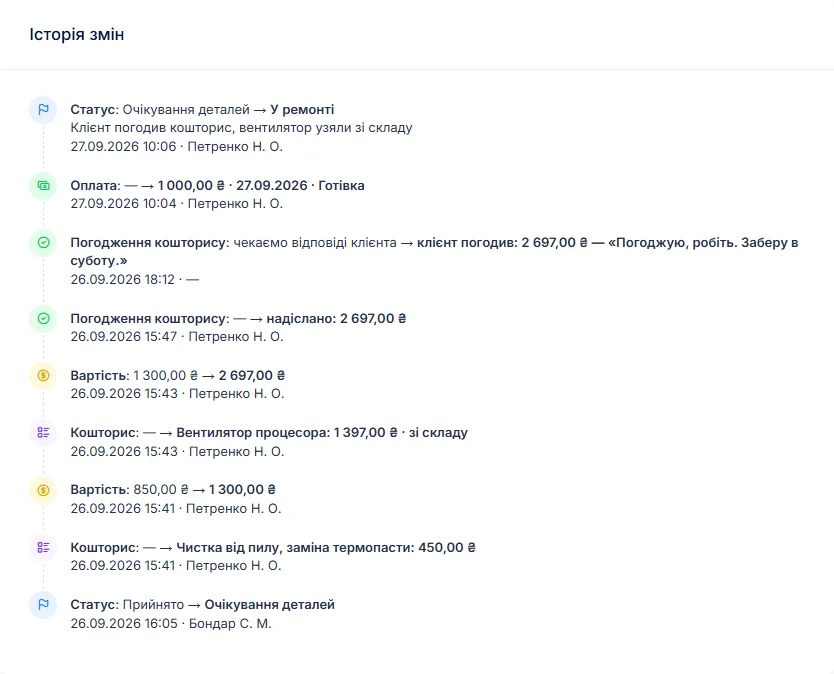
To be straight: there is no dedicated test bench report form. What you measure goes into the job’s work log with a date — “barrel worn in stroke zone, rod scored 40 mm, piston seal torn”, “pump: case drain flow above spec at 3,600 psi, rotating group worn”. Internal notes — bore and rod sizes, seal kit numbers, what you suspect — go in “Notes for the technician”: the customer never sees that field, and text search finds it a year later. Advice such as changing filters, flushing the system or checking the relief valve goes in “Recommendations for the customer”, which prints on the completion report.
Approval before the expensive work
A cylinder reseal is an easy number. A piston pump or a drive motor is not — customers want to see it first. After teardown, move the job to “waiting for approval” and build an itemised estimate: seal kit from stock, labour from the labour list, and outside work such as re-chroming or honing as its own line. A button sends it by email or Telegram; the customer sees each line and the total and presses “I agree” or “I decline”, and the answer is stored with the date. For a fleet account that means the person who pays is the one who approved — on record.
Not worth fixing — a bent rod, a cracked pump housing? “Repair refused” or “beyond repair” closes the job. A replacement pump on order puts the job in “waiting for parts”. Rewinding the electric motor of a power unit is covered on the electric motor repair page.
Rush jobs for contractors and farms
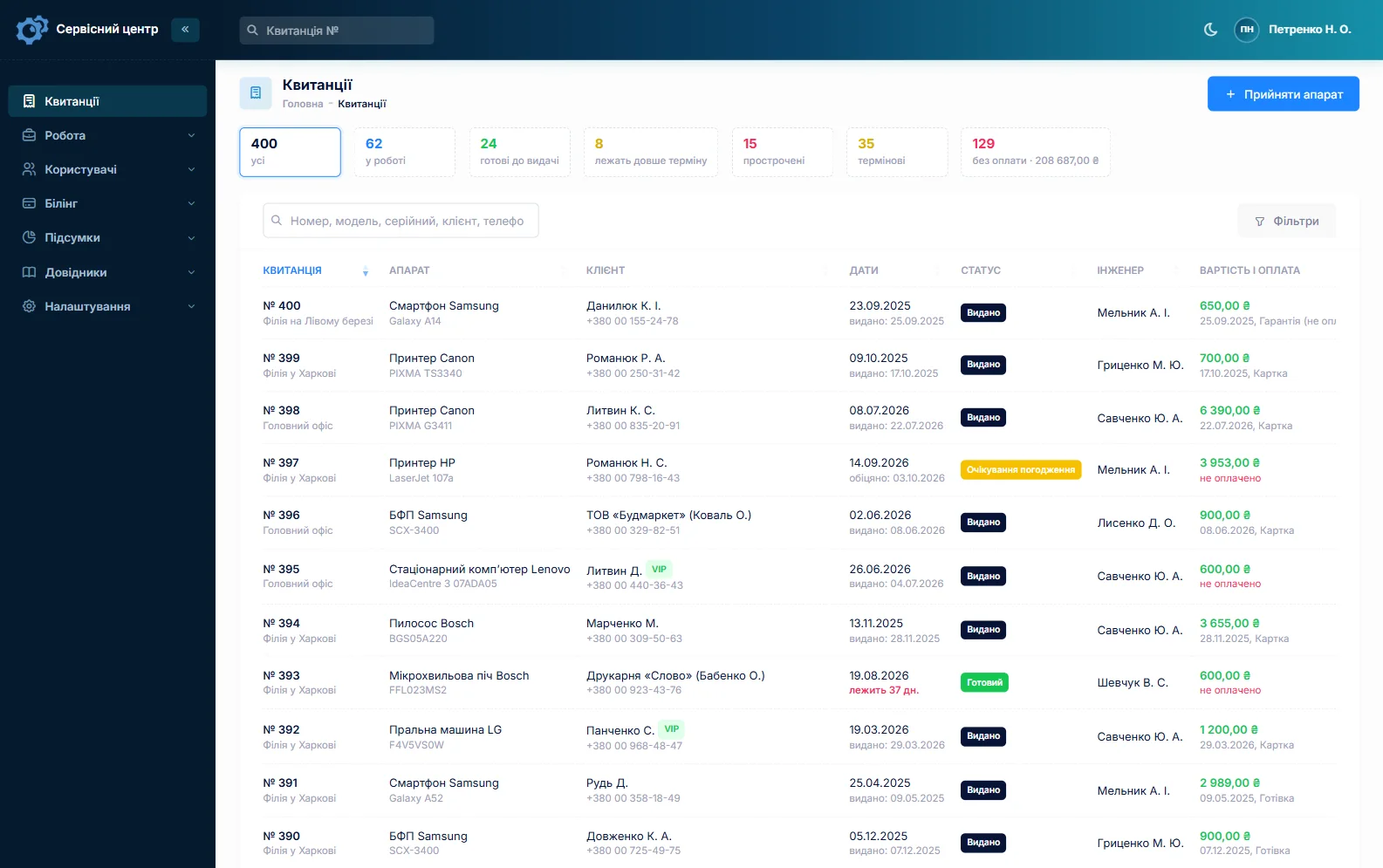
The “Urgent” flag shows right in the list — for the excavator holding up a crew or the combine that has to be back in the field tomorrow. Every job has a promised date; once it passes, the row turns red and the “overdue” filter collects those jobs. Statuses of your own, with a colour and a tile above the list — “On the bench”, “Out for chrome”, “Awaiting field call” — show where everything is with one click. A field call-out is a labour item with a price and goes onto the estimate as a line.
Seal kits, hose and fittings in stock
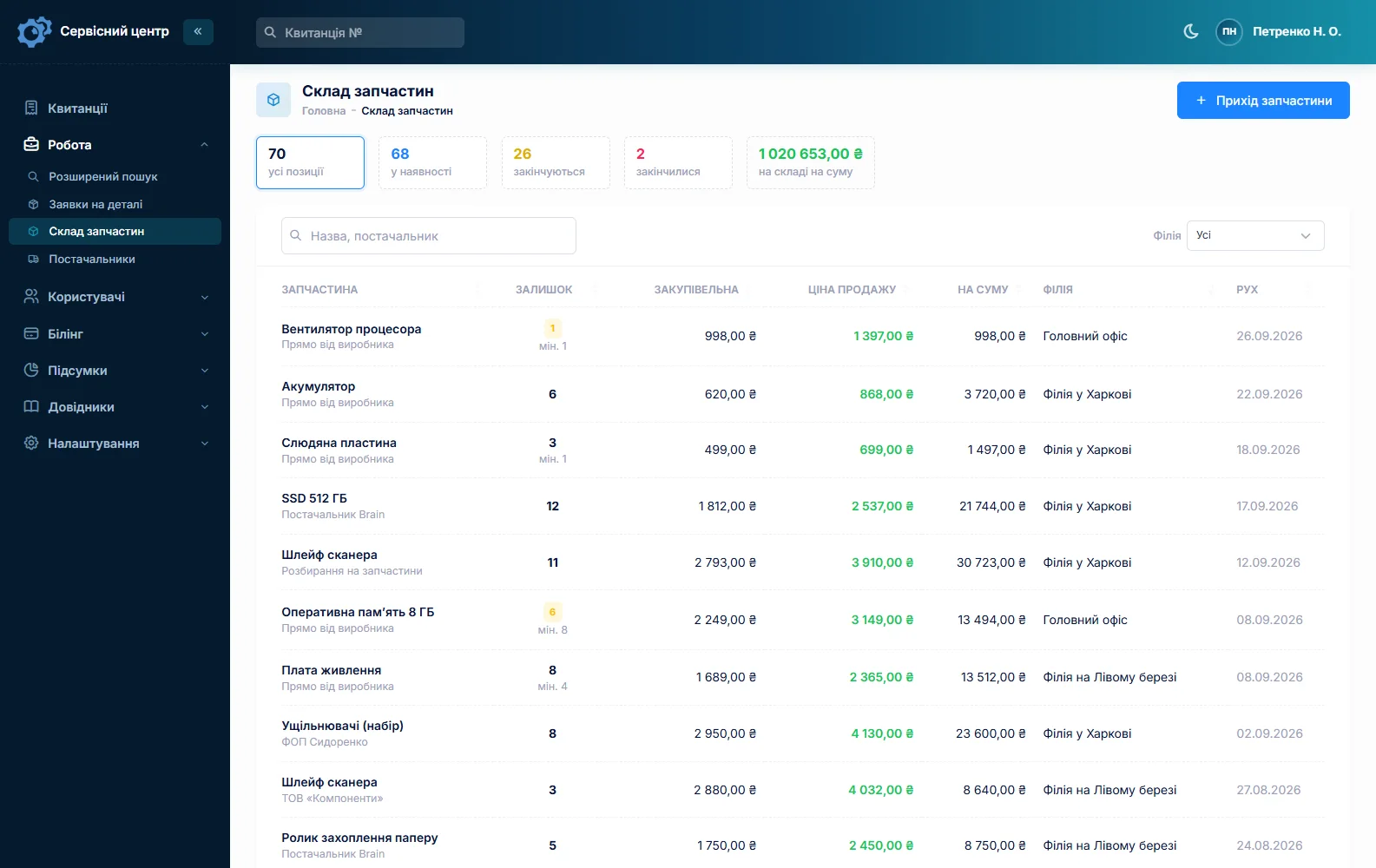
Stock is a movement log: goods in with cost and supplier, used on a job as an estimate line, returned, adjusted at stock-take. A seal kit picked from stock reduces the balance by itself. A typical shelf: seal kits for common cylinders, rod seals, wipers, wear rings, O-rings, hose fittings and ferrules, bulk hose. Quantities are whole numbers, so track hose in whole feet or metres and oil by the pail.
A hose assembly fits an estimate naturally: hose by length, two fittings, crimping as labour. Minimum levels and a “running low” tile tell you to reorder before the season, not in it. A pump or motor for a specific machine is ordered from the job, and the request is emailed to your supplier. More on spare parts tracking.
Fleet customers and getting paid
The “Company” field makes a contractor or a farm business one customer, whoever drops off the component. Its record shows every job and the balance owed. A job can take several payments — a deposit on an expensive pump, the rest on completion — and the “unpaid” filter lists what has gone out without being paid. The completion report has estimate lines, the work log, recommendations and the amount due.
When a component is ready, the customer gets an email or a Telegram message, and the ready list shows how many days each one has been waiting — a cylinder nobody has collected for a week is hard to miss. If you also look after material handling equipment, see forklift repair software.
What stays outside the software
Rules for working on pressurised components, pressure testing and workshop safety depend on your country and on the equipment manufacturer, and are not handled by the software. Dispose of used oil and contaminated seals under local rules.
What repairs typically cost
As a rough guide only — prices vary with region, size, make and condition: cylinder reseal €150–500 labour plus the seal kit, rod re-chroming €150–700 depending on length and diameter, gear pump repair €250–800, piston pump or motor rebuild €800–4,000, control valve repair €250–1,200, hose assembly €25–150 per hose. You set your own prices: per device type, in the labour list and as estimate lines.
What it does not do
- a dedicated test bench report form — measurements go in the work log;
- a fleet management module — machines are found by unit number in product code;
- photos or file attachments on jobs;
- SMS, a mobile app, online payment by the customer;
- supplier integrations or seal catalogues;
- fractional stock quantities.
What it costs
One price for the whole shop — no extra charge for staff or branches.
Monthly
Paid every month, cancel whenever you like.
Yearly
Cheaper than paying monthly. Invoice or card payment.
Custom work
Changes tailored to the way you work — hourly, by agreement.
Off-the-shelf not enough — your own forms, roles, reports or workflow? We will build a program for you. How it works
Try it without signing up in the demo: check in a cylinder, enter the machine’s unit number, add a seal kit to the estimate and send it for approval.

We are very happy working with servicecentersoft.com: they built everything we asked for, even though our request was unusual, since we deal with medical devices. Everything was done precisely and on the agreed schedule. Thank you for the cooperation — we keep working together.

I tried the ServiceCenterSoft demo and came away with a good impression. The program is simple and easy to understand, yet it has everything you need for the job: customers, repairs, devices, spare parts, statuses and statistics.
I especially liked the dark theme and the responsive design — working from a phone is perfectly comfortable. Another plus is the instant search that works as you type, so you don't have to press a separate "Search" button every time.
You can tell the program was built specifically for service centers rather than being a generic CRM adapted for the repair business. The interface has no unnecessary frills; everything is logical and to the point.
A good, practical tool for the day-to-day work of a service center.

I liked that you get a free 14-day trial and that they are willing to handle my special requests — setting things up exactly the way I need them.
I also liked how payment works. You can simply pay the monthly fee by card online — basically the same as a regular Spotify subscription or any other service. No separate contracts to sign and no invoices to pay manually.
And there's no feeling of strict limits on the number of employees. One service center is one account, and inside it you can organize the work of your technicians and run several branches.
For me this is far more convenient than plans where you have to pay for every single user or keep counting how many employees are working today.

My business is fairly specific, so the program's standard features weren't enough — I needed my own custom fields, my own sorting options and search by additional parameters. The work completion certificate and the printed repair receipt also needed some changes to fit the way we work.
I contacted technical support. To be honest, I expected changes like these to take a long time, but everything was done within a single day. The team quickly understood exactly what we needed, suggested the right solution and did everything properly.
I'd especially like to mention the support: they get straight to the point, with no unnecessary bureaucracy, and they genuinely help instead of just sending you off to read the documentation.
For me this is a big advantage of the program: it isn't just sold "as is" — it can be adapted to how you actually work. Thanks to the team for the quick response and for treating the customer right.
Highly recommended!
In short
- One job per component; the customer’s machine in product code, searchable.
- A device type each for cylinders, pumps, motors, valves and hoses, with their own diagnostic price.
- Teardown and bench results in the work log, advice on the completion report.
- Pumps and motors only after the customer clicks “I agree”.
- Seal kits, hose and fittings in stock with minimum levels.
- Urgent and overdue jobs in plain sight; fleet customers with deposits, balances and reports.
- €20 a month for the whole shop.
See also
Solar inverter repair software
For shops that repair grid-tie and hybrid solar inverters and MPPT charge controllers: installers as trade customers sending units in batches, manufacturer and installer warranties, pick-up from site and reinstallation, boards and power stages through estimate approval, monthly accounts and completion reports.
Read moreStarting your own repair shop: where to begin
For people who can fix phones and laptops and want to work for themselves: what a small repair business needs on day one, the paperwork that protects you from the first customer, and how to run a shop in a country whose language is not your own.
Read moreSoftware for home appliance service
Contents recorded at intake, warranty at the brand price list, callouts, slow parts and partner shops.
Read moreSee how it works
The demo is open — go in and try it. Ask us anything by email, Telegram or the form on this site.