Motorcycle repair shop software
For shops that service and repair motorcycles, scooters, mopeds and ATVs: a spring rush with promised dates, mileage and services in the work log, parts ordered per bike with a deposit, winter storage as a custom status, and delivery fleets and rental firms as business customers.
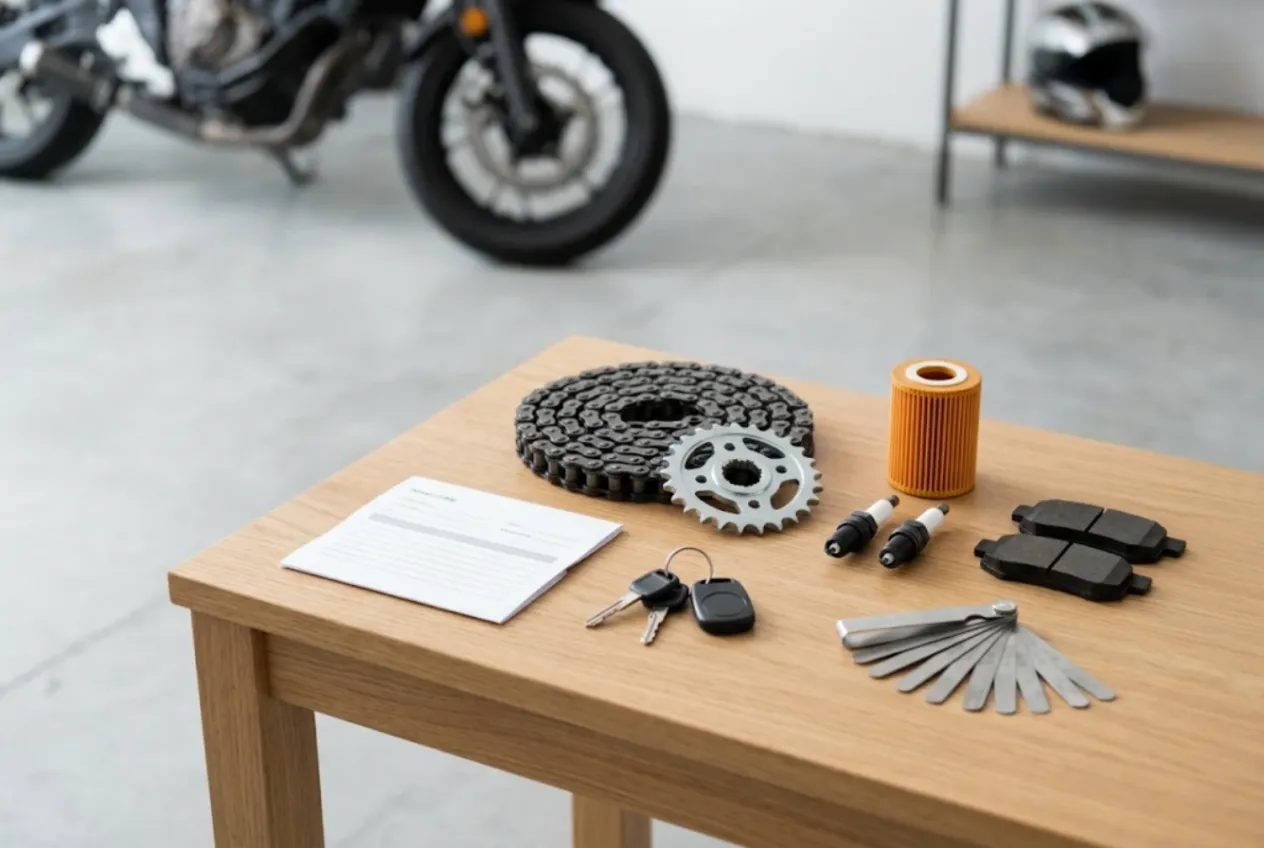
ServiceCenterSoft is repair-tracking software for motorcycle shops: road bikes and tourers, dirt bikes, scooters and mopeds, ATVs and quads.Book the bike in with its mileage and keys, keep the spring queue honest with promised dates, run services from your own price list, send estimates for approval and order parts for a specific job. It runs in the browser — on the front-counter PC and on a phone in the workshop bay.
Who it is for
Few repair businesses are as seasonal as a motorcycle shop. Winter is quiet: an engine rebuild here, a carb strip there. Then the first dry weekend arrives and everyone wheels their bike out of the garage at once. Flat battery, carbs gummed up with stale fuel, dark brake fluid, a rusty chain. By mid-April the yard is full and every owner believes theirs is a five-minute job.
Where it usually goes wrong:
- five customers were promised “by the weekend”, and who actually came first is decided by who phones most;
- the bike came in with two keys and a top box, one key is missing at collection, and nothing was written down;
- a part for a rare model was ordered and paid for, and then the customer changed their mind;
- the same bike has been in every spring, but nobody knows when the chain was last changed or at what mileage;
- you run out of oil filters for the most common model on exactly the week everyone wants a service.
Booking in: VIN, plate, mileage, keys
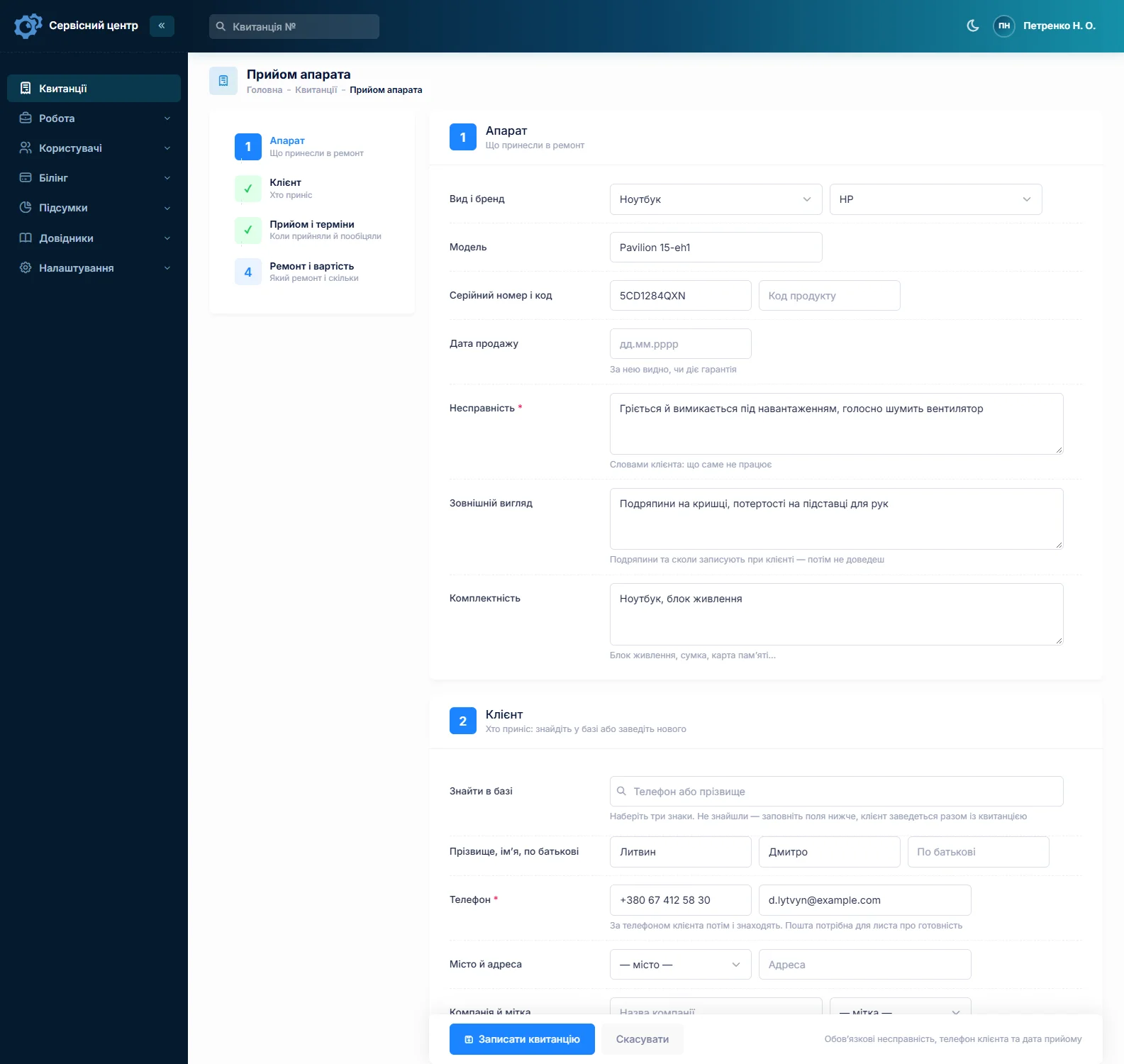
Set up a device type for each kind of machine — “Motorcycle”, “Scooter”, “ATV” — each with its own diagnostics price and its own list of works. The frame number or VIN goes in the serial number field, the registration plate in “Product code”. The advanced search in “device” mode finds the bike by either one, even by part of it, and brings up its full repair history.
There is no dedicated mileage field. Record the odometer reading in the technician’s notes at intake: “11,460 miles, half a tank, laid up all winter”. The customer does not see that field, and a “text” search will find it again next season.
Fill in “Accessories” in front of the customer — it prints on the job sheet they sign: “2 keys, alarm fob, top box, left mirror missing”. Under “Condition” go scratches on the tank, cracked fairings, a bent lever, crash damage on the alternator cover.
The spring rush, one promised date at a time
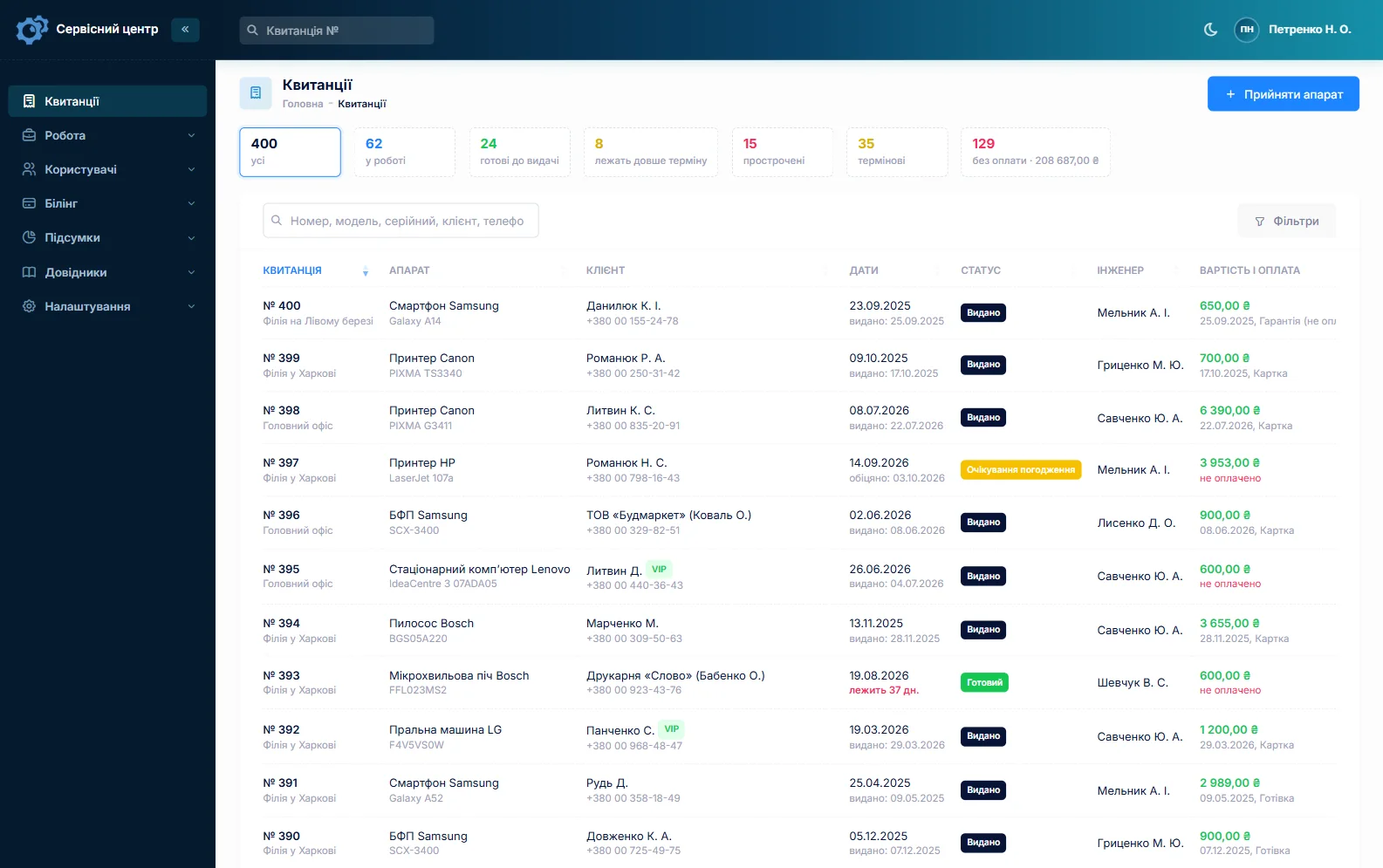
Every job has a promised date. Miss it and the row turns red; the “overdue” filter gathers those jobs in one place. The “urgent” flag is for the delivery rider whose scooter is their income — it stands out in the list, and a tile above the list shows how many urgent jobs are open.
Statuses are a list you control. Next to the defaults — diagnostics, awaiting parts, awaiting approval, ready — add your own, each with a colour: “Road test” for a bike that needs a lap after the work, “Waiting for tyres”, “De-winterising”. Tiles above the list show how many bikes sit at each step.
A bike you saw last spring does not need re-entering: copy last year’s job — customer, device type, model and notes carry over, and you type in the VIN.
Mileage-based services and estimates
Add your services to the “Works” list with a price per device type: “Scooter service”, “Minor service”, “Valve clearance check”, “Chain and sprocket kit”, “Fork seals”. A service goes onto the estimate as one line, parts as lines from stock. What was done, and at what mileage, goes in the work log: “oil, filter, plugs, brake fluid; 11,460 mi”.
The next service goes into the recommendations for the customer: “next oil change at 15,000 mi or in spring; chain near its limit, check tension after 300 miles”. Recommendations print on the completion report the customer takes home. The software does not send service reminders — it does not track mileage — so the customer sees the next interval on the report and you see it in the bike’s history.
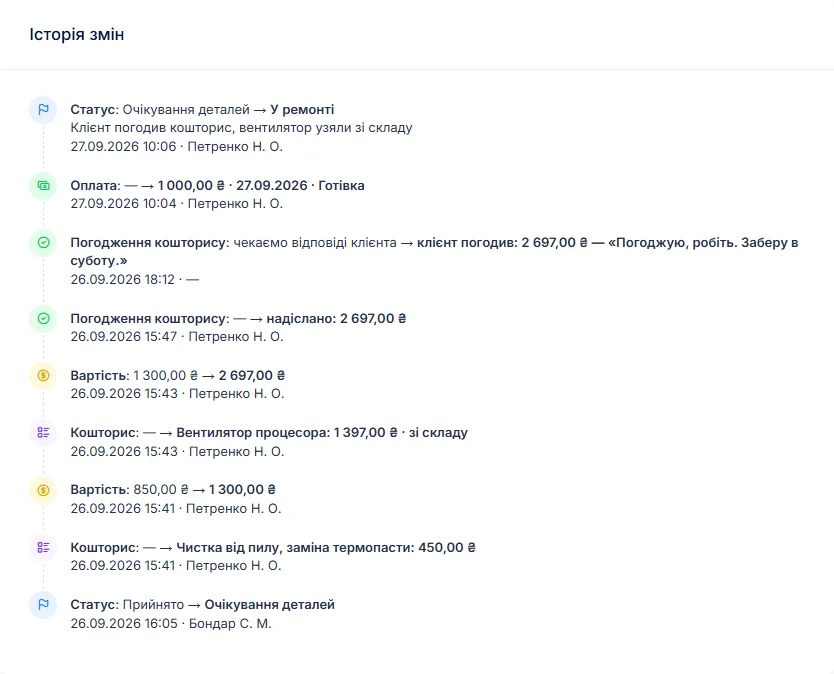
When diagnosis turns up more than a routine service — big-end play, a scored cylinder, a worn-out scooter variator, torn CV boots on a quad — the technician writes it in the work log, the job moves to “awaiting approval” and an itemised estimate goes to the customer by email or Telegram. The link shows every line with “I agree” and “I decline” buttons; the answer and date land in the job history. Not worth repairing? “Repair refused” or “beyond repair” closes the job.
Parts ordered per bike, with a deposit
No shop can stock parts for every model, and some take weeks to arrive from abroad. Order the part from the job itself: the order is emailed to the supplier, the job waits in “awaiting parts”, and you can see exactly which bike is held up.
To avoid being left holding an expensive part, take a deposit. A job can take several payments — a deposit when ordering, the balance at collection — and the software shows what is still due. Customer brought their own part? Put only the labour on the estimate and note in the work log that the part was supplied by the customer.
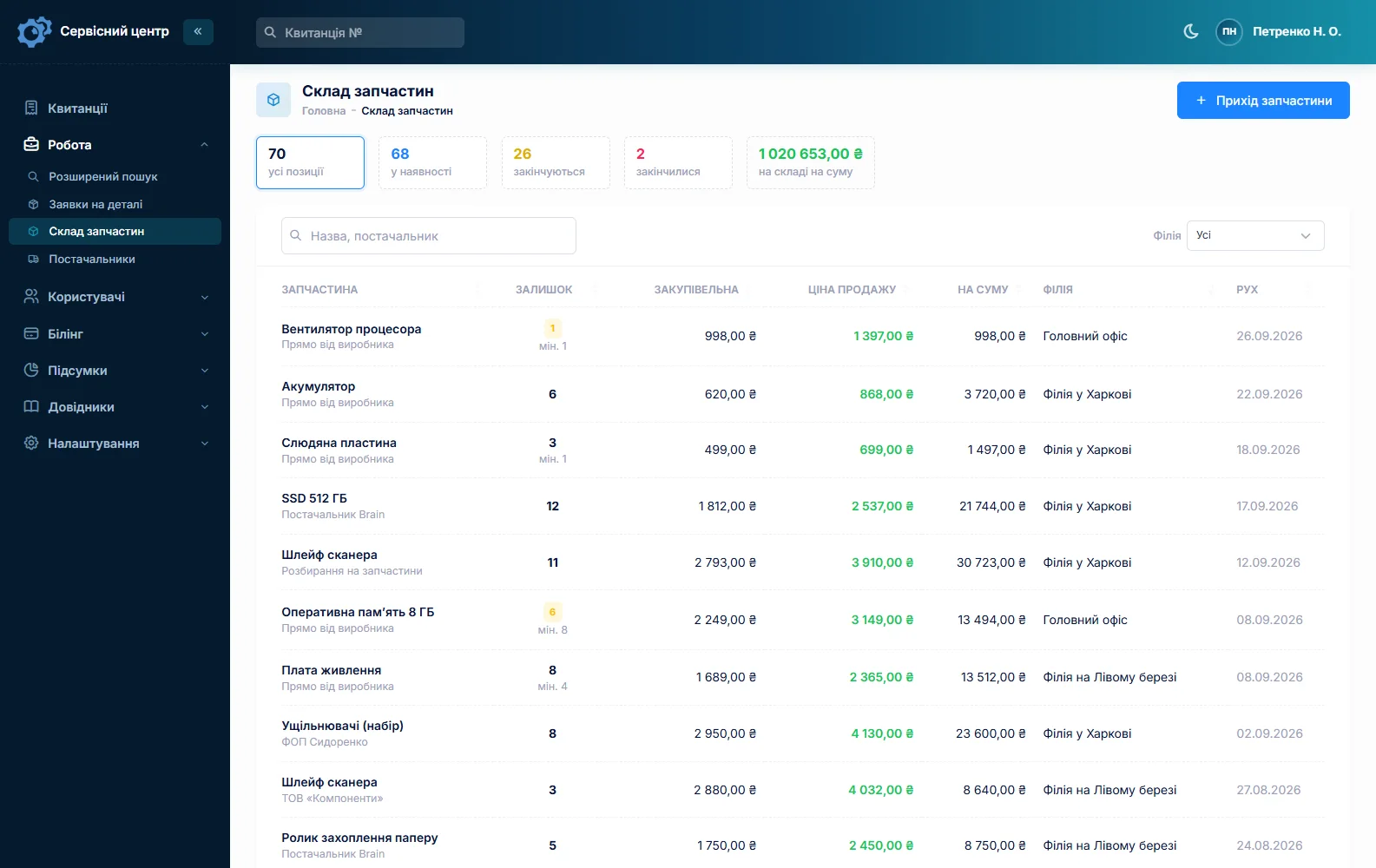
Keep the fast movers in stock: oil and air filters, plugs, brake pads, chains and sprockets, fork seals, bulbs, variator belts and rollers. Stock is a movement journal — receipts with cost price and supplier, parts used as estimate lines, returns, stocktakes. A minimum level and the “running low” tile remind you to order filters in February, not in April. Quantities are whole numbers, so count oil by the bottle. More on spare parts tracking.
Winter storage
Many shops store bikes over winter: fuel stabiliser, battery on a maintainer, tyres at pressure. There is no dedicated storage module, so you build it from what is there: a custom “Winter storage” status with its own tile, and a “Storage, per month” work charged as an estimate line with the number of months. The same approach for outboards is described on the boat motor repair software page.
Delivery fleets, rental firms, dealers
A scooter delivery company or an ATV rental business is one customer with a “Company” field — all jobs and the outstanding balance on one card, whoever drops the machines off. The “unpaid” filter lists everything collected but not paid. Five identical scooters for a service? Fill in the first job and copy the rest. A dealer who sends you pre-delivery and warranty work is set as a partner, and the job list filters by partner.
Seasonal mechanics are assigned to estimate lines, and the reports work out each one’s share by their rate. A completion report prints for every job: the estimate as a table, the work log, recommendations and the total.
When a bike is ready, the customer gets an email or a Telegram message. Finished bikes show how many days they have been waiting; past your free storage period, the counter turns red.
Bicycles and e-bikes have their own page, bike repair shop software, and e-scooters are covered under e-scooter repair software.
About regulations
The software tracks repairs. Registration, roadworthiness testing and vehicle requirements depend on your country. Check brakes, tyres and steering after work according to your own shop procedures — the software does not do that for you. Dispose of used oil and fluids according to local rules.
What repairs typically cost
A rough guide only — prices depend on country, model and condition: diagnosis €40–90, scooter service €70–150, minor motorcycle service €120–250 plus parts, valve clearance check €200–500, chain and sprocket fitting €60–150 labour, fork seals €120–250, carb cleaning and balancing €80–300, tyre fitting €25–50 per wheel. Storage at your own rates. You set your own prices in device types, the “Works” list and estimate lines.
What it does not have
- a mileage field or service reminders by mileage or date;
- online booking or a bay calendar;
- a connection to diagnostic scan tools;
- photos or file attachments on a job;
- SMS, a mobile app, or online payment by the customer;
- supplier integrations, parts catalogues, or a dedicated storage module.
What it costs
One price for the whole workshop — no extra charge for staff or branches.
Monthly
Paid every month, cancel whenever you like.
Yearly
Cheaper than paying monthly. Invoice or card payment.
Custom work
Changes tailored to the way you work — hourly, by agreement.
Off-the-shelf not enough — your own forms, roles, reports or workflow? We will build a program for you. How it works
Try it without signing up in the demo: book a bike in, put the mileage in the notes, add a service from the works list and send the estimate for approval.

We are very happy working with servicecentersoft.com: they built everything we asked for, even though our request was unusual, since we deal with medical devices. Everything was done precisely and on the agreed schedule. Thank you for the cooperation — we keep working together.

I tried the ServiceCenterSoft demo and came away with a good impression. The program is simple and easy to understand, yet it has everything you need for the job: customers, repairs, devices, spare parts, statuses and statistics.
I especially liked the dark theme and the responsive design — working from a phone is perfectly comfortable. Another plus is the instant search that works as you type, so you don't have to press a separate "Search" button every time.
You can tell the program was built specifically for service centers rather than being a generic CRM adapted for the repair business. The interface has no unnecessary frills; everything is logical and to the point.
A good, practical tool for the day-to-day work of a service center.

I liked that you get a free 14-day trial and that they are willing to handle my special requests — setting things up exactly the way I need them.
I also liked how payment works. You can simply pay the monthly fee by card online — basically the same as a regular Spotify subscription or any other service. No separate contracts to sign and no invoices to pay manually.
And there's no feeling of strict limits on the number of employees. One service center is one account, and inside it you can organize the work of your technicians and run several branches.
For me this is far more convenient than plans where you have to pay for every single user or keep counting how many employees are working today.

My business is fairly specific, so the program's standard features weren't enough — I needed my own custom fields, my own sorting options and search by additional parameters. The work completion certificate and the printed repair receipt also needed some changes to fit the way we work.
I contacted technical support. To be honest, I expected changes like these to take a long time, but everything was done within a single day. The team quickly understood exactly what we needed, suggested the right solution and did everything properly.
I'd especially like to mention the support: they get straight to the point, with no unnecessary bureaucracy, and they genuinely help instead of just sending you off to read the documentation.
For me this is a big advantage of the program: it isn't just sold "as is" — it can be adapted to how you actually work. Thanks to the team for the quick response and for treating the customer right.
Highly recommended!
In short
- VIN as serial number, plate as product code, mileage in the technician’s notes.
- Spring rush: promised dates, overdue and urgent jobs in plain sight.
- Services from your works list; the next interval in the recommendations.
- Bigger repairs go through an estimate the customer approves by link.
- Parts ordered per bike from the job, with a deposit.
- Delivery fleets and rental firms as companies; dealers as partners.
- €20 a month for the whole workshop.
See also
Shoe repair software
For cobbler shops and bag repair counters: a steady stream of small jobs, one ticket per pair, deposits on bigger work, a day counter for uncollected items, and stock of heel tips, glue and zips.
Read moreStarting your own repair shop: where to begin
For people who can fix phones and laptops and want to work for themselves: what a small repair business needs on day one, the paperwork that protects you from the first customer, and how to run a shop in a country whose language is not your own.
Read moreSoftware for home appliance service
Contents recorded at intake, warranty at the brand price list, callouts, slow parts and partner shops.
Read moreSee how it works
The demo is open — go in and try it. Ask us anything by email, Telegram or the form on this site.