Guitar repair shop software
For guitar repair shops and luthiers: quick setups alongside slow fret and crack work, humidity season, pickups and wiring — one ticket per instrument, estimates the customer approves by link, history by serial number, and stock of strings and fret wire.
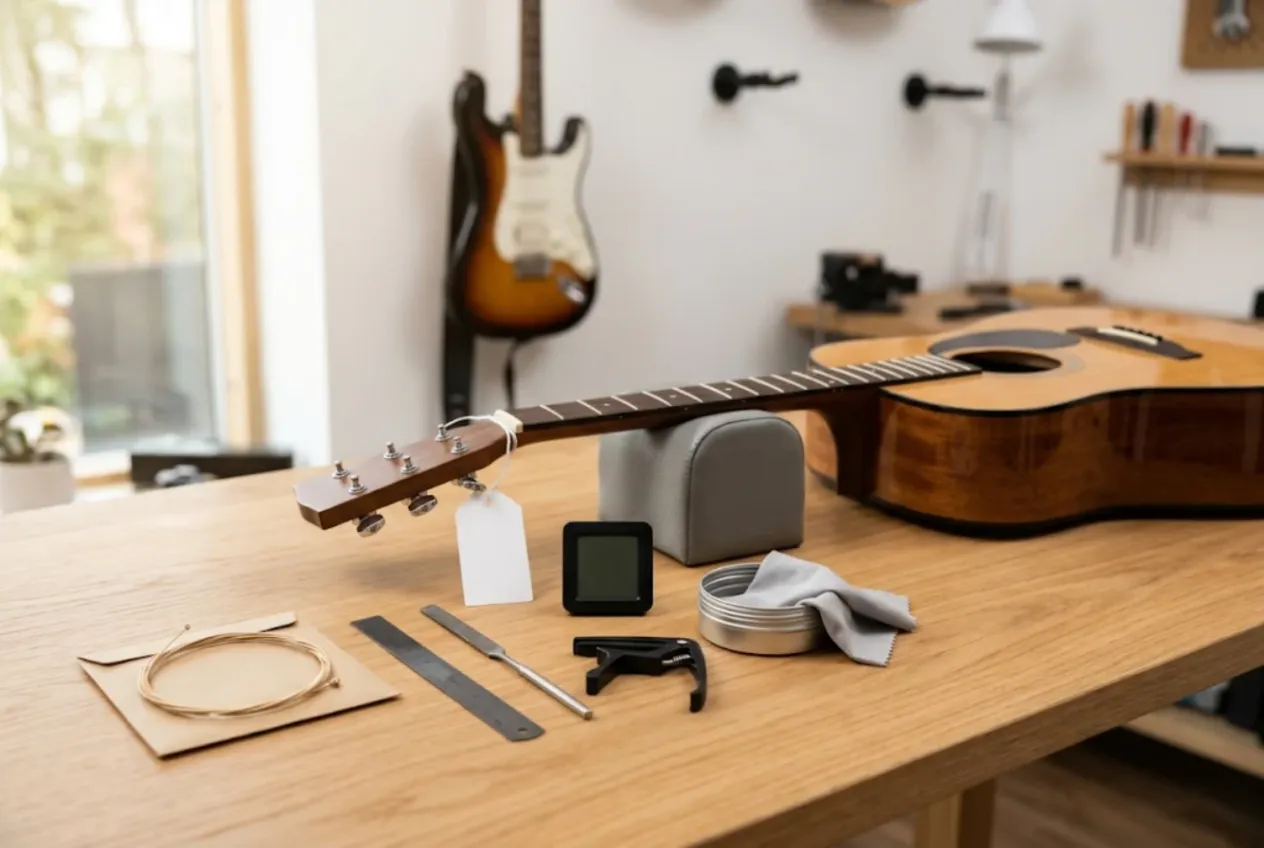
ServiceCenterSoft is repair-tracking software for guitar repair shops and luthiers. Setups and restrings, truss rod adjustments, fret level, crown and polish, refrets, nuts and saddles, bridge reglues, top cracks, headstock breaks, pickup swaps and rewiring — every job goes through one intake form and one list. It covers acoustic, classical, electric and bass guitars, ukuleles, mandolins and banjos, and runs in the browser on the bench PC, a laptop or a phone.
This page is about wood, finish and strings. If you work on amps, synths, mixers and effects pedals, that is electronics, and it has its own page: music equipment repair software. Many shops do both — one system covers it.
Fast jobs and slow jobs on the same bench
A guitar shop runs at two speeds. The fast lane is setups before a gig, fresh strings, a crackling pot, a loose output jack — an hour or two each, and lots of them. The slow lane is refrets, cracked tops, lifting bridges, snapped headstocks: glue needs a day to cure, finish touch-ups need a week, and the owner calls every few days.
Then there is the weather. When the heating comes on, the air dries out: fret ends start poking out of the fingerboard, tops sink, cracks open up. In spring and summer the wood takes on moisture, necks move and the action climbs. Those are the weeks when everyone turns up at once.
Where it usually goes wrong:
- the case came in with a capo and a truss rod wrench, and at pickup they “were never there”;
- finish checking that was always there is suddenly “something you did”;
- the customer wants it “like last time”, and nobody remembers which strings or what action height;
- you took a deposit on a refret, and the amount is on a sticky note that has vanished;
- your best-selling string gauge runs out on a Friday evening.
One guitar, one ticket
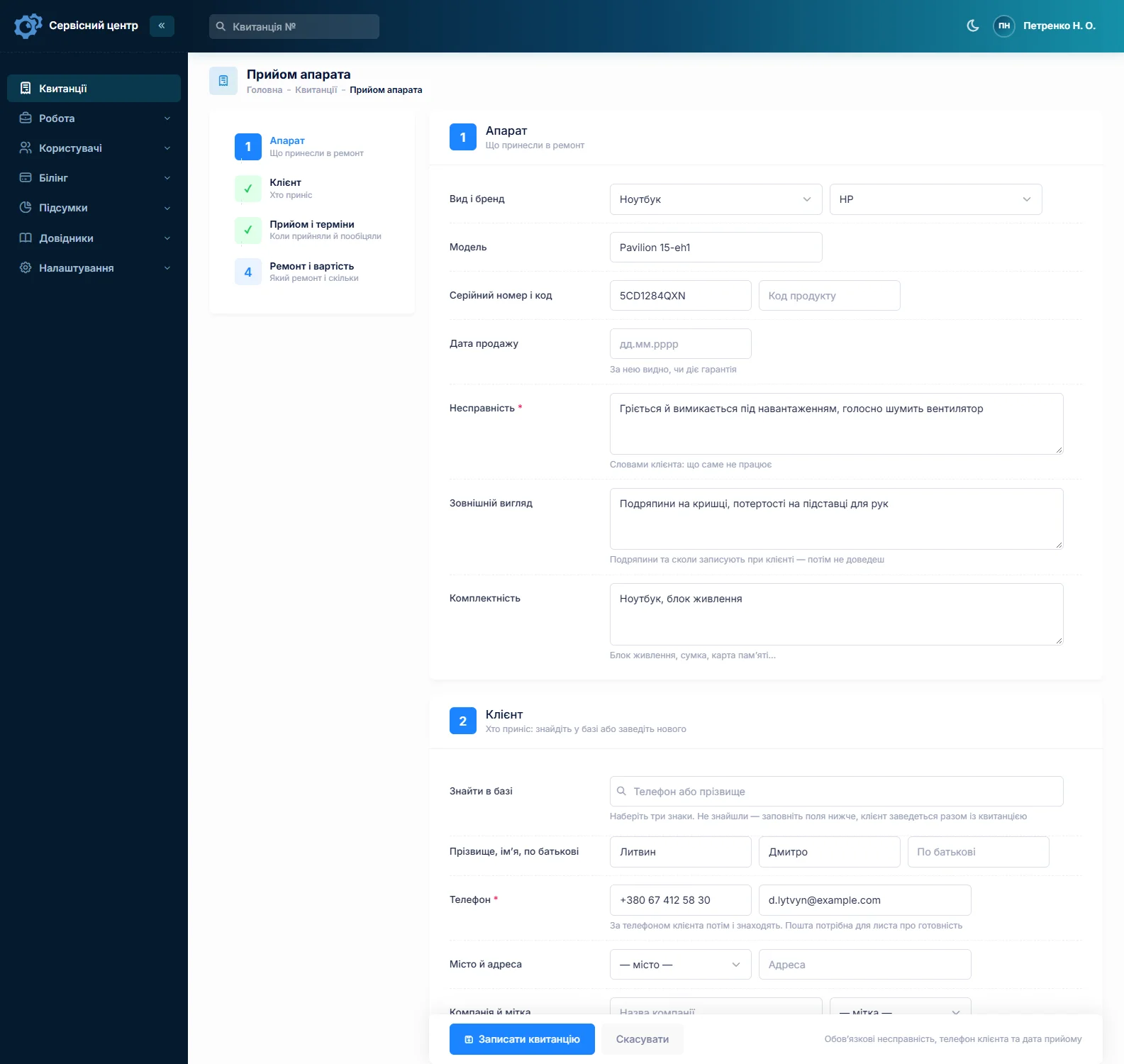
Every instrument gets its own ticket with a number, status and price. Find the customer by phone or name, or add a new one on the spot. Device types — “Acoustic guitar”, “Classical guitar”, “Electric guitar”, “Bass”, “Ukulele” — are set up once. The model field takes make, model and colour; the serial number goes in its own field, from the headstock or the label inside the body; the fault is written the way the customer says it: “action too high”, “buzzing on frets 5 to 7”, “crack by the bridge”, “bridge pickup dead”.
The “Condition” field is filled in while the customer is at the counter: chips and scratches in the finish, finish checking, pick wear, worn frets, dings on the headstock. “Accessories” lists the case or gig bag, strap, capo, truss rod wrench, cable and spare strings. It all prints on the ticket the customer signs. You cannot attach photos to a ticket — if you photograph the guitar, keep the pictures on your side and note on the ticket that photos were taken. What else belongs on the ticket is covered on the repair intake form page.
Gig on Friday? Tick “urgent” and set a promised date. Urgent jobs stand out in the list, overdue ones turn red and gather under the “overdue” filter.
Your price list: setups, frets, electronics
The “Works” list is your price board: setup, restring, truss rod adjustment, action and intonation, fret level, crown and polish, partial and full refret, new nut, new saddle, bridge reglue, top crack repair, headstock repair, pickup install, pot and jack replacement, shielding. Each work has a default price and, where needed, its own price per type — a bass setup or a 24-fret refret is not the same job as on a classical guitar. At intake you pick the work from the list and it becomes an estimate line; strings, fret wire or a pickup from stock become further lines.
The work log is where the useful numbers go: neck relief, action at the 12th fret, string gauge, what was filed down. When the customer comes back six months later asking for “the same as last time”, the serial number brings up the earlier ticket and everything on it. If a guitar returns with the same problem, the “Repeat repair” type keeps it separate in the reports.
Big jobs: approval before the glue comes out
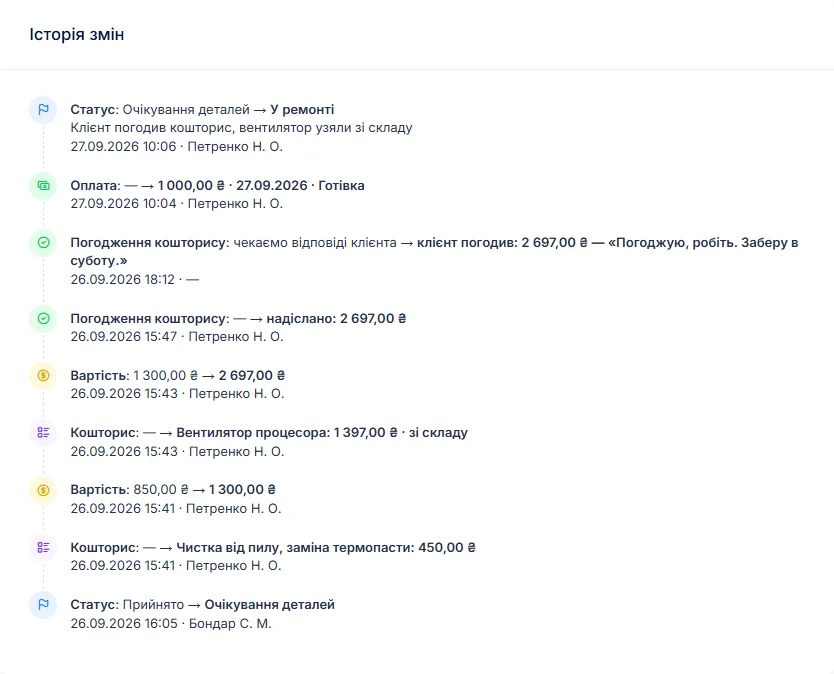
A cracked top, a broken headstock, a full refret — the customer should know the price before you start. The ticket moves to “awaiting approval” and the itemised estimate goes out by email or Telegram. The link shows every line with “I agree” and “I decline” buttons, and the answer and date land in the ticket history. Find halfway through that the bridge needs regluing too? Add a line and send it for approval again.
If you charge for assessing a vintage instrument even when the owner says no, give the device type a diagnostics price and switch the ticket’s base to “diagnostics only” — the amount is on the ticket from day one.
Deposits on refrets and pickups
A ticket can take several payments. Setups are usually paid on pickup; for a refret or a set of pickups you take a deposit, because the wire and parts are bought for that particular guitar. Record it at intake and the ticket shows “received” and “balance due”; at collection the balance is filled in for you. The “unpaid” filter lists everything handed over but not paid, and the customer card shows what they owe across all tickets.
Humidity advice the customer takes home
Half of the seasonal repairs would never happen if guitars were stored properly. That is what the “Recommendations” field is for: “keep it in the case with a humidifier during heating season”, “not next to the radiator”, “check the neck relief again in spring”. Recommendations print on the completion report together with the estimate lines, the work log and the amount due, so the advice leaves the shop on paper. See the completion report page for how it looks.
Finished guitars and storage
When a guitar is ready, the customer gets an email or a Telegram message; it can be sent again, at most once a day. Details are on the customer notifications page. Customers can also check the repair status themselves in the customer area, with the login printed on their ticket.
Every finished instrument shows how many days it has been waiting. You set a free storage period in the settings; once it passes, the counter turns red and a “past free storage” tile gathers those instruments together.
Put your storage terms — how long instruments are kept free and what happens after — in the ticket text the customer signs. What you may do with an uncollected instrument, and when, depends on the law where you trade and on the terms the customer accepted. The software only counts the days; if in doubt, ask a lawyer.
Stock: strings, fret wire, nut blanks
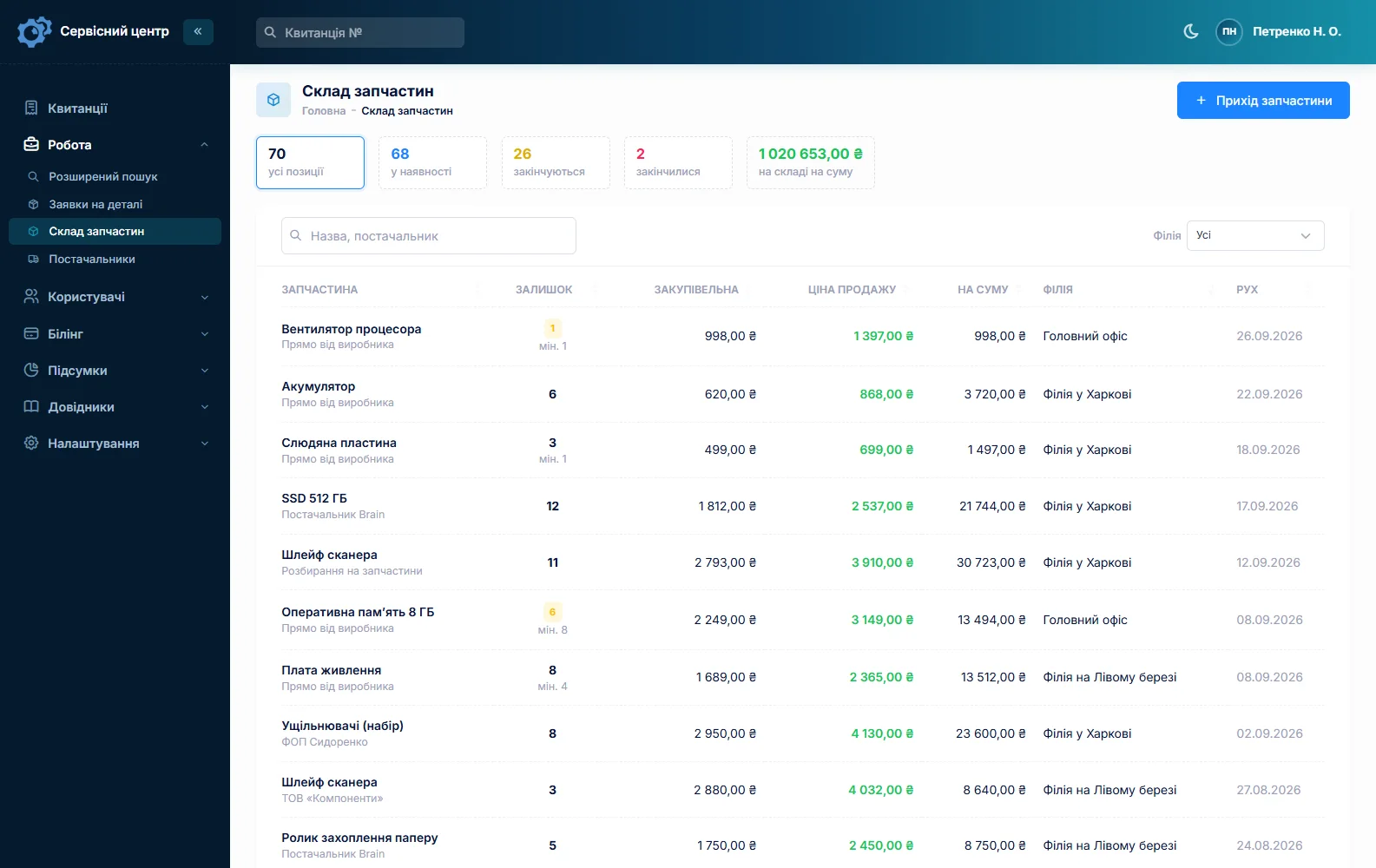
Stock is a movement journal: receipts with cost price and supplier, items used on a job as estimate lines, returns and stocktakes. Typical lines are string sets (one item per gauge), fret wire, nut and saddle blanks, tuners, pickups, pots, jacks, switches, strap buttons and batteries for active electronics. Add an item to an estimate and the quantity on hand drops; a minimum level and the “running low” tile tell you when to reorder. Quantities are whole numbers, so count fret wire in neck-sized sets rather than inches.
More than one person at the bench
If several people share the bench, each ticket shows who did the work, and reports for a period show jobs handed over and takings — overall and per person, with the list of works.
What guitar repairs typically cost
A rough guide only — prices vary by country, instrument and condition: setup €50–90, restring with basic adjustment €20–40 plus strings, fret level, crown and polish €120–250, full refret €300–550, new bone nut €60–120, bridge reglue €100–200, top crack repair €80–250, headstock break repair €150–400, pickup install €40–90 plus the pickup, pot or jack replacement €25–60. You set your own prices in the “Works” list and estimate lines.
What it does not have
- photos, audio clips or file attachments on a ticket;
- SMS, a mobile app, or online payment by the customer;
- integrations with suppliers.
What it costs
One price for the whole shop — no extra charge for staff or branches.
Monthly
Paid every month, cancel whenever you like.
Yearly
Cheaper than paying monthly. Invoice or card payment.
Custom work
Changes tailored to the way you work — hourly, by agreement.
Off-the-shelf not enough — your own forms, roles, reports or workflow? We will build a program for you. How it works
Try it without signing up in the demo: book in an acoustic guitar with its case and capo, add a setup and a set of strings to the estimate and send it for approval.

We are very happy working with servicecentersoft.com: they built everything we asked for, even though our request was unusual, since we deal with medical devices. Everything was done precisely and on the agreed schedule. Thank you for the cooperation — we keep working together.

I tried the ServiceCenterSoft demo and came away with a good impression. The program is simple and easy to understand, yet it has everything you need for the job: customers, repairs, devices, spare parts, statuses and statistics.
I especially liked the dark theme and the responsive design — working from a phone is perfectly comfortable. Another plus is the instant search that works as you type, so you don't have to press a separate "Search" button every time.
You can tell the program was built specifically for service centers rather than being a generic CRM adapted for the repair business. The interface has no unnecessary frills; everything is logical and to the point.
A good, practical tool for the day-to-day work of a service center.

I liked that you get a free 14-day trial and that they are willing to handle my special requests — setting things up exactly the way I need them.
I also liked how payment works. You can simply pay the monthly fee by card online — basically the same as a regular Spotify subscription or any other service. No separate contracts to sign and no invoices to pay manually.
And there's no feeling of strict limits on the number of employees. One service center is one account, and inside it you can organize the work of your technicians and run several branches.
For me this is far more convenient than plans where you have to pay for every single user or keep counting how many employees are working today.

My business is fairly specific, so the program's standard features weren't enough — I needed my own custom fields, my own sorting options and search by additional parameters. The work completion certificate and the printed repair receipt also needed some changes to fit the way we work.
I contacted technical support. To be honest, I expected changes like these to take a long time, but everything was done within a single day. The team quickly understood exactly what we needed, suggested the right solution and did everything properly.
I'd especially like to mention the support: they get straight to the point, with no unnecessary bureaucracy, and they genuinely help instead of just sending you off to read the documentation.
For me this is a big advantage of the program: it isn't just sold "as is" — it can be adapted to how you actually work. Thanks to the team for the quick response and for treating the customer right.
Highly recommended!
In short
- One ticket per guitar, with serial number, finish condition and case contents signed for.
- A works price list with separate prices for acoustic, classical, electric and bass.
- Cracks, refrets and headstocks — estimate approval by link.
- Deposits and balances as separate payments.
- Humidity advice printed on the completion report.
- “Ready” by email and Telegram, a day counter for uncollected instruments.
- Strings, fret wire and pickups in stock with minimum levels.
- €20 a month for the whole shop.
See also
Starting your own repair shop: where to begin
For people who can fix phones and laptops and want to work for themselves: what a small repair business needs on day one, the paperwork that protects you from the first customer, and how to run a shop in a country whose language is not your own.
Read moreSoftware for home appliance service
Contents recorded at intake, warranty at the brand price list, callouts, slow parts and partner shops.
Read morePhone repair shop software
Intake in a minute, screens and batteries tracked, a ready-for-pickup email, output per technician.
Read moreSee how it works
The demo is open — go in and try it. Ask us anything by email, Telegram or the form on this site.