Turbocharger repair software for turbo rebuild shops
For turbo rebuild shops: units from trade garages filtered by partner, inspection findings and failure cause in the work log, cartridges and balancing as estimate lines, exchange units and core charges handled through stock, warranty returns traced by serial number.
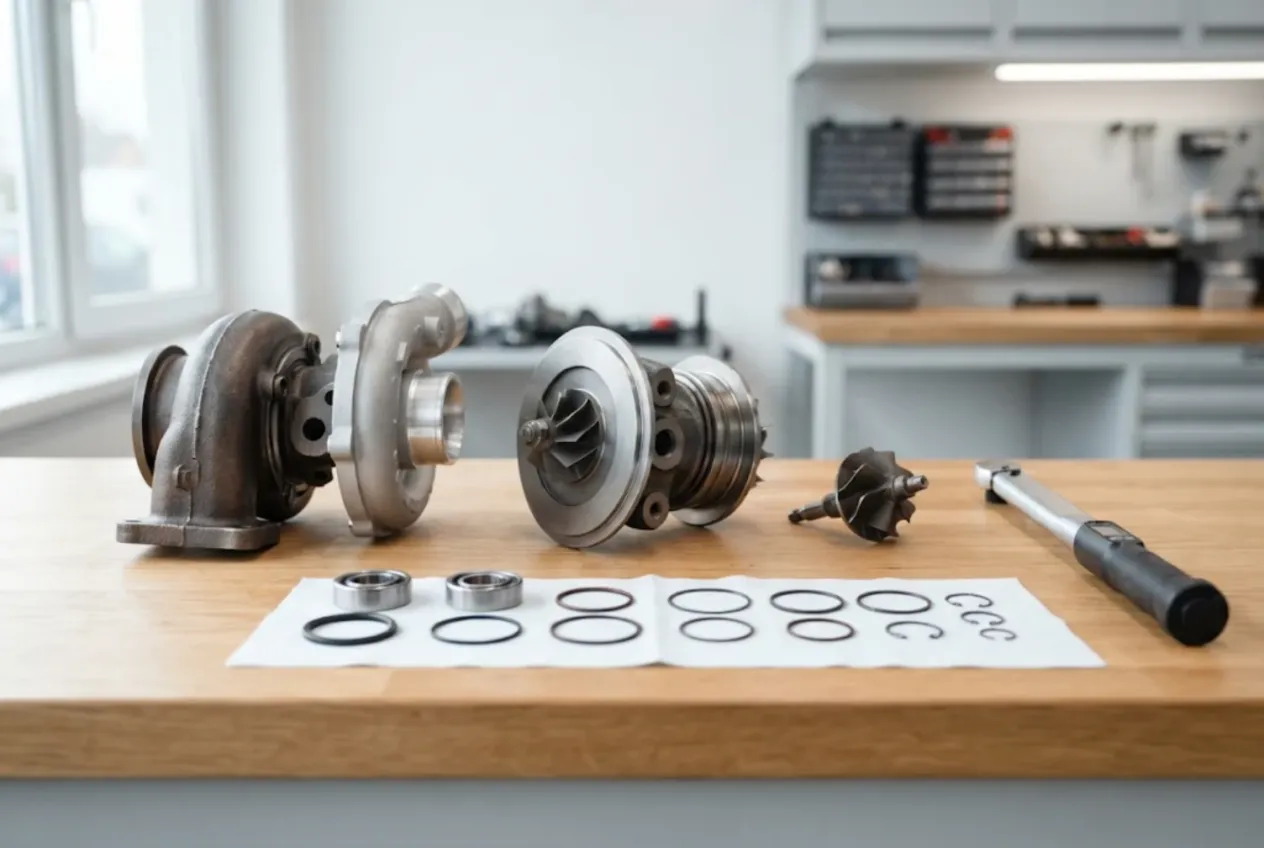
ServiceCenterSoft is job-tracking software for shops that rebuild and repair turbochargers — car, van, truck, marine and agricultural. Every turbo gets a ticket with a number, a promised date, an itemised estimate and a history: what the teardown showed, which parts went in, how it was balanced, who collected it and on what terms. It runs in the browser, on the PC next to the balancer and on a phone.
Who it is for, and where it goes wrong
Most of your work arrives as a bare unit, not a car. Much of it comes from trade customers — independent garages and fleet workshops dropping off two or three turbos a day — plus DIY owners who pulled the unit themselves and farms with a tractor waiting. The vehicle is off the road until the turbo goes back on, so “when will it be ready?” is a daily call.
The familiar trouble spots:
- two identical turbos from two garages sit side by side and get swapped at collection;
- the teardown findings — worn bearings, wheel rub, shaft play — exist only in the rebuilder’s head;
- an exchange unit went out the door and the customer’s core never came back;
- a turbo returns under warranty a month later, the real cause is oil starvation, and there is nothing on paper to show it;
- the cartridge you need is out of stock on the day you need it;
- a garage owes for several units and nobody can say which ones.
Intake: part number, serial number, engine
Equipment types are your own list — “Turbo, passenger car”, “Turbo, VNT”, “Turbo, heavy duty”, “Turbo, agricultural” — each with its own inspection fee. The model field holds the make and type, the serial number comes off the nameplate, and the manufacturer’s part number goes into the product code field. Advanced search finds every job with that number, so you can see what usually goes wrong with that unit.
There is no dedicated VIN or engine field; type them into the fault description or the technician notes: “2.0 diesel, 175k miles, blue smoke, whistle, loss of boost”. Condition covers oil residue, damaged flanges, a broken actuator; accessories lists actuator, sensor, hoses and gaskets if they came in. All of it prints on the ticket the customer signs.
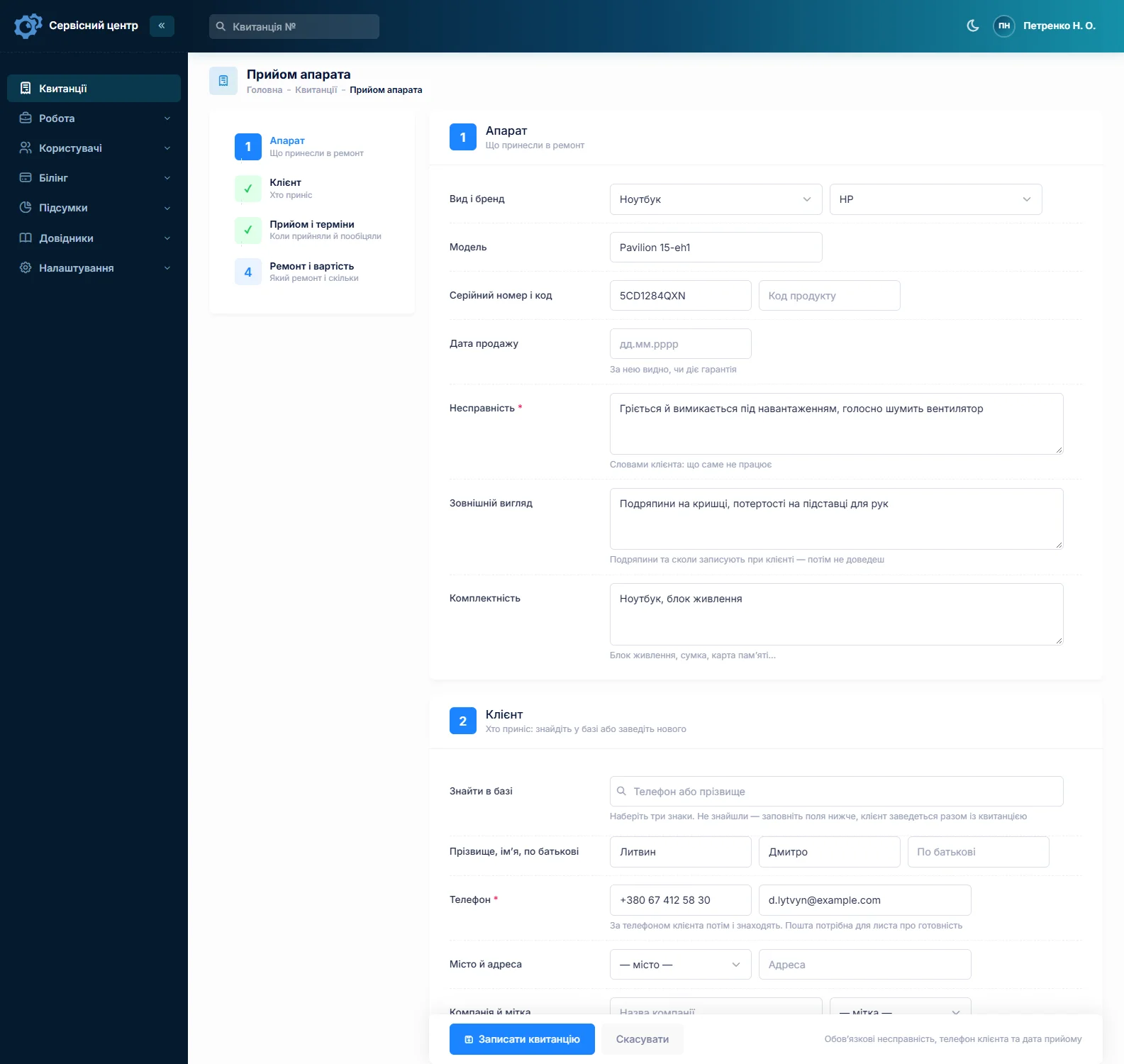
Three turbos from one garage? The second and third tickets are copies of the first; only the serial number changes.
Trade customers and partners
A garage can be a customer, with its name in the company field, or a partner set on each ticket. Filtering the job list by partner shows how many units came from that garage, where each one stands and what is ready to collect. The customer record shows every ticket, payment and balance owed. The same set-up for ECU work is described on the auto electronics repair software page.
A “ready” message goes out by email or Telegram, and each finished unit shows how many days it has been waiting. When a garage rings, a search by serial number or company name brings up the status and the latest comment.
Teardown, cartridge and balancing
After stripping the unit, the rebuilder writes the findings into the work log: “shaft play, compressor wheel rub, coked oil feed”. Then the estimate, line by line: “CHRA cartridge” from stock, “high-speed balance”, “VNT geometry and actuator set-up”, “rebuild kit”. Labour comes from your price list, parts come from stock with the quantity on hand.
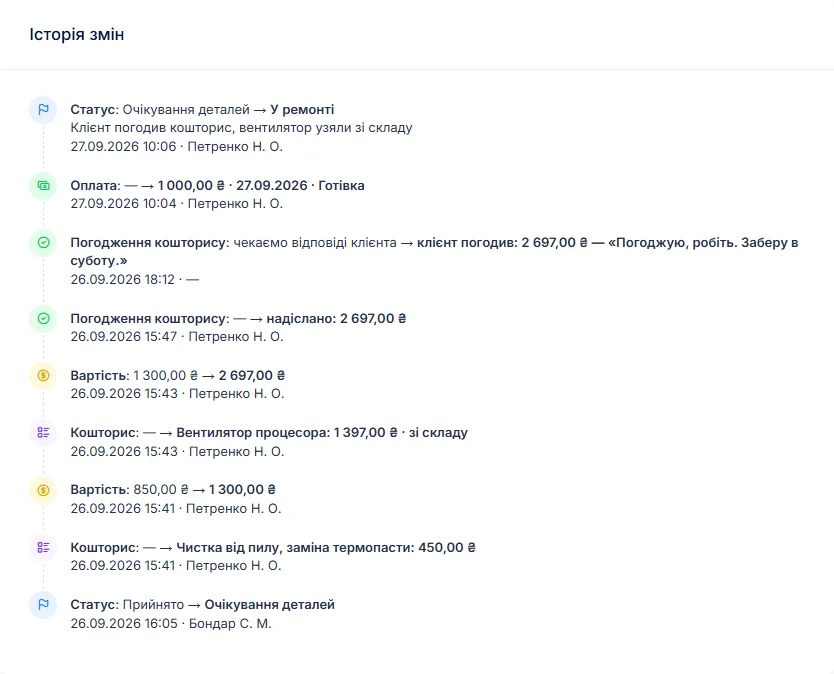
For a big job the estimate goes to the customer by email or Telegram first. The link shows every line with “I agree” and “I decline” buttons, and the answer lands in the ticket history with its date. Approved by phone? Add it as a comment on the status change. Declined? Switch the ticket’s base to “diagnostics only” so the inspection fee is what appears on the paperwork.
About the balancer: the software is not connected to your balancing machine and does not store its reports or photos. Note the result as a line in the work log and keep the printout with your paperwork.
Exchange units and core charges
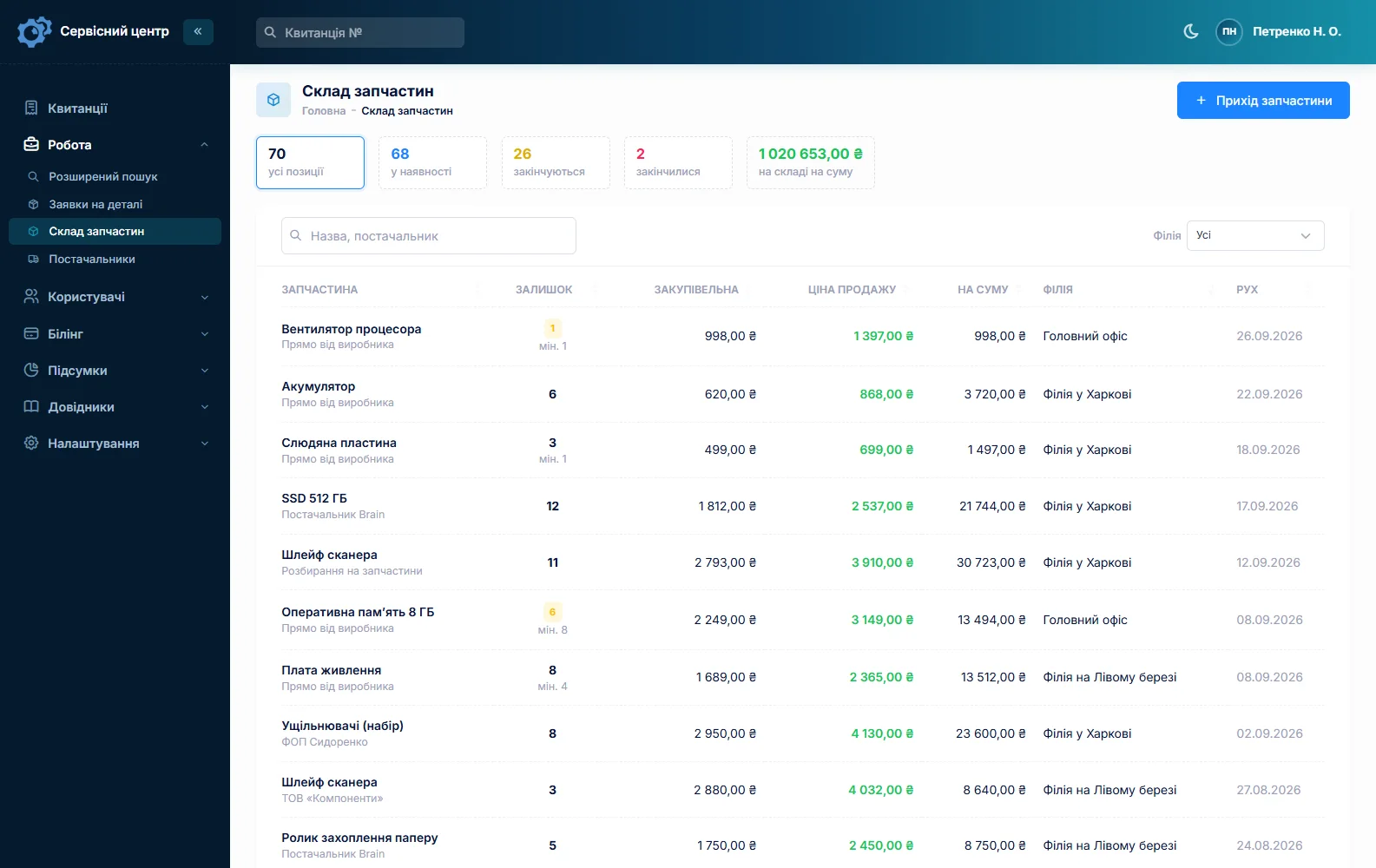
There is no separate exchange module, but the stock journal handles it. Set up rebuilt units as stock items — “Turbo 2.0 diesel, remanufactured, exchange” — booked in with their cost. When one goes to a customer, it is an estimate line from stock and the quantity on hand drops.
Note the customer’s old unit under accessories: “core returned for exchange, serial …”. If the core has not arrived yet, add a “core charge” line to the estimate; when the core comes in, remove the line, and the change stays in the ticket history. A core you rebuild is booked back into the same stock item; one beyond saving is written off with a reason.
Cartridges, bearings, seals, actuators and kits live in the same stock, each with a minimum level and a “running low” tile. A parts request can be emailed to your supplier straight from the ticket. More on spare parts tracking.
Warranty terms the customer actually gets
Most rebuilt turbos that fail were killed by something else: old oil left in, a blocked drain, a split intercooler hose, debris in the intake, excessive crankcase pressure. So your warranty conditions need to be in writing.
You edit the wording of the ticket and the completion report yourself under “Print forms”: oil and filter change, a new oil feed line, drain and intake checks. Advice for that particular engine goes into the recommendations field, which prints on the report the customer receives. See the page on the certificate of completed repair work.
Your own warranty and the buyer’s statutory rights are separate things. You set the terms of your warranty; what the law requires where you trade is worth checking on its own.
Warranty returns with the evidence attached
When a turbo comes back, open a new ticket with the “Warranty” or “Repeat repair” type. A search by serial number pulls up the original job: what was replaced, what was recommended, when it left. The rebuilder records the verdict in the work log — “carbon on shaft, signs of oil starvation, warranty claim not accepted” — and you can close it with your own status such as “Claim declined”, alongside the built-in “Repair refused” and “Beyond repair”.
Warranty and repeat tickets can be filtered in the job list. Reports do not break them out separately.
What turbo repairs typically cost
A rough guide only — it depends on the market, the unit and its condition: inspection €30–80, rebuild with kit and balancing €150–350, cartridge replacement on a car turbo €250–600 including the part, VNT set-up €50–120, heavy-duty units from about €600. You set your own prices.
Take a deposit on an expensive cartridge: a ticket can have several payments, and the “unpaid” filter shows work that went out unpaid.
If tractors and combines are part of your trade, see also agricultural machinery repair software.
What it does not have
- a dedicated exchange or core-tracking module — it runs through stock and estimate lines;
- VIN or engine fields — these are plain text;
- a link to the balancing machine, test reports or photos on a ticket;
- reports broken down by repair type — only a filter in the job list;
- SMS, a mobile app, online payment by the customer, supplier integrations.
What it costs
One price for the whole shop — no extra charge for staff or branches.
Monthly
Paid every month, cancel whenever you like.
Yearly
Cheaper than paying monthly. Invoice or card payment.
Custom work
Changes tailored to the way you work — hourly, by agreement.
Off-the-shelf not enough — your own forms, roles, reports or workflow? We will build a program for you. How it works
Try it without signing up in the demo: add a “Turbo, VNT” type, book a unit in with its part number in the product code, add a cartridge from stock and send the estimate for approval.

We are very happy working with servicecentersoft.com: they built everything we asked for, even though our request was unusual, since we deal with medical devices. Everything was done precisely and on the agreed schedule. Thank you for the cooperation — we keep working together.

I tried the ServiceCenterSoft demo and came away with a good impression. The program is simple and easy to understand, yet it has everything you need for the job: customers, repairs, devices, spare parts, statuses and statistics.
I especially liked the dark theme and the responsive design — working from a phone is perfectly comfortable. Another plus is the instant search that works as you type, so you don't have to press a separate "Search" button every time.
You can tell the program was built specifically for service centers rather than being a generic CRM adapted for the repair business. The interface has no unnecessary frills; everything is logical and to the point.
A good, practical tool for the day-to-day work of a service center.

I liked that you get a free 14-day trial and that they are willing to handle my special requests — setting things up exactly the way I need them.
I also liked how payment works. You can simply pay the monthly fee by card online — basically the same as a regular Spotify subscription or any other service. No separate contracts to sign and no invoices to pay manually.
And there's no feeling of strict limits on the number of employees. One service center is one account, and inside it you can organize the work of your technicians and run several branches.
For me this is far more convenient than plans where you have to pay for every single user or keep counting how many employees are working today.

My business is fairly specific, so the program's standard features weren't enough — I needed my own custom fields, my own sorting options and search by additional parameters. The work completion certificate and the printed repair receipt also needed some changes to fit the way we work.
I contacted technical support. To be honest, I expected changes like these to take a long time, but everything was done within a single day. The team quickly understood exactly what we needed, suggested the right solution and did everything properly.
I'd especially like to mention the support: they get straight to the point, with no unnecessary bureaucracy, and they genuinely help instead of just sending you off to read the documentation.
For me this is a big advantage of the program: it isn't just sold "as is" — it can be adapted to how you actually work. Thanks to the team for the quick response and for treating the customer right.
Highly recommended!
In short
- Part number in the product code, serial from the nameplate, engine as text.
- Garages as customers or partners, with a partner filter and balances on the record.
- Teardown and balancing in the work log, the cartridge as a line from stock.
- Exchange units as stock items, the core charge as an estimate line.
- Warranty terms in your print forms, engine-specific advice on the report.
- Returns traced by serial number, the cause in the log, your own status.
- €20 a month for the whole shop.
See also
Diesel injector repair software for fuel injection shops
For diesel fuel injection specialists: a full set of injectors from one engine on a single ticket with a result for each, test bench readings in the work log, trim codes on the completion report, batches from garages, nozzles and valves in stock.
Read moreStarting your own repair shop: where to begin
For people who can fix phones and laptops and want to work for themselves: what a small repair business needs on day one, the paperwork that protects you from the first customer, and how to run a shop in a country whose language is not your own.
Read moreSoftware for home appliance service
Contents recorded at intake, warranty at the brand price list, callouts, slow parts and partner shops.
Read moreSee how it works
The demo is open — go in and try it. Ask us anything by email, Telegram or the form on this site.