Steering rack repair software for rack and power steering shops
For shops that rebuild steering racks, power steering pumps and EPS units: racks from trade garages filtered by partner, test-bench results in the work log, bushes and seal kits in stock, exchange racks and core charges, warranty terms on the completion report.
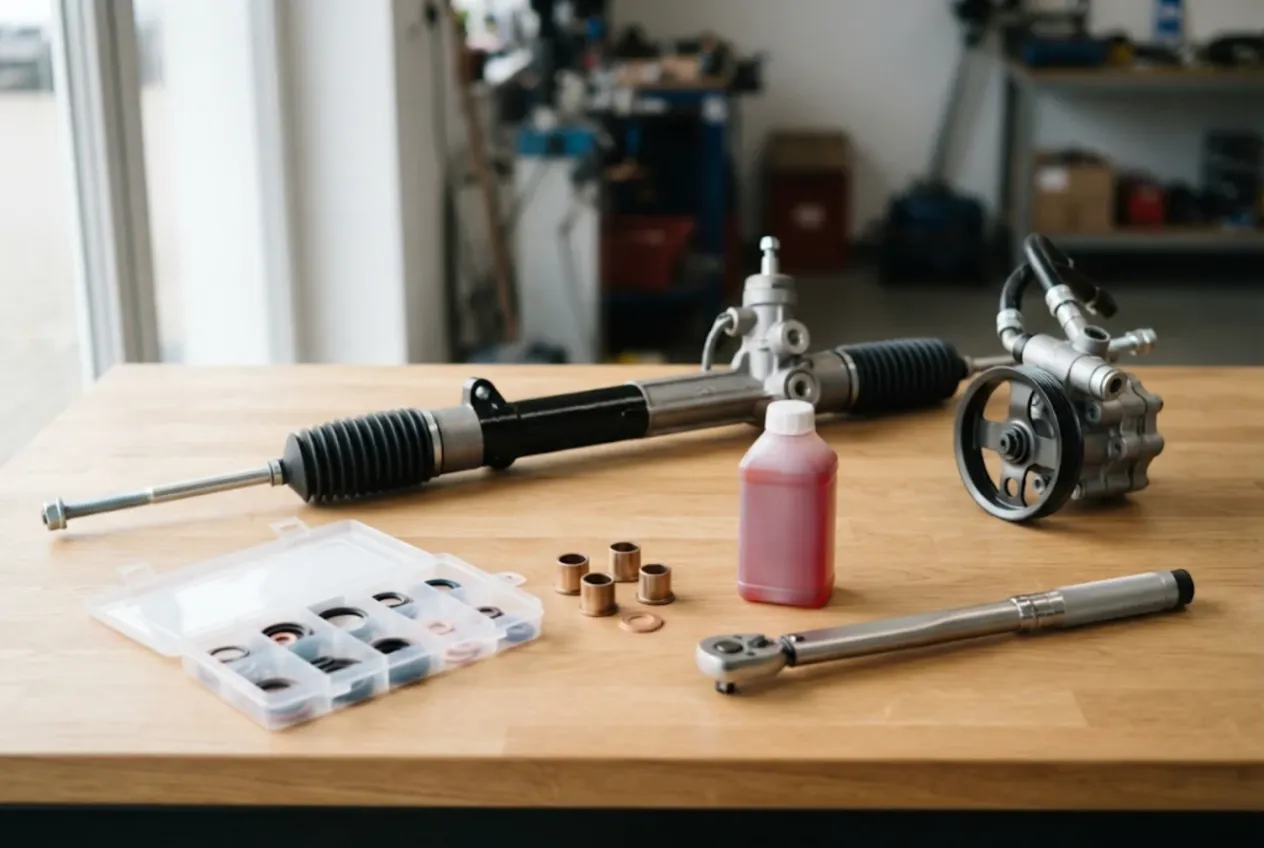
ServiceCenterSoft is job-tracking software for shops that remanufacture steering racks — hydraulic and electric — along with power steering pumps, electro-hydraulic pumps and EPS columns. Every unit gets a ticket with a number, a promised date, an itemised estimate and a history: what the test bench showed, which bushes and seals went in, who collected it and under what warranty terms. It runs in the browser, on the workshop PC and on a phone.
Who it is for
A rack shop rarely sees the car. The unit arrives on the bench already removed — mostly from independent garages and fleet workshops, sometimes from a DIY owner, sometimes by courier from another town. Meanwhile the car sits on a ramp somewhere, so the garage rings every day. Whether you can give a date usually depends on one thing: whether the right bush and seal kit are on your shelf.
The familiar trouble spots:
- two identical racks from two garages get swapped at collection;
- the rack was rebuilt but the pump that was shedding metal stayed in, and the rack is back a month later as a “warranty claim”;
- an exchange rack went out and the core never came back;
- the rack is stripped and the bush for that model is out of stock;
- nobody did the alignment or the EPS calibration after fitting, and the rack gets the blame;
- a garage owes for several units and nobody can say which.
Intake: hydraulic rack, EPS rack, pump
Equipment types are your own list — “Rack, hydraulic”, “Rack, EPS”, “Pump, PAS”, “Pump, electro-hydraulic”, “Column, EPS” — each with its own diagnostic fee, because a bench test on a hydraulic rack and fault-finding on an electric one are different jobs. The model field takes the maker and the vehicle, the serial comes off the housing, and the manufacturer’s part number goes into the product code. Advanced search finds every rack with that number you have handled before.
There is no dedicated VIN or vehicle field; type them into the fault description or the technician notes: “Ford Focus 2012, knock on the left over bumps, heavy at low speed”. Condition covers split boots, fluid on the housing, a pitted bar; accessories lists tie rods, track rod ends, the connector and sensor if they came in. All of it prints on the ticket the customer signs.
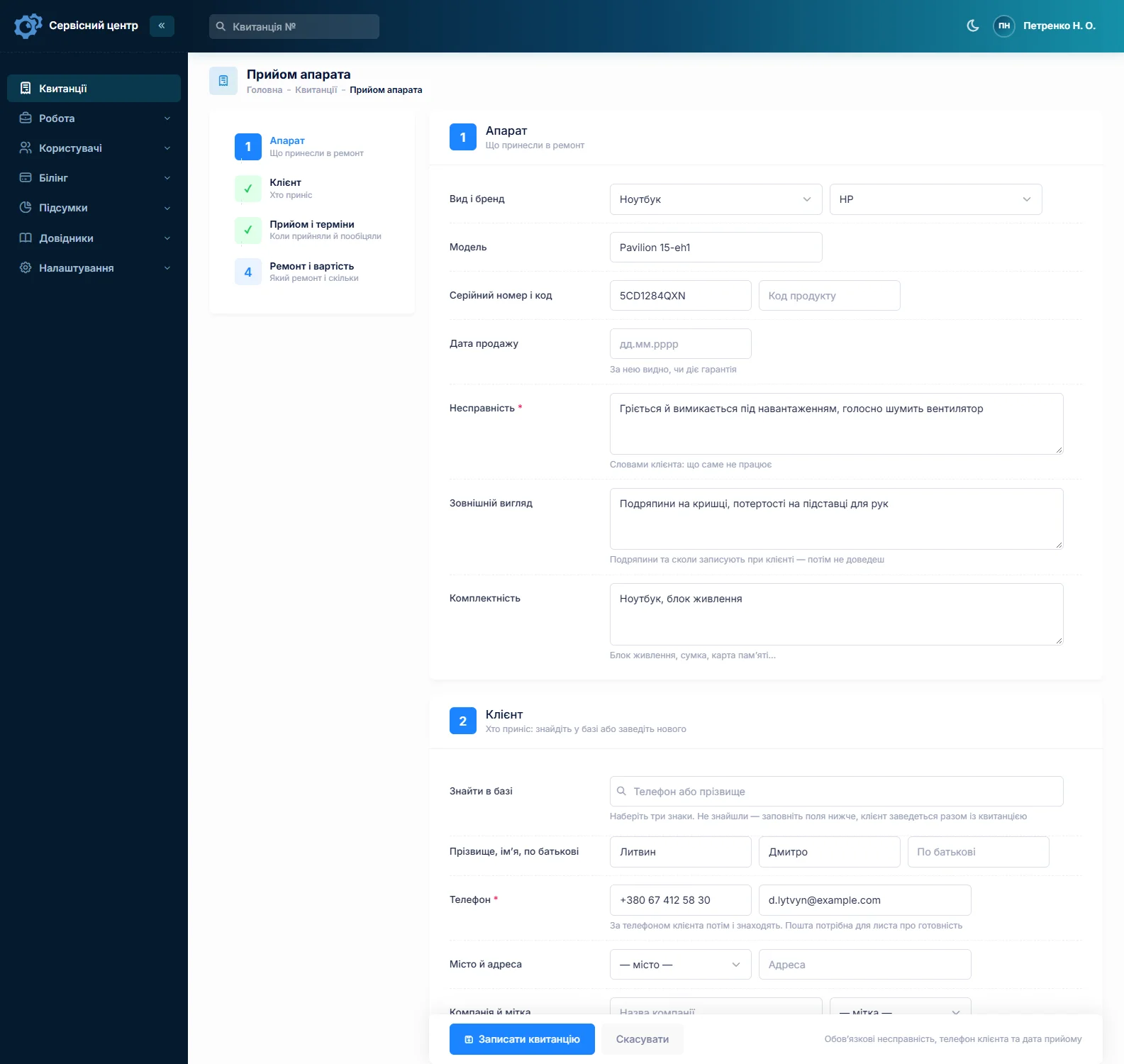
Rack and pump arrived together? Book them as two tickets — the second as a copy of the first, with only the serial number changed — so each unit has its own status and estimate.
Trade customers and partners
A garage can be a customer with its name in the company field, or a partner set on each ticket. Filtering by partner shows how many units came from that garage, where each one stands and what is ready to collect; the customer record shows every ticket, payment and balance owed. A “ready” message goes out by email or Telegram, and each finished rack shows how many days it has been waiting. If an EPS fault turns out to be the control module itself, see auto electronics repair software.
Bench test, strip-down and estimate
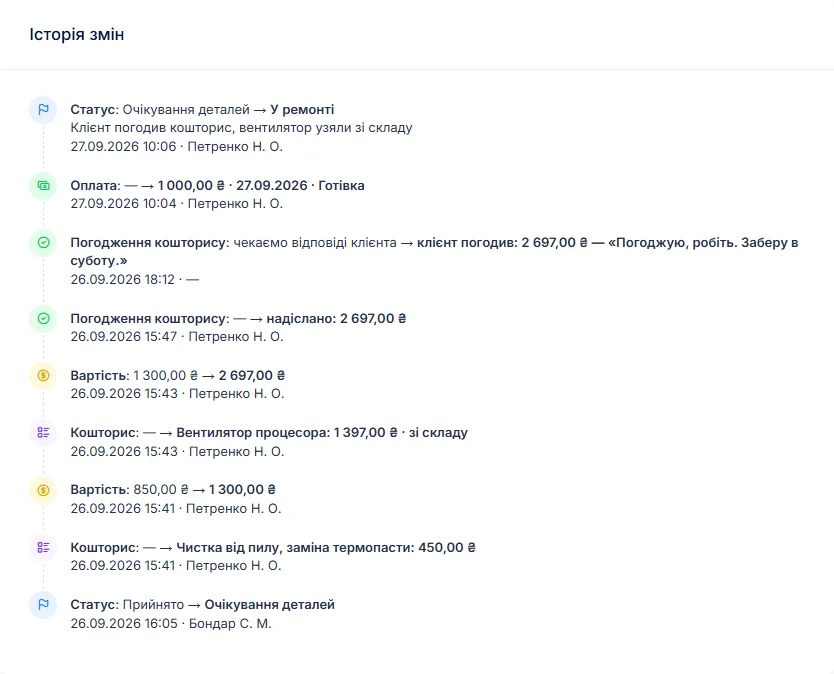
After testing and stripping the unit, the technician writes the findings into the work log: “bar bush worn, scoring in the cylinder, valve seal leaking, pinion play”. Then the estimate, line by line: “seal kit” and “bar bush” from stock, “rack rebuild” and “bench test” from your labour list, “inner tie rod” if the customer wants it replaced.
For a big job the estimate goes to the customer by email or Telegram first. The link shows every line with “I agree” and “I decline” buttons, and the answer lands in the ticket history with its date. Approved by phone? Add a comment to the status change. Declined? Switch the ticket’s base to “diagnostics only” so the test fee is what appears on the paperwork.
About the test bench: the software is not connected to it and does not store bench reports or photos. Write the result as a line in the work log — “holds pressure, no leaks, even effort both ways” — and it prints on the completion report.
Bushes, seals, exchange racks and cores
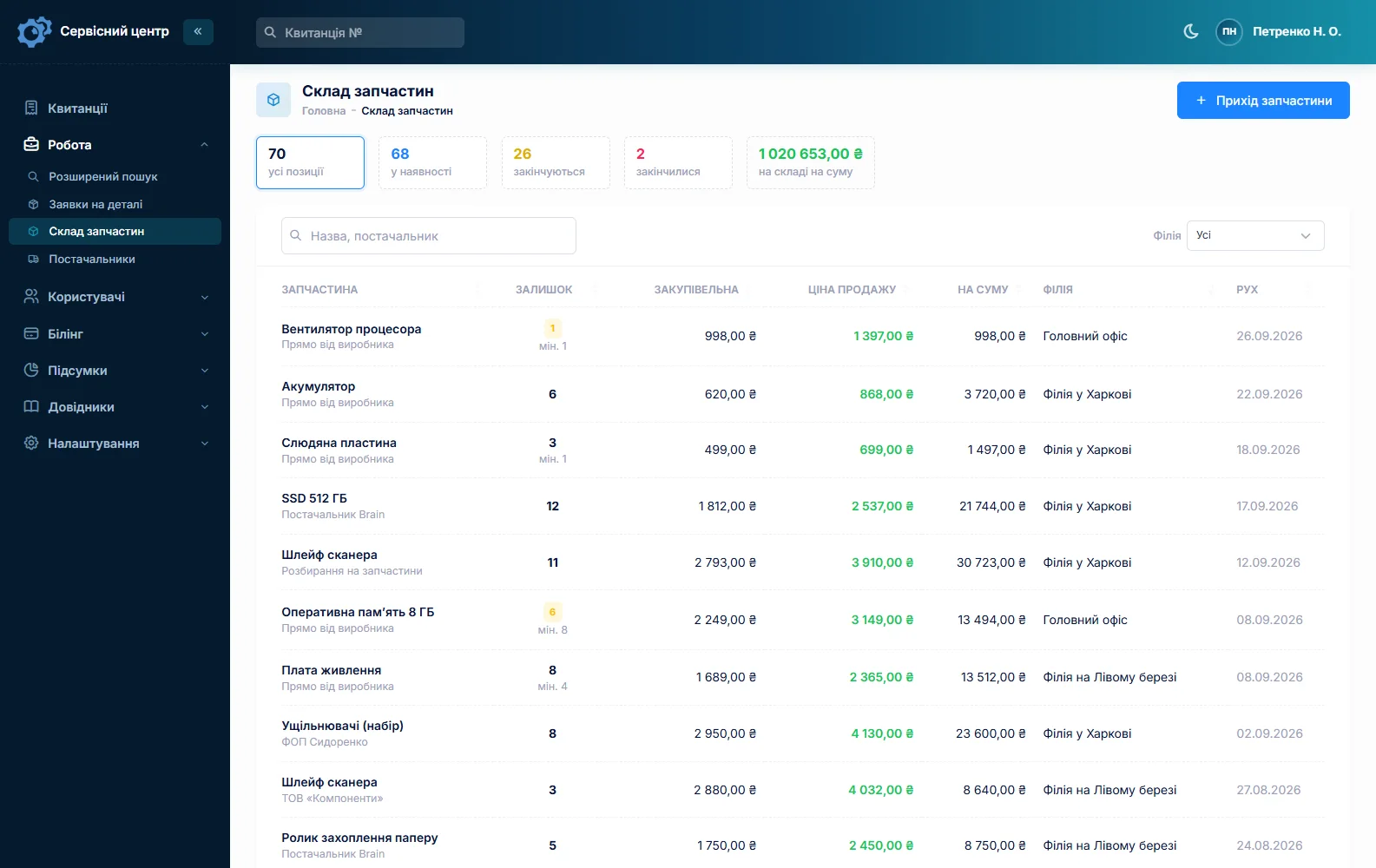
Stock is a movement journal: goods in, issued to a job, returned, written off with a reason, stock-take. Seal kits, bushes, boots, tie rods, rod ends and pump internals are items with a minimum level; a “running low” tile tells you what to reorder, and a parts request can be emailed to your supplier from the ticket. Quantities are whole numbers, so keep fluid by the bottle or the can. More on spare parts tracking.
Many rack shops run on exchange units with a core charge. There is no dedicated exchange module: remanufactured racks are stock items, the customer’s old unit goes under accessories, and an outstanding core is an estimate line you remove when it arrives. The same set-up is described in detail on the turbocharger repair software page.
The rack and the pump are one system
A worn pump sends debris that kills a fresh rack within weeks; a tight rack overloads a new pump. Ask about the other half of the system at intake, and put it in the recommendations: “flush the system, new fluid and filter, check the pump”. Recommendations print on the completion report the customer receives.
Electric racks add one more step: after fitting, the garage has to calibrate the steering angle sensor and code the rack with a scan tool. The software does not do this and never talks to the vehicle, but a line on the report saying “calibration and wheel alignment required after fitting” settles most arguments before they start. If you also rebuild cylinders and pumps for plant and farm machinery, see hydraulics repair software.
Warranty and returns
You edit the wording of the ticket and the report yourself under “Print forms”: fluid change, alignment after fitting, EPS calibration, a healthy pump. Your own warranty and the buyer’s statutory rights are separate things; you set your terms, and what the law requires where you trade is worth checking on its own.
When a rack comes back, open a new ticket with the “Warranty” or “Repeat repair” type. A search by serial number pulls up the original job. The technician records the verdict in the work log — “metal in the fluid, pump not replaced” — and you can close it with a status of your own such as “Claim declined”. Warranty and repeat tickets can be filtered in the job list; reports do not break them out separately.
What rack and pump repairs typically cost
A rough guide only — it depends on the market, the vehicle and the condition: diagnosis €40–90, hydraulic rack rebuild €200–450, EPS rack €300–700, power steering pump €100–250, exchange units more by the value of the core. You set your own prices. Take a deposit on big jobs: a ticket can carry several payments, and the “unpaid” filter shows work that left without being paid for.
What it does not have
- a dedicated exchange or core-tracking module — it runs through stock and estimate lines;
- VIN or vehicle fields — these are plain text;
- a link to the test bench, bench reports, photos or files on a ticket;
- EPS calibration or coding — that is the garage’s scan tool;
- SMS, a mobile app, online payment by the customer, supplier integrations.
What it costs
One price for the whole shop — no extra charge for staff or branches.
Monthly
Paid every month, cancel whenever you like.
Yearly
Cheaper than paying monthly. Invoice or card payment.
Custom work
Changes tailored to the way you work — hourly, by agreement.
Off-the-shelf not enough — your own forms, roles, reports or workflow? We will build a program for you. How it works
Try it without signing up in the demo: add a “Rack, EPS” type, book a rack in with its part number in the product code, add a seal kit from stock and send the estimate for approval.

We are very happy working with servicecentersoft.com: they built everything we asked for, even though our request was unusual, since we deal with medical devices. Everything was done precisely and on the agreed schedule. Thank you for the cooperation — we keep working together.

I tried the ServiceCenterSoft demo and came away with a good impression. The program is simple and easy to understand, yet it has everything you need for the job: customers, repairs, devices, spare parts, statuses and statistics.
I especially liked the dark theme and the responsive design — working from a phone is perfectly comfortable. Another plus is the instant search that works as you type, so you don't have to press a separate "Search" button every time.
You can tell the program was built specifically for service centers rather than being a generic CRM adapted for the repair business. The interface has no unnecessary frills; everything is logical and to the point.
A good, practical tool for the day-to-day work of a service center.

I liked that you get a free 14-day trial and that they are willing to handle my special requests — setting things up exactly the way I need them.
I also liked how payment works. You can simply pay the monthly fee by card online — basically the same as a regular Spotify subscription or any other service. No separate contracts to sign and no invoices to pay manually.
And there's no feeling of strict limits on the number of employees. One service center is one account, and inside it you can organize the work of your technicians and run several branches.
For me this is far more convenient than plans where you have to pay for every single user or keep counting how many employees are working today.

My business is fairly specific, so the program's standard features weren't enough — I needed my own custom fields, my own sorting options and search by additional parameters. The work completion certificate and the printed repair receipt also needed some changes to fit the way we work.
I contacted technical support. To be honest, I expected changes like these to take a long time, but everything was done within a single day. The team quickly understood exactly what we needed, suggested the right solution and did everything properly.
I'd especially like to mention the support: they get straight to the point, with no unnecessary bureaucracy, and they genuinely help instead of just sending you off to read the documentation.
For me this is a big advantage of the program: it isn't just sold "as is" — it can be adapted to how you actually work. Thanks to the team for the quick response and for treating the customer right.
Highly recommended!
In short
- Hydraulic racks, EPS racks and pumps as separate types, each with its own diagnostic fee.
- Part number in the product code, vehicle and VIN as text.
- Garages as partners, with a partner filter and balances on the record.
- Bench results in the work log, bushes and kits as lines from stock.
- Exchange racks as stock items, the core charge as an estimate line.
- Flush, alignment and calibration in the recommendations and your warranty terms.
- €20 a month for the whole shop.
See also
Lab equipment repair software
For service businesses repairing centrifuges, pipettes, analysers and moisture analysers: labs and universities as customers, bench work and site visits, pipette batches, results on the work report, routine servicing kept in order.
Read moreStarting your own repair shop: where to begin
For people who can fix phones and laptops and want to work for themselves: what a small repair business needs on day one, the paperwork that protects you from the first customer, and how to run a shop in a country whose language is not your own.
Read moreSoftware for home appliance service
Contents recorded at intake, warranty at the brand price list, callouts, slow parts and partner shops.
Read moreSee how it works
The demo is open — go in and try it. Ask us anything by email, Telegram or the form on this site.