Pressure washer repair software for service shops and car wash equipment
For pressure washer repair shops and car wash equipment service: consumer units across the bench, commercial machines where a down bay means lost takings, pump servicing with seal and valve kits from stock, estimate approval after freeze damage, and a history for every machine.
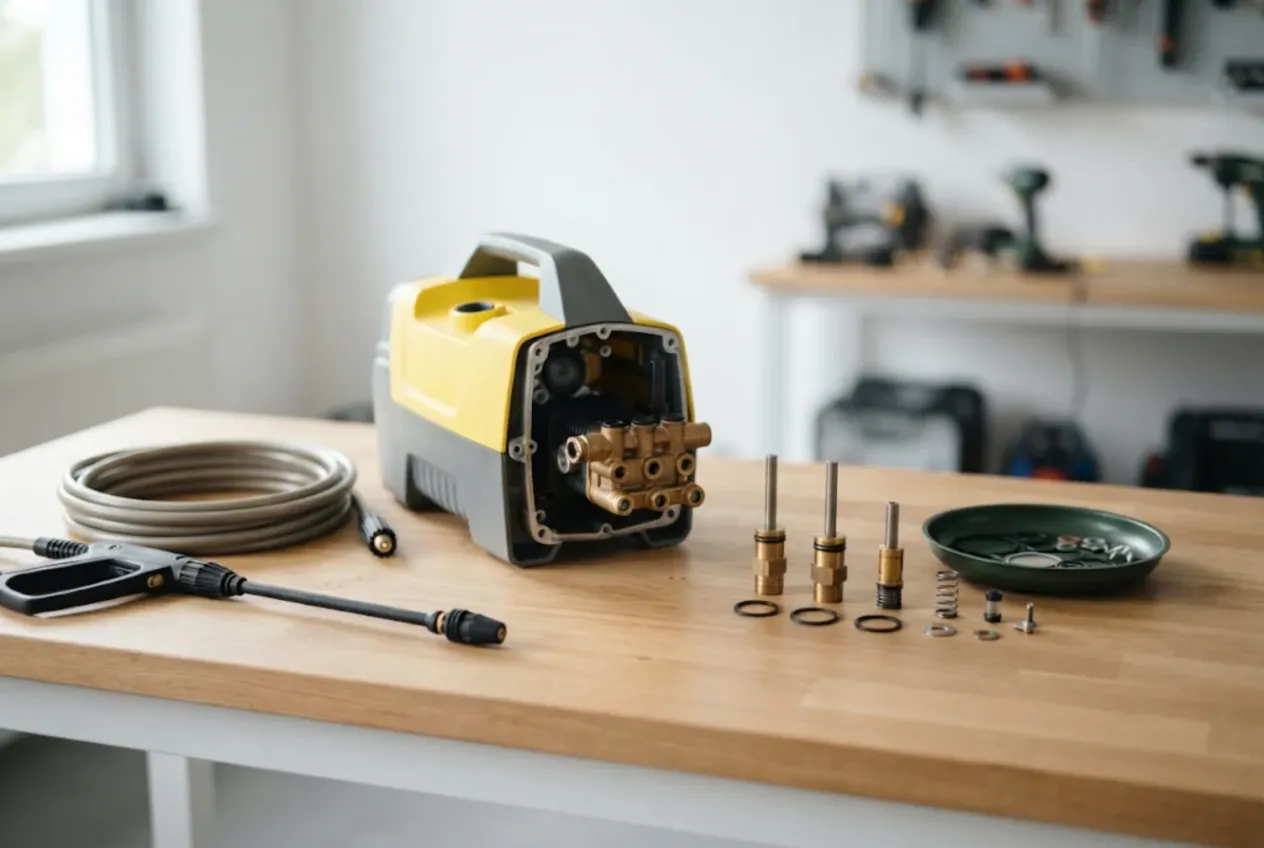
ServiceCenterSoft is job-tracking software for shops that repair and service pressure washers: homeowner units, commercial cold-water and hot-water machines, the pump stations of self-serve car washes, plus guns, hoses, lances and nozzles. Every machine gets a ticket with a number, a promised date, an itemised estimate and a history. It runs in the browser — on the workshop PC and on a phone standing in a wash bay.
Two kinds of customer, one workshop
A pressure washer repair shop serves two very different people. One is a homeowner with an electric washer that pulses, hums without spraying or leaks from under the cover. The machine was cheap, so the real question is whether it is worth fixing. The other runs a car wash, a detailing business or a cleaning contractor. For them a dead bay or a dead machine is revenue lost by the hour.
The usual trouble spots:
- a homeowner unit is stripped and a pump is ordered, then the customer says they would rather buy a new washer;
- a car wash has six bays and nobody can say which pump has had its packings replaced three times this year;
- what went into a pump last spring, and at what hours, lives in the head of a technician who is out on a call;
- the right seal kit runs out on the day a customer’s bay is down;
- in spring the freeze-damaged machines arrive all at once and the queue grows faster than the bench can clear it;
- the work at the car wash is finished, but the paperwork and the payment are still outstanding.
Homeowner washers: repair or replace
You find the customer by phone number and book the machine in within a minute. Equipment types are your own list — “Electric pressure washer”, “Gas pressure washer”, “Commercial cold water”, “Hot water unit”, “Car wash pump”, “Gun and hose” — and each type carries its own diagnostic fee. Serial number and date of purchase go on at intake: the date tells you whether the retailer’s warranty still applies, the serial number whether this machine has been in before.
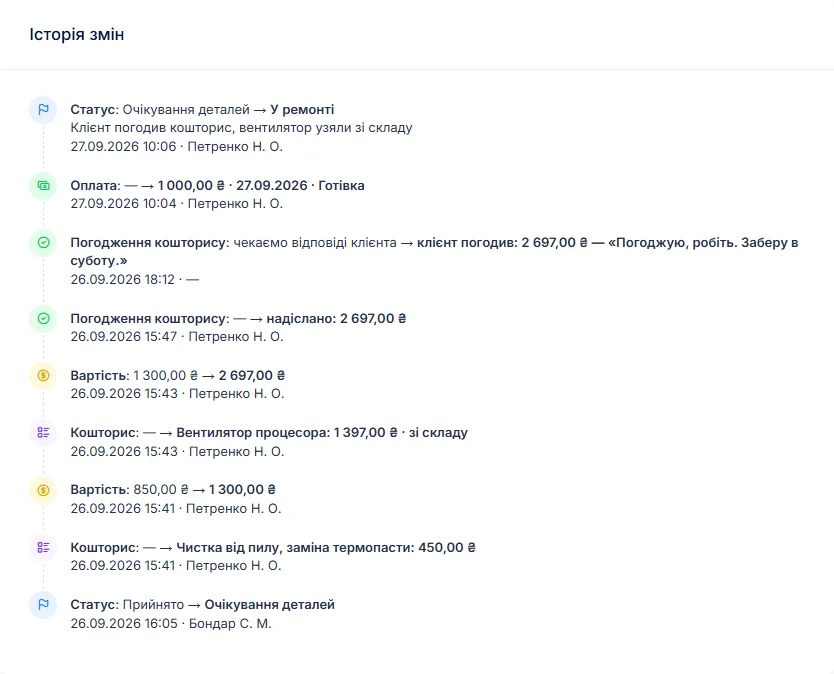
After diagnosis the technician builds the estimate line by line — “valve kit”, “seal replacement”, “complete pump” — the ticket moves to “Awaiting approval”, and the estimate goes out by email or Telegram. The link shows every line with “I agree” and “I decline” buttons, and the answer and date land in the ticket history. If the repair costs more than a new washer and the customer declines, switch the ticket’s base to “diagnostics only”: the diagnostic fee is what appears on the paperwork. The built-in statuses “Repair refused” and “Beyond repair” close such tickets.
Car wash customers: downtime and promised dates
Every ticket has a promised date. Overdue jobs turn red and gather under the “overdue” filter. A machine the car wash cannot operate without gets the urgent flag and stands out in the list. When the owner rings, a search by company name or serial number brings up the status and the latest comment.
For work done on site, add your own repair type — say “On site” — and your own statuses: “Visit booked”, “Repair in bay”, “Taken to workshop”, “Waiting for part”. Any status can sit as a tile above the list, so one click shows every site you still have to get to. The technician opens the ticket on a phone in the bay and writes into the work log what was found.
To be clear about call-outs: there is no visit calendar, map or route planning. You agree the time yourself and note it in the status comment; the site address sits on the customer record. Loan machines are not tracked either — if you leave one of yours at the wash, put it in the technician notes.
One car wash, several bays
The business name goes in the company field, and the customer record shows all their tickets, payments and any balance owed. Each machine gets its own ticket, and the product code field is a good place for the bay and the pump serial: “Bay 3, pump 1234567”. A search then returns the history of that exact pump — when the packings were done, which valves went in, what was recommended. If it leaks again soon after a repair, choose the “Repeat repair” type; those tickets can be filtered in the job list, though reports do not break them out separately.
A ticket can take several payments — a deposit on an expensive pump, the balance on completion. The “unpaid” filter lists finished work that has not been paid. Work done and recommendations print on the completion report, and you edit the wording of every document yourself under “Print forms”.
Pump service: seals, valves, plungers
The triplex plunger pump is the heart of a commercial pressure washer, and it needs regular attention. Here a pump service is an ordinary ticket: labour from your price list of standard jobs (“Pump service — packings and valves”) plus stock lines — seal kit, valve kit, plungers, pump oil. That set of lines is your service kit; next time, for the same pump, you add the same lines.
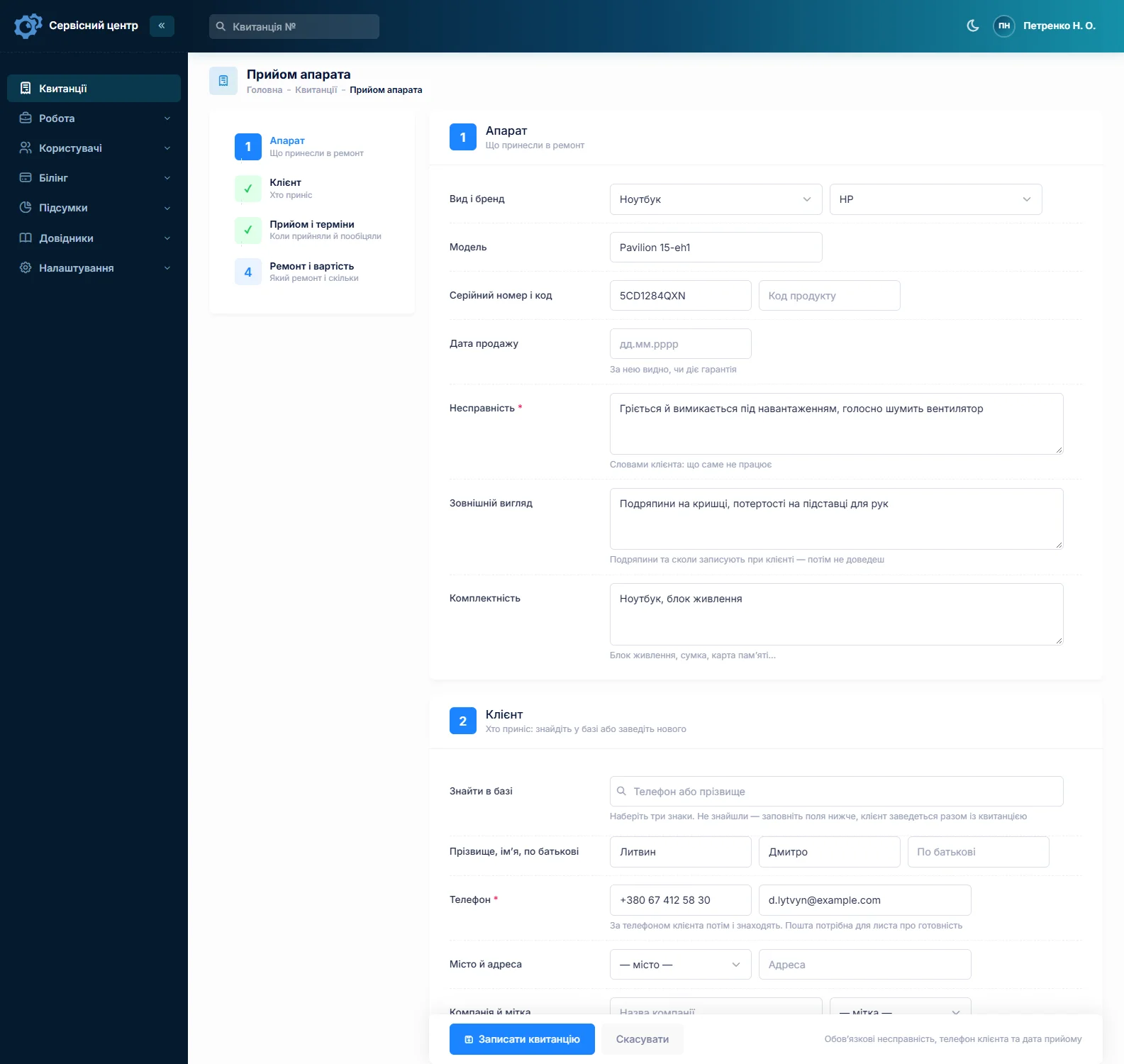
About hours: there is no dedicated hour-meter field. Type the reading into the fault field — “scheduled service, 1,850 hours” — and it prints on the ticket. What was done goes into the work log; when the next service is due goes into recommendations, which print on the completion report. There is no maintenance scheduler, no service reminders and no service-contract module. You keep the “who is due” list yourself, and wording the recommendation the same way every time lets the advanced text search find those tickets. The same approach is described on the air compressor repair software page.
If you also repair well and irrigation pumps, see pump repair software.
The season: freeze damage, then winterizing
Every spring brings the machines nobody drained in the autumn: a cracked manifold, a split valve chamber. That repair quickly approaches the price of a new pump, so the estimate needs approving before the part is ordered, not after.
In the autumn, winterizing becomes something you sell: drain, pump antifreeze, check the seals. Add it to your price list of standard jobs with a price per equipment type and offer it at collection. How small-engine shops use the same trick to even out the year is on the outdoor power equipment repair software page.
Hot-water units add a burner and a coil: nozzle and electrode service, descaling, flame and temperature sensors. On the ready shelf every machine shows how many days it has been waiting, and the “ready” message goes to the customer by email or Telegram.
Stock: kits and small parts
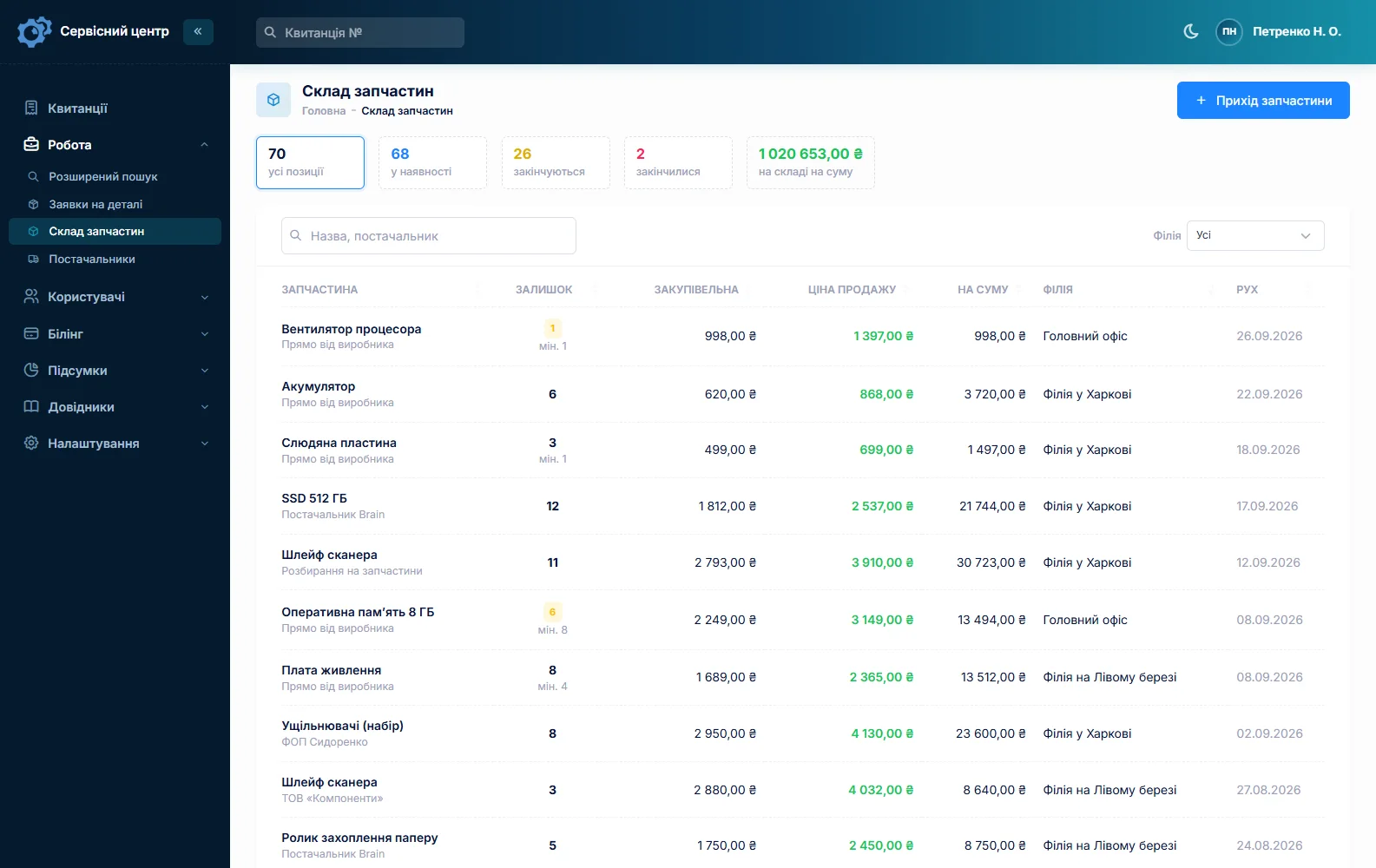
Stock is a movement journal: receipts with cost price and supplier, parts used on a job as estimate lines, returns, stocktakes. For a pressure washer shop that means seal kits, valve kits, plungers, unloaders, nozzles, guns, hoses, couplers, O-rings and inlet filters. Each item has a minimum level, and the “running low” tile tells you to reorder before the season starts. Quantities are whole numbers, so count oil by the bottle and hose by the cut length. A parts request can be emailed to your supplier from the ticket. More on spare parts tracking.
What pressure washer repairs typically cost
A rough guide only — it varies by region, machine class and pump condition: diagnosis €25–70, homeowner washer repair €40–150, commercial valve replacement €80–200, packing and seal replacement €120–350 plus kit, burner service €120–300, coil descaling €150–400, call-out €50–150, a pump head after freeze damage often from €500. You set your own prices.
Wastewater and cleaning chemicals at a car wash, electrical safety and periodic inspection of commercial machines are governed by local rules and are the equipment owner’s responsibility. The software does not track them.
What it does not have
- a maintenance scheduler or service reminders;
- a dedicated hour-meter field — readings are plain text;
- service contracts, a visit calendar or route planning;
- tracking of loan machines;
- fractional stock quantities;
- photos or file attachments on a ticket;
- SMS, a mobile app, online payment by the customer, supplier integrations.
What it costs
One price for the whole shop — no extra charge for staff or branches.
Monthly
Paid every month, cancel whenever you like.
Yearly
Cheaper than paying monthly. Invoice or card payment.
Custom work
Changes tailored to the way you work — hourly, by agreement.
Off-the-shelf not enough — your own forms, roles, reports or workflow? We will build a program for you. How it works
Try it without signing up in the demo: add a “Commercial cold water” type, book in a pump from a car wash bay, add a seal kit from stock and send the estimate for approval.

We are very happy working with servicecentersoft.com: they built everything we asked for, even though our request was unusual, since we deal with medical devices. Everything was done precisely and on the agreed schedule. Thank you for the cooperation — we keep working together.

I tried the ServiceCenterSoft demo and came away with a good impression. The program is simple and easy to understand, yet it has everything you need for the job: customers, repairs, devices, spare parts, statuses and statistics.
I especially liked the dark theme and the responsive design — working from a phone is perfectly comfortable. Another plus is the instant search that works as you type, so you don't have to press a separate "Search" button every time.
You can tell the program was built specifically for service centers rather than being a generic CRM adapted for the repair business. The interface has no unnecessary frills; everything is logical and to the point.
A good, practical tool for the day-to-day work of a service center.

I liked that you get a free 14-day trial and that they are willing to handle my special requests — setting things up exactly the way I need them.
I also liked how payment works. You can simply pay the monthly fee by card online — basically the same as a regular Spotify subscription or any other service. No separate contracts to sign and no invoices to pay manually.
And there's no feeling of strict limits on the number of employees. One service center is one account, and inside it you can organize the work of your technicians and run several branches.
For me this is far more convenient than plans where you have to pay for every single user or keep counting how many employees are working today.

My business is fairly specific, so the program's standard features weren't enough — I needed my own custom fields, my own sorting options and search by additional parameters. The work completion certificate and the printed repair receipt also needed some changes to fit the way we work.
I contacted technical support. To be honest, I expected changes like these to take a long time, but everything was done within a single day. The team quickly understood exactly what we needed, suggested the right solution and did everything properly.
I'd especially like to mention the support: they get straight to the point, with no unnecessary bureaucracy, and they genuinely help instead of just sending you off to read the documentation.
For me this is a big advantage of the program: it isn't just sold "as is" — it can be adapted to how you actually work. Thanks to the team for the quick response and for treating the customer right.
Highly recommended!
In short
- Homeowner washers — estimate approval, “diagnostics only” and refusal statuses.
- Car washes — urgent flag, promised dates, your own “On site” repair type.
- One ticket per machine; bay and pump serial in the product code.
- Pump service as stock lines; hours as text, next service on the report.
- No maintenance scheduler or reminders — you keep that list.
- Seal and valve kits in stock with minimum levels before the season.
- €20 a month for the whole shop.
See also
Turbocharger repair software for turbo rebuild shops
For turbo rebuild shops: units from trade garages filtered by partner, inspection findings and failure cause in the work log, cartridges and balancing as estimate lines, exchange units and core charges handled through stock, warranty returns traced by serial number.
Read moreDiesel injector repair software for fuel injection shops
For diesel fuel injection specialists: a full set of injectors from one engine on a single ticket with a result for each, test bench readings in the work log, trim codes on the completion report, batches from garages, nozzles and valves in stock.
Read moreStarting your own repair shop: where to begin
For people who can fix phones and laptops and want to work for themselves: what a small repair business needs on day one, the paperwork that protects you from the first customer, and how to run a shop in a country whose language is not your own.
Read moreSee how it works
The demo is open — go in and try it. Ask us anything by email, Telegram or the form on this site.