Gate automation repair software for gate opener and barrier service
For gate automation service companies: slide, swing and garage door operators, barrier arms, roller shutters, control boards, remotes and photo eyes — installers as trade customers, sites on a service contract, call-outs and bench repairs on one ticket, remotes and operators in stock.
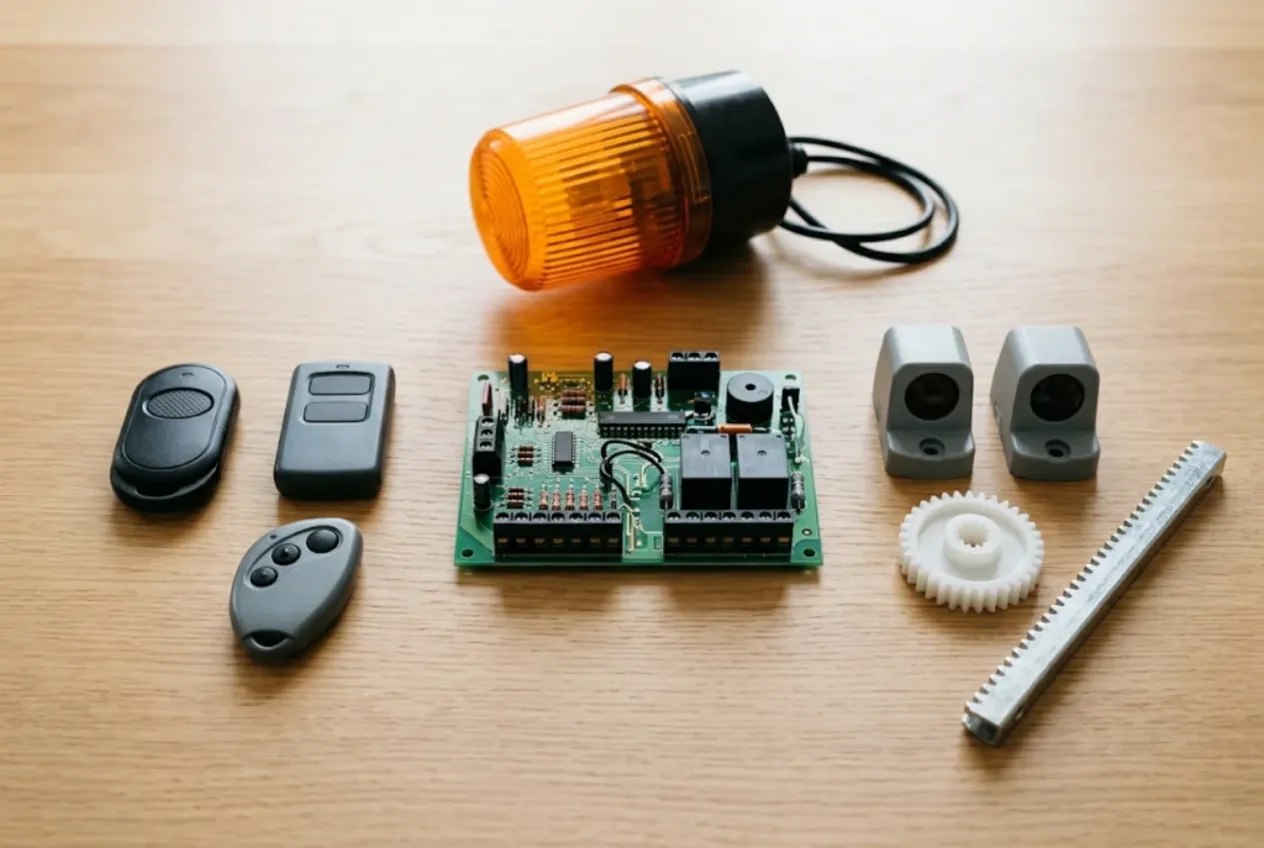
ServiceCenterSoft is job-tracking software for companies that repair and maintain gate automation: slide and swing gate operators, garage and sectional door openers, barrier arms, roller shutters, control boards, remotes and receivers, photo eyes and warning lights. The site visit and the bench repair stay on one ticket, the customer approves the estimate by link, and the serial number shows what was done to that unit before. It runs in the browser — on the office PC and on your phone at the gate.
Cameras, recorders and intercoms have their own page: CCTV repair software. This one is about the things that move — gearboxes, arms and leaves — and the electronics that drive them.
Two kinds of customer, one kind of urgency
The first customer is the installer or fencing contractor. They fit gates, and when a board burns out or an operator seizes, they bring it to you. The second is the site itself: an apartment block, a homeowners’ association, a car park, a warehouse yard, a private driveway. They just want the entrance working.
Both are in a hurry: while the operator is down, the gate is either stuck shut or standing open. A barrier that will not lift at eight in the morning means a queue of cars.
Where it usually goes wrong:
- an installer drops off three boards from three sites, and a week later nobody knows which is which;
- a site is on a maintenance contract, but what was done last visit lives only in the technician’s head;
- a lightning-damaged board gets repaired, and the customer says “at that price I would have bought a new one”;
- “is this under the install warranty?” turns into an argument because the install date is not written anywhere;
- remotes on the right frequency run out the week a building orders forty.
One unit, one ticket
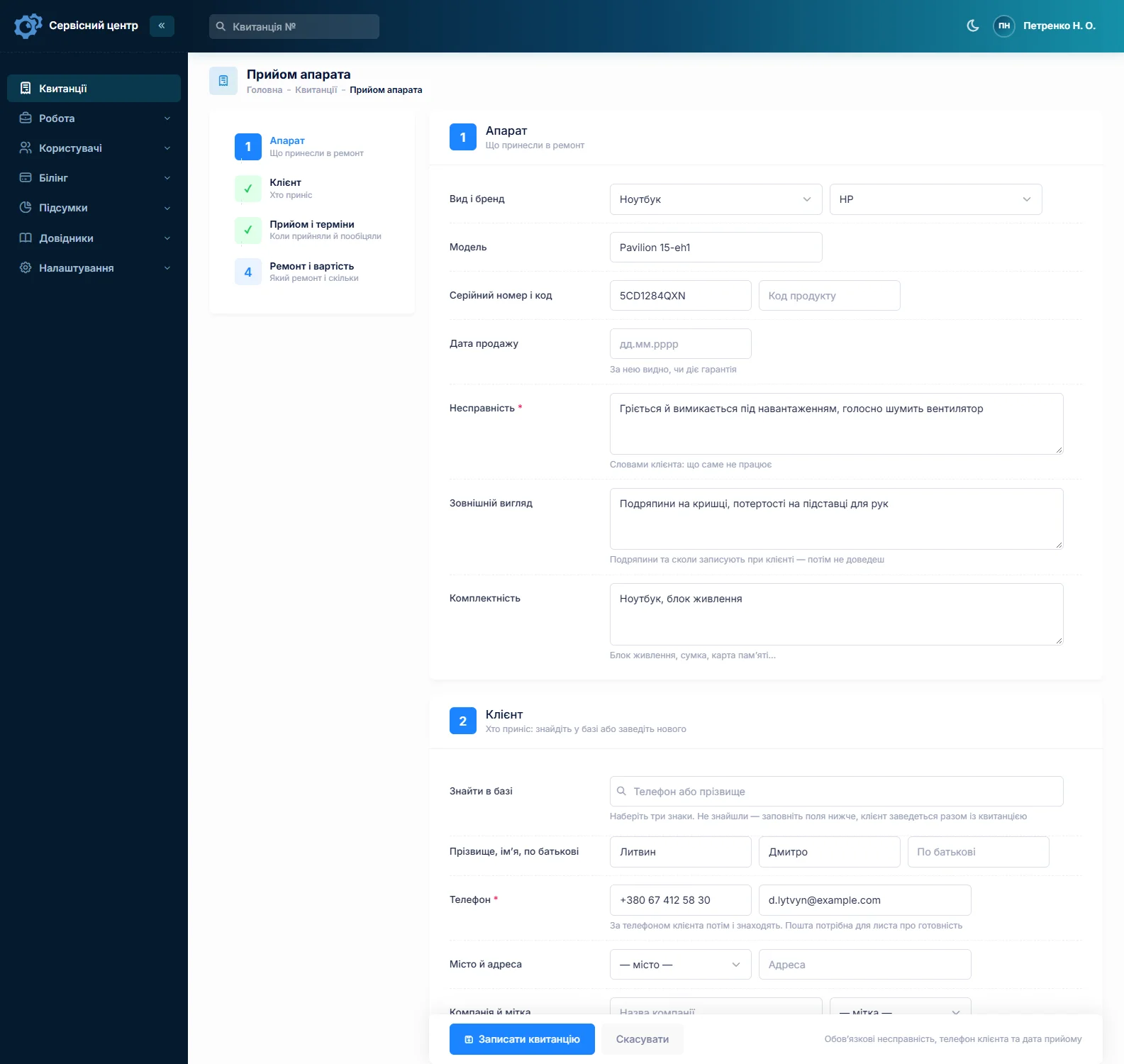
Each operator, board or barrier is a ticket with a number, a status and a price. Device types follow your work: “Slide gate operator”, “Swing gate operator”, “Garage door opener”, “Barrier arm”, “Roller shutter”, “Control board”, “Receiver and remotes”, “Photo eyes”. Make and model come from the nameplate, the serial number has its own field, and the fault is written the way the customer says it: “opens but won’t close”, “moves in jerks”, “doesn’t see the remote”, “arm drops”, “hums and doesn’t move”.
The “Accessories” field records what arrived with the unit: cover, release key, capacitor, limit switches, brackets, how many remotes. “Condition” covers water marks, burnt tracks, corrosion, a cracked gearbox housing. It all prints on the ticket the customer signs.
You cannot attach photos to a ticket; keep them on your side and note on the ticket that photos exist.
Installers as trade customers
The installer’s business name goes into the “Company” field on the customer card; the person who drops things off stays as the contact. The site and the position on it go into the “Product code” field: “Elm Court, entrance 2, left leaf”. Advanced search by device finds the ticket by that text, as it does by model or serial number.
Several identical boards at once? Fill in the first ticket, copy it for the rest, and give each its own serial number and site. The customer card shows what the installer owes across all tickets.
Sites on a service contract
There is no contracts module, but you can run contract sites with what is there. Add your own repair type, “Contract”, next to the built-in “Paid” and “Warranty”, and the ticket list filters contract work by repair type. Each maintenance visit is a ticket: lubricated, limits and photo eyes checked, chain tensioned, safety edge tested. The work log and the “Recommendations” field print on the completion report the site representative signs — see the completion report page.
Next time, the operator’s serial number brings up its history: when it was serviced, what was replaced, what you advised. The software sends no reminders for the next service and produces no combined monthly report — you keep the visit schedule yourself.
Call-out and bench on one ticket
The technician swaps a capacitor or a limit switch on site — or pulls the board and takes it to the bench. Then a second visit: refit, set force and travel limits, program the remotes. That is still one ticket.
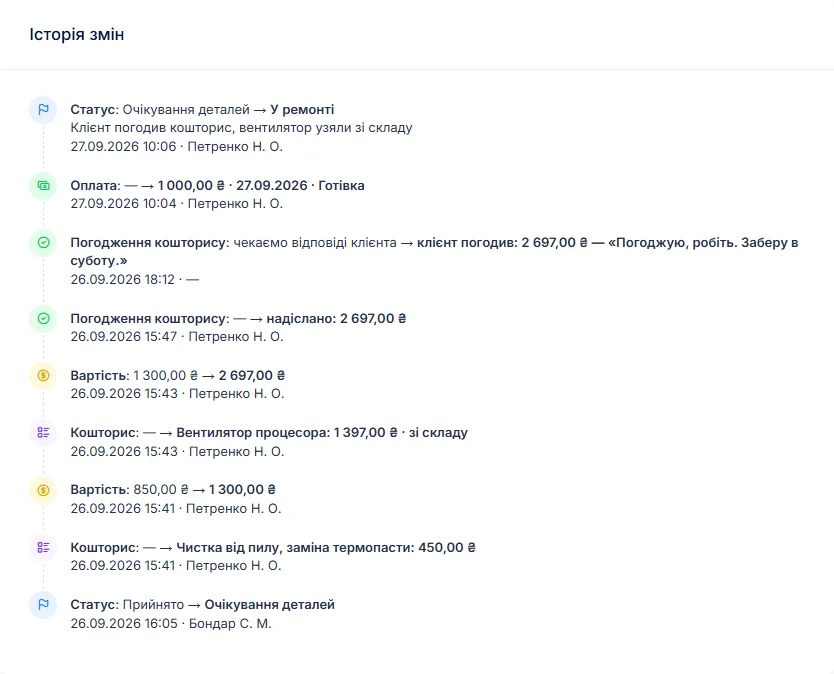
You define your own statuses, for example “Call-out booked”, “Board on the bench”, “Waiting for parts”, “Awaiting approval”, “Refit on site”, “Done”. Each status change with a comment — “board removed, gate on manual release” — goes into the history with date and name. The call-out is an entry in your “Works” list, added to the estimate as a line.
“Entrance down” gets the urgent flag and a promised date; overdue jobs turn red and gather under their own filter. To be clear: there is no dispatch calendar or route map. You filter by technician and status; the address and the gatehouse phone number are in the technician notes.
Control boards: repair or replace
After a surge or water ingress a board loses relays, varistors, tracks, sometimes the processor. A repair can cost half the price of a new board, or nearly the same — so the customer decides before you pick up the iron. The ticket moves to “awaiting approval”, and the itemised estimate — labour from your list, parts from stock — goes out by email or Telegram. The customer clicks “I agree” or “I decline”; the answer and date land in the history.
If you charge for diagnosis even when the customer opts for a new board, give the device type a diagnostics price and switch the ticket’s base to “diagnostics only”.
Install warranty and repair warranty
Put the installation date into the “Date of sale” field, and “warranty or chargeable” is settled by a date, not a debate. Warranty jobs go under the “Warranty” repair type, and the ticket list filters them by that type. If an operator comes back after your repair, the serial number finds the earlier ticket with its estimate and work log; the “Repeat repair” type keeps such returns apart. Your warranty wording — term and exclusions such as vehicle impact or flooding — is yours to edit under “Print forms”.
Remotes, receivers and operators in stock
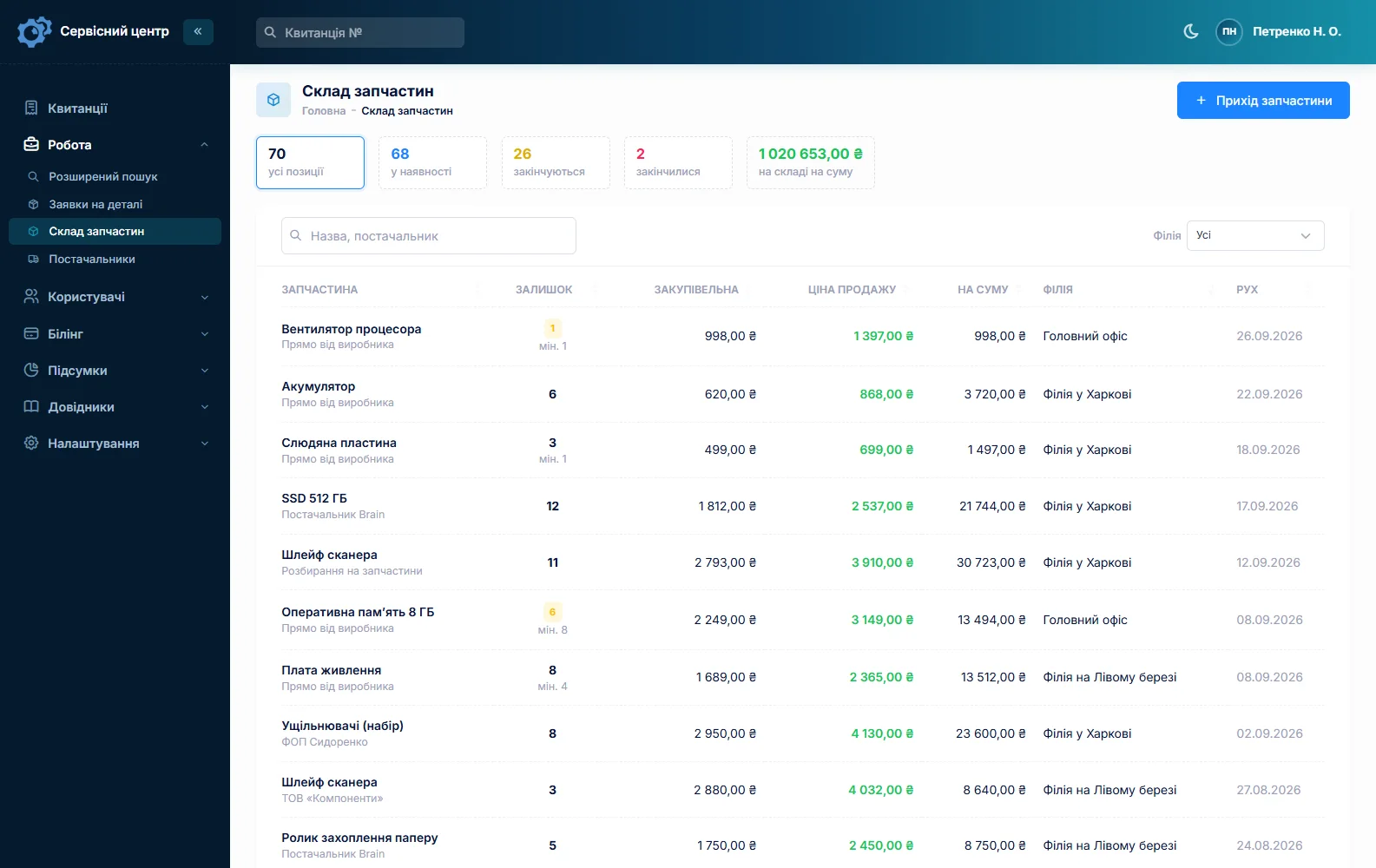
Stock is a movement journal: receipts with cost price and supplier, items used on a job as estimate lines, returns, stocktakes. Typical lines: remotes in several frequencies, receivers, photo eyes, capacitors, limit switches, drive gears, gear rack, replacement boards and a spare operator or two. A minimum level and the “running low” tile tell you when to reorder. Quantities are whole numbers; stock does not track serial numbers of individual items. More on the spare parts tracking page.
Programming remotes is a labour line; the remotes themselves are estimate lines from stock. A rare gear or board is requested from the supplier by email straight from the ticket.
Deposits, “ready” messages and boards on the shelf
A ticket can take several payments: a deposit for an operator or board, the balance after fitting. The ticket shows “received” and “balance due”. When a board is ready, the customer gets an email or a Telegram message; you can resend it, at most once a day. See customer notifications. Every finished unit shows how many days it has been waiting; the counter turns red once your free storage period has passed.
Powered gates are a safety matter: requirements for installing and inspecting them, and what you may do with an uncollected unit, are governed by the rules where you trade and by the terms the customer accepted. The software does not track any of that.
What gate automation repairs typically cost
A rough guide only — prices vary by region, brand and the state of the unit: board diagnosis €40–90, site call-out €60–150, control board repair €80–250, drive gear or gearbox repair €120–400, capacitor replacement €30–70 plus the part, photo eye replacement €50–120 plus parts, programming a remote €15–40, barrier operator repair €150–500. You set your own prices in the “Works” list and in the estimate lines.
What it does not have
- a site register or service contracts module, or reminders for the next service;
- a combined monthly report;
- a dispatch calendar or route map;
- photos or file attachments on a ticket;
- SMS, a mobile app, or online payment by the customer;
- integrations with suppliers.
What it costs
One price for the whole business — no extra charge for staff or branches.
Monthly
Paid every month, cancel whenever you like.
Yearly
Cheaper than paying monthly. Invoice or card payment.
Custom work
Changes tailored to the way you work — hourly, by agreement.
Off-the-shelf not enough — your own forms, roles, reports or workflow? We will build a program for you. How it works
Try it without signing up in the demo: book in a control board with the site in “Product code”, add a call-out to the estimate and send it for approval.

We are very happy working with servicecentersoft.com: they built everything we asked for, even though our request was unusual, since we deal with medical devices. Everything was done precisely and on the agreed schedule. Thank you for the cooperation — we keep working together.

I tried the ServiceCenterSoft demo and came away with a good impression. The program is simple and easy to understand, yet it has everything you need for the job: customers, repairs, devices, spare parts, statuses and statistics.
I especially liked the dark theme and the responsive design — working from a phone is perfectly comfortable. Another plus is the instant search that works as you type, so you don't have to press a separate "Search" button every time.
You can tell the program was built specifically for service centers rather than being a generic CRM adapted for the repair business. The interface has no unnecessary frills; everything is logical and to the point.
A good, practical tool for the day-to-day work of a service center.

I liked that you get a free 14-day trial and that they are willing to handle my special requests — setting things up exactly the way I need them.
I also liked how payment works. You can simply pay the monthly fee by card online — basically the same as a regular Spotify subscription or any other service. No separate contracts to sign and no invoices to pay manually.
And there's no feeling of strict limits on the number of employees. One service center is one account, and inside it you can organize the work of your technicians and run several branches.
For me this is far more convenient than plans where you have to pay for every single user or keep counting how many employees are working today.

My business is fairly specific, so the program's standard features weren't enough — I needed my own custom fields, my own sorting options and search by additional parameters. The work completion certificate and the printed repair receipt also needed some changes to fit the way we work.
I contacted technical support. To be honest, I expected changes like these to take a long time, but everything was done within a single day. The team quickly understood exactly what we needed, suggested the right solution and did everything properly.
I'd especially like to mention the support: they get straight to the point, with no unnecessary bureaucracy, and they genuinely help instead of just sending you off to read the documentation.
For me this is a big advantage of the program: it isn't just sold "as is" — it can be adapted to how you actually work. Thanks to the team for the quick response and for treating the customer right.
Highly recommended!
In short
- One ticket per operator, board or barrier, with its serial number.
- The installer in “Company”, the site and position in “Product code”.
- Contract work under its own repair type; history by serial number.
- Call-out and bench repair on one ticket, with your own statuses.
- Repair the board or replace it — estimate approval by link.
- Remotes, photo eyes and gears in stock with minimum levels.
- €20 a month for the whole business.
See also
Car key repair software for automotive locksmiths
For car key shops and automotive locksmiths: transponder keys, remote and smart keys, shell and button repairs, batteries, and mobile call-outs — deposits before the blank is cut, key blanks and chips in stock by the piece, and a signed note of the ownership documents shown.
Read moreEyeglass repair software for optical shops and repair workshops
For eyewear repair shops and optical stores with a repair bench: while-you-wait fixes logged in a minute, frame condition signed for at drop-off, lens replacement in the customer’s own frame with a deposit, promised dates and uncollected orders.
Read moreStarting your own repair shop: where to begin
For people who can fix phones and laptops and want to work for themselves: what a small repair business needs on day one, the paperwork that protects you from the first customer, and how to run a shop in a country whose language is not your own.
Read moreSee how it works
The demo is open — go in and try it. Ask us anything by email, Telegram or the form on this site.