Battery repair shop software for e-bike and e-scooter packs
For shops that test, repair and rebuild e-bike, e-scooter and light EV battery packs: each pack is its own job, capacity before and after on the completion certificate, cells as estimate lines from stock, deposits, rebuild warranty returns, fleets and mail-in work.
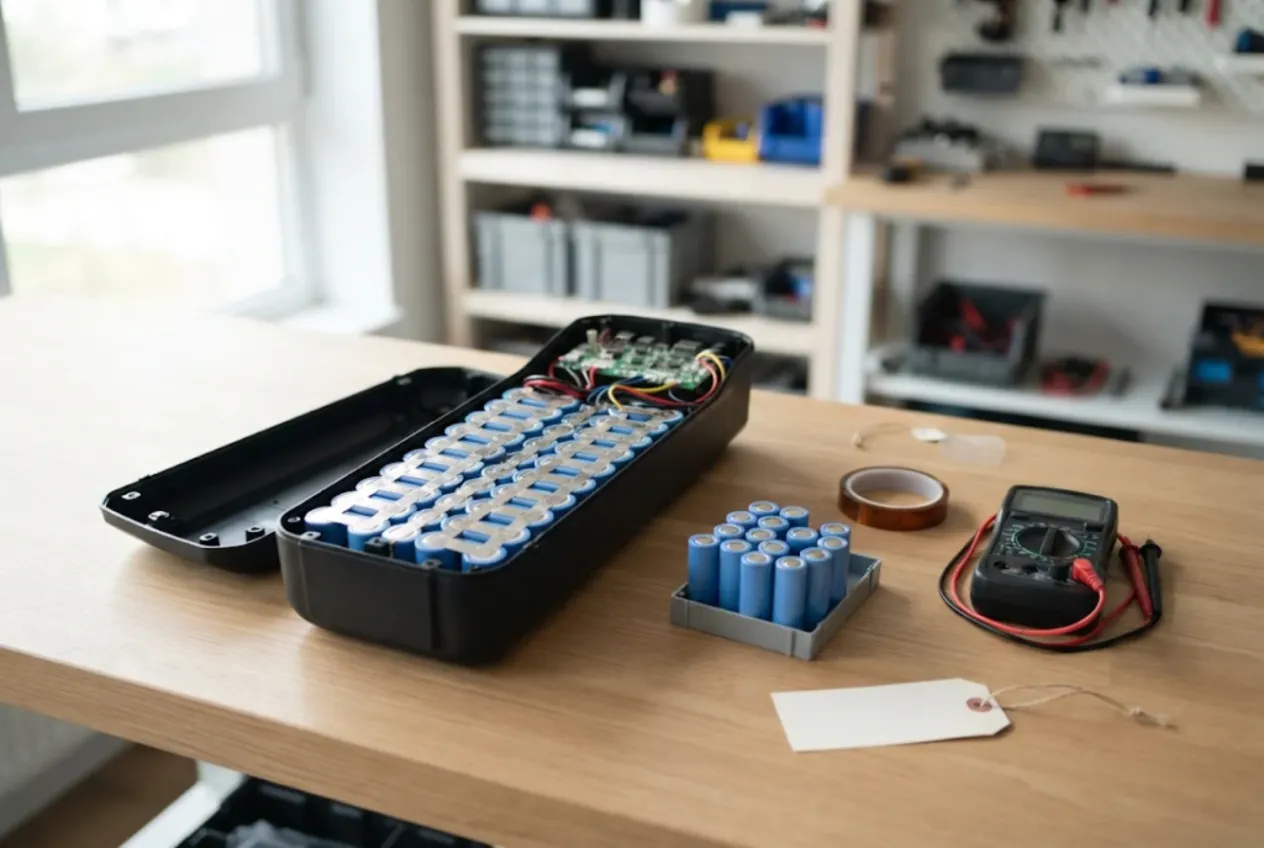
ServiceCenterSoft is job-tracking software for workshops where the thing on the bench is a battery, not a vehicle. Cell testing, balancing, BMS replacement, full rebuilds, connector and casing repairs — for e-bike, e-scooter and moped packs, and now and then a single module from an electric car. Every pack is a ticket with a number, a promised date, an itemised estimate and a history. It runs in the browser, on a PC and on a phone.
If you repair whole vehicles, see e-scooter repair software and bike repair shop software; portable power stations have a page of their own. This one is about packs that arrive without the vehicle.
Who it is for, and what goes wrong
A battery repair shop has problems an ordinary repair shop does not. Packs look alike: black shrink wrap, a yellow connector, often no label at all. The result of the work is invisible — it is a capacity figure the customer has to trust. Most of the price is cells, bought for the specific job. And a good share of the work comes from rental fleets, courier companies and bike shops that drop packs off by the crate and settle up monthly.
The usual trouble spots:
- six identical 36 V packs on the shelf, and only one person knows whose is whose;
- “it holds less than before” — and nobody wrote down the readings before and after;
- cells were ordered without a deposit, and the customer backed out;
- three weak groups turned up instead of one, and the customer first hears the new price at collection;
- a pack comes back after six months, and no one can say which cells went into it;
- a fleet dropped off twelve packs, collected eight and paid for five — all in a notebook.
Every pack is its own job, with its own number
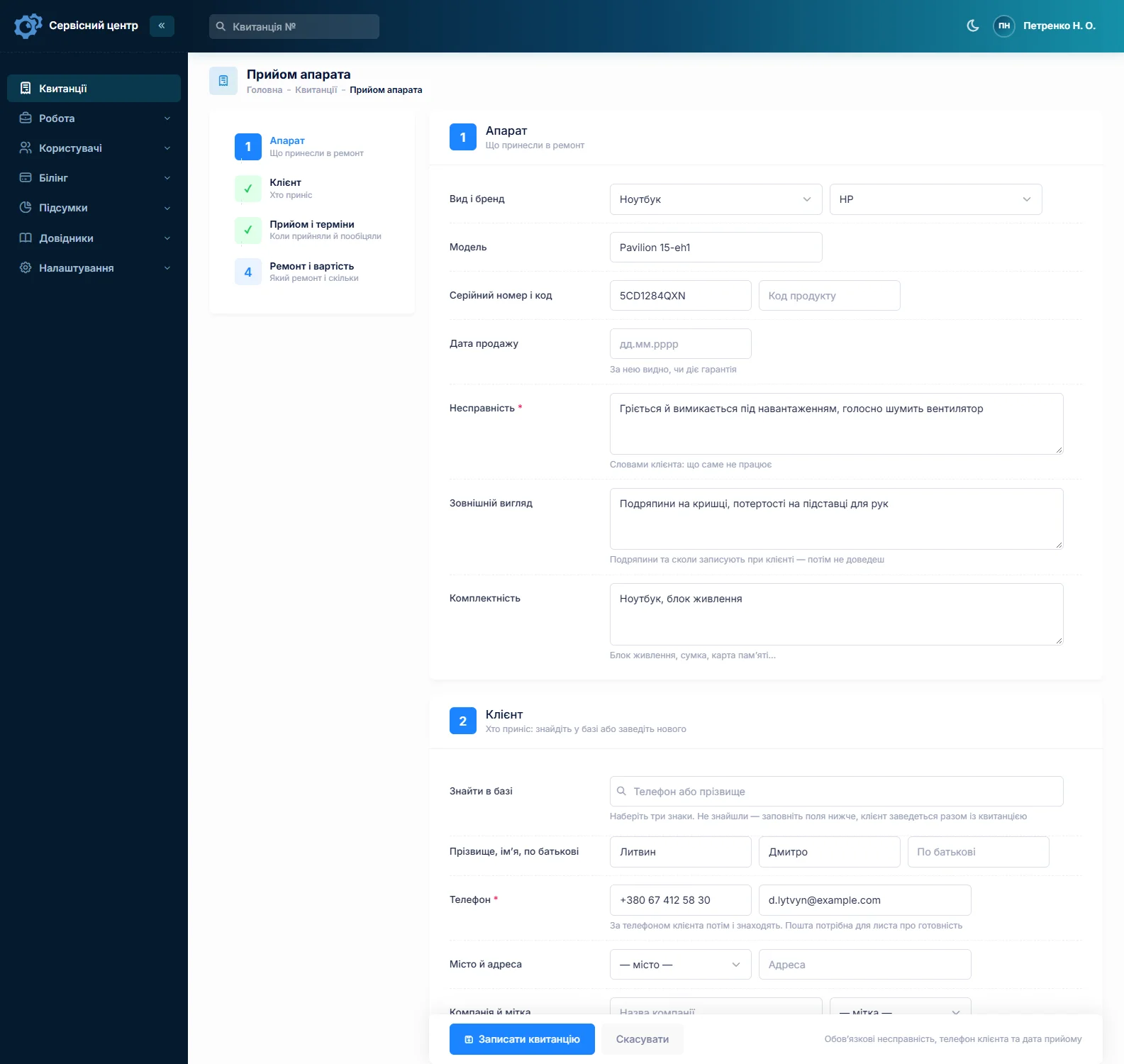
Item types are your own list: “Scooter pack 36 V”, “E-bike pack 48 V”, “Moped pack 60 V”, “EV module”. Each type has its own diagnostics price. When a customer only wants a capacity test, the ticket’s base is switched to “diagnostics only”, and the amount is known at drop-off.
The serial number field takes the number on the label. No label? Write the ticket number on the casing with a marker and enter the same number in the field — the pack is no longer anonymous. The product code field suits the configuration — “10S3P” — or the fleet’s own asset number. Advanced search finds a ticket by any part of either number.
The fault field holds the complaint and what the customer tells you: “8 km instead of 25, roughly 300 cycles, always charged with the original charger”. “Condition” records swelling, dents, water marks, a melted connector, signs that someone has been inside. “Accessories” lists the charger, key, mounting rail, bag. All three print on the ticket the customer signs.
Capacity before and after: plain text, but on the certificate
To be clear: there are no dedicated fields for capacity, voltage or cycle count. They go in as plain text, and what matters is where. Bench readings — voltage on arrival, spread between groups, which groups are dead — go into the technician notes, which the customer never sees. What the customer should take home goes into the work log: “5.9 Ah before, 40 cells replaced, 17.1 Ah after balancing”. The work log and the recommendations both print on the certificate of completed work, so the capacity figure ends up on a document.
Recommendations are the place for care advice: do not charge a frozen pack, do not store it empty over winter. The software does not connect to a tester or read BMS logs; it stores what you type.
Cells, BMS boards and consumables as estimate lines
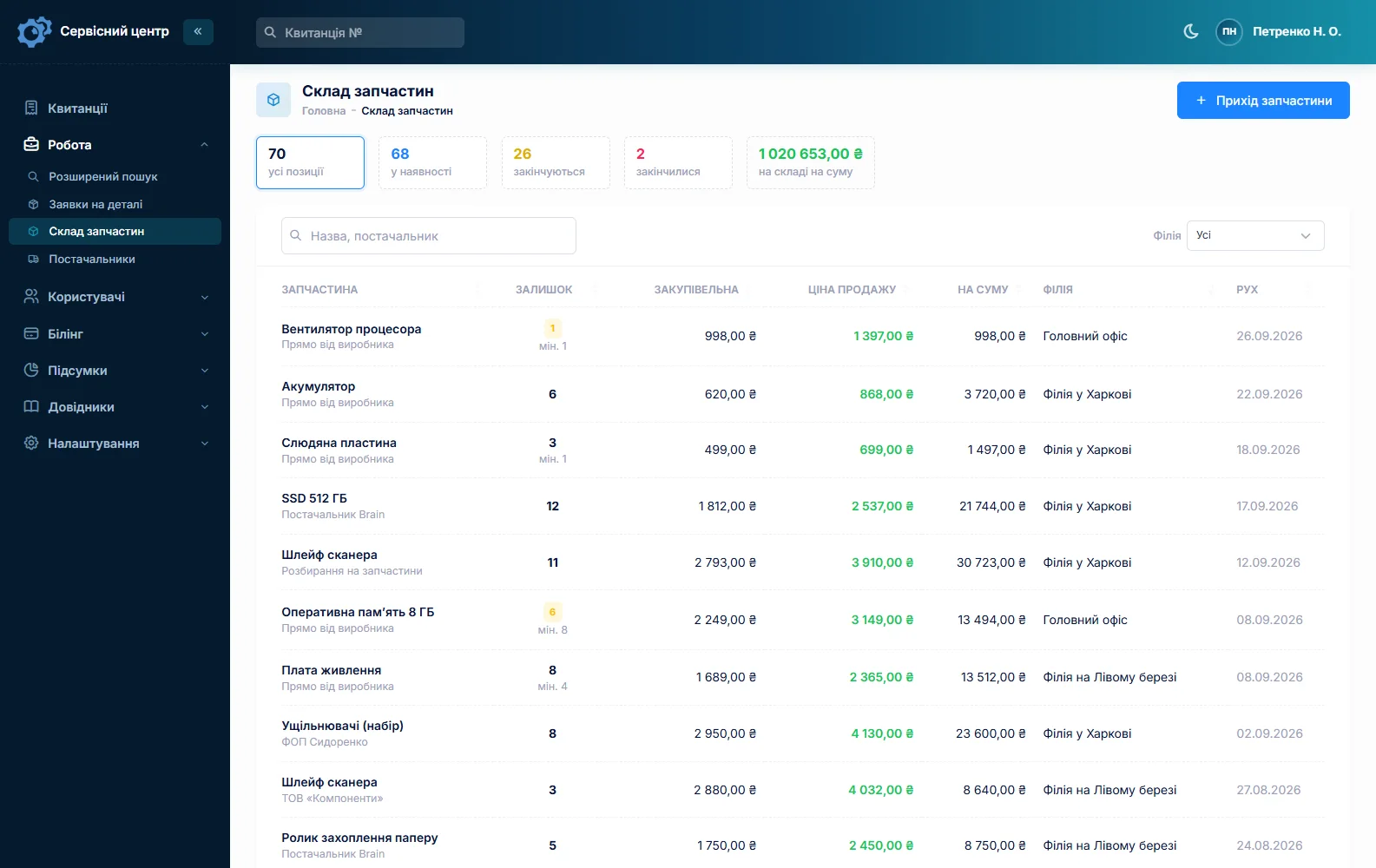
An estimate is built from lines. Labour comes from your price list of jobs — “diagnostics”, “balancing”, “rebuild 10S3P”, “BMS replacement”. Parts come from stock: “21700 cell, 5,000 mAh × 40”, a BMS board, connectors, shrink wrap, insulation rings. Add the line and the stock level drops.
Stock is a movement journal: receipts with cost price and supplier, parts used on jobs, returns, stocktakes. Give your common cells a minimum level and the “running low” tile tells you when to reorder. Quantities are whole numbers, so count cells singly and nickel strip by the roll or the cut length. Individual cell serial numbers are not tracked; if the batch matters, put it in the item name or in the technician notes.
Battery rebuild job tracking: approval and a deposit first
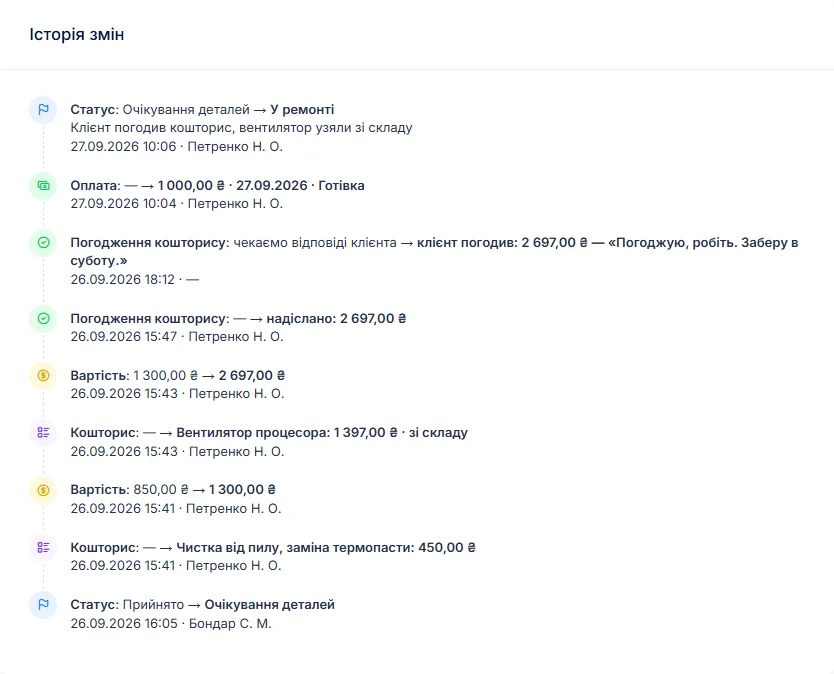
Nobody knows how many groups need replacing until the pack is open. So after diagnostics the estimate goes to the customer by email or Telegram. The link shows every line with “I agree” and “I decline” buttons, and the answer lands in the ticket history with its date. Agreed on the phone instead? Add it as a comment on the status change.
A ticket can take several payments: a deposit for the cells once the customer agrees, the balance at collection. The ticket shows “received” and “balance due”. If the cells are not in stock, the request can be emailed to your supplier straight from the ticket. Statuses are yours to define — “Waiting for cells”, “Capacity test”, “Balancing”, “Beyond repair” — and any of them can sit as a tile above the list.
Rebuild warranty and packs that come back
There is no warranty-period field. You write your warranty terms once into the wording of your completion certificate under “Print forms”, and they print on every certificate; the period for a particular pack can be added to its recommendations. When a pack returns, a search by serial number brings up the earlier ticket: when it left, which cells were fitted, what capacity it tested at.
The new ticket is made as a copy of the old one with the repair type set to “Repeat repair”. The ticket list can be filtered by that type, which gives you every comeback of the season in one view. Reports are not broken down by repair type, so the comeback rate is something you count from that list yourself.
Fleets, couriers and bike shops
The customer record has a company field, and every pack from one fleet sits under it: number of jobs, total billed, amount owed. A crate of identical packs? The second and later tickets are copies of the first, each with its own serial number. The “unpaid” filter lists finished work that has not been paid for. A bike shop that passes its customers’ packs on to you is handled the same way. Reports show jobs and revenue, overall and per technician.
Mail-in packs
Mail-in work uses the same ticket. The address is on the customer record; the tracking number goes into a comment on the status change or into the notes, where text search will find it. Add statuses of your own for the journey — “On its way to us”, “Shipped back”. The customer gets the “ready” notice by email or Telegram (see customer notifications). The software sends no SMS and has no link to carriers.
Shipping lithium batteries is regulated, and carriers set their own conditions on packaging and on the state of the pack. Check with your carrier before anything goes in a box.
Storage: finished packs and unsafe ones
Each finished job shows how many days it has been waiting. Once the free storage period from your settings has passed, the counter turns red and a “past free storage” filter gathers those jobs. In a battery shop, the fewer packs sitting around, the better.
The general rule every technician knows: a swollen, flooded or punctured pack is kept apart from the rest and never charged unattended, and removed cells go to recycling under local rules. The software does not monitor any of this. It can only show you the count — a status of your own such as “Unsafe — stored separately”, set as a tile above the list.
What battery repairs typically cost
A rough guide only — prices depend on region, cell choice and pack layout: diagnostics with a capacity test €20–50, balancing €30–70, BMS replacement €50–120 including the board, connector repair €15–40, rebuilding a 36 V scooter pack €150–350, a 48 V e-bike pack €250–500. You set your own prices in the price list of jobs and in the estimate lines.
What it does not have
- dedicated fields for capacity, voltage or cycle count — plain text only;
- tracking of individual cell serial numbers or batches;
- connections to testers or BMS log import;
- a warranty-period field, warranty reminders or a report by repair type;
- fractional stock quantities;
- photos or file attachments on a ticket, label or barcode printing;
- SMS, a mobile app, or online payment by the customer;
- integrations with cell suppliers or carriers.
What it costs
One price for the whole shop — no extra charge for staff or branches.
Monthly
Paid every month, cancel whenever you like.
Yearly
Cheaper than paying monthly. Invoice or card payment.
Custom work
Changes tailored to the way you work — hourly, by agreement.
Off-the-shelf not enough — your own forms, roles, reports or workflow? We will build a program for you. How it works
Try it without signing up in the demo: add a “Scooter pack 36 V” type, book a pack in, put cells from stock on the estimate and send it for approval.

We are very happy working with servicecentersoft.com: they built everything we asked for, even though our request was unusual, since we deal with medical devices. Everything was done precisely and on the agreed schedule. Thank you for the cooperation — we keep working together.

I tried the ServiceCenterSoft demo and came away with a good impression. The program is simple and easy to understand, yet it has everything you need for the job: customers, repairs, devices, spare parts, statuses and statistics.
I especially liked the dark theme and the responsive design — working from a phone is perfectly comfortable. Another plus is the instant search that works as you type, so you don't have to press a separate "Search" button every time.
You can tell the program was built specifically for service centers rather than being a generic CRM adapted for the repair business. The interface has no unnecessary frills; everything is logical and to the point.
A good, practical tool for the day-to-day work of a service center.

I liked that you get a free 14-day trial and that they are willing to handle my special requests — setting things up exactly the way I need them.
I also liked how payment works. You can simply pay the monthly fee by card online — basically the same as a regular Spotify subscription or any other service. No separate contracts to sign and no invoices to pay manually.
And there's no feeling of strict limits on the number of employees. One service center is one account, and inside it you can organize the work of your technicians and run several branches.
For me this is far more convenient than plans where you have to pay for every single user or keep counting how many employees are working today.

My business is fairly specific, so the program's standard features weren't enough — I needed my own custom fields, my own sorting options and search by additional parameters. The work completion certificate and the printed repair receipt also needed some changes to fit the way we work.
I contacted technical support. To be honest, I expected changes like these to take a long time, but everything was done within a single day. The team quickly understood exactly what we needed, suggested the right solution and did everything properly.
I'd especially like to mention the support: they get straight to the point, with no unnecessary bureaucracy, and they genuinely help instead of just sending you off to read the documentation.
For me this is a big advantage of the program: it isn't just sold "as is" — it can be adapted to how you actually work. Thanks to the team for the quick response and for treating the customer right.
Highly recommended!
In short
- Every pack is a ticket with its own number, label or no label.
- Casing and connector condition on a ticket the customer signs.
- Capacity before and after as text in the work log, printed on the completion certificate.
- Cells, BMS boards and consumables as estimate lines from stock, in whole units.
- Rebuilds start after approval by link and a deposit.
- Warranty terms in your own certificate wording; comebacks as “Repeat repair” with a list filter.
- Fleets and couriers as company customers with the balance owed on record.
- €20 a month for the whole shop.
See also
Dental handpiece repair software for mail-in repair shops
For shops that repair dental handpieces and equipment: one ticket per handpiece with its serial number, batches from a practice booked in by copying, mail-in parcels both ways, rush jobs, practice accounts with balances, repair warranty and repeat repairs.
Read moreAir compressor repair software for compressor and air tool service shops
For compressor service companies and pneumatic tool repair shops: air tools across the bench, rotary screw machines serviced on site, hours-based maintenance with filters and oil from stock, estimate approval before an airend is opened, and a history for every machine by serial number.
Read moreStarting your own repair shop: where to begin
For people who can fix phones and laptops and want to work for themselves: what a small repair business needs on day one, the paperwork that protects you from the first customer, and how to run a shop in a country whose language is not your own.
Read moreSee how it works
The demo is open — go in and try it. Ask us anything by email, Telegram or the form on this site.