Cash counter and ATM repair software
For service businesses repairing banknote counters and sorters, counterfeit detectors, coin counters, ATMs and self-service kiosks: banks, retailers and bureaux de change on service contracts, site visits, loan units, sensors and rollers in stock.
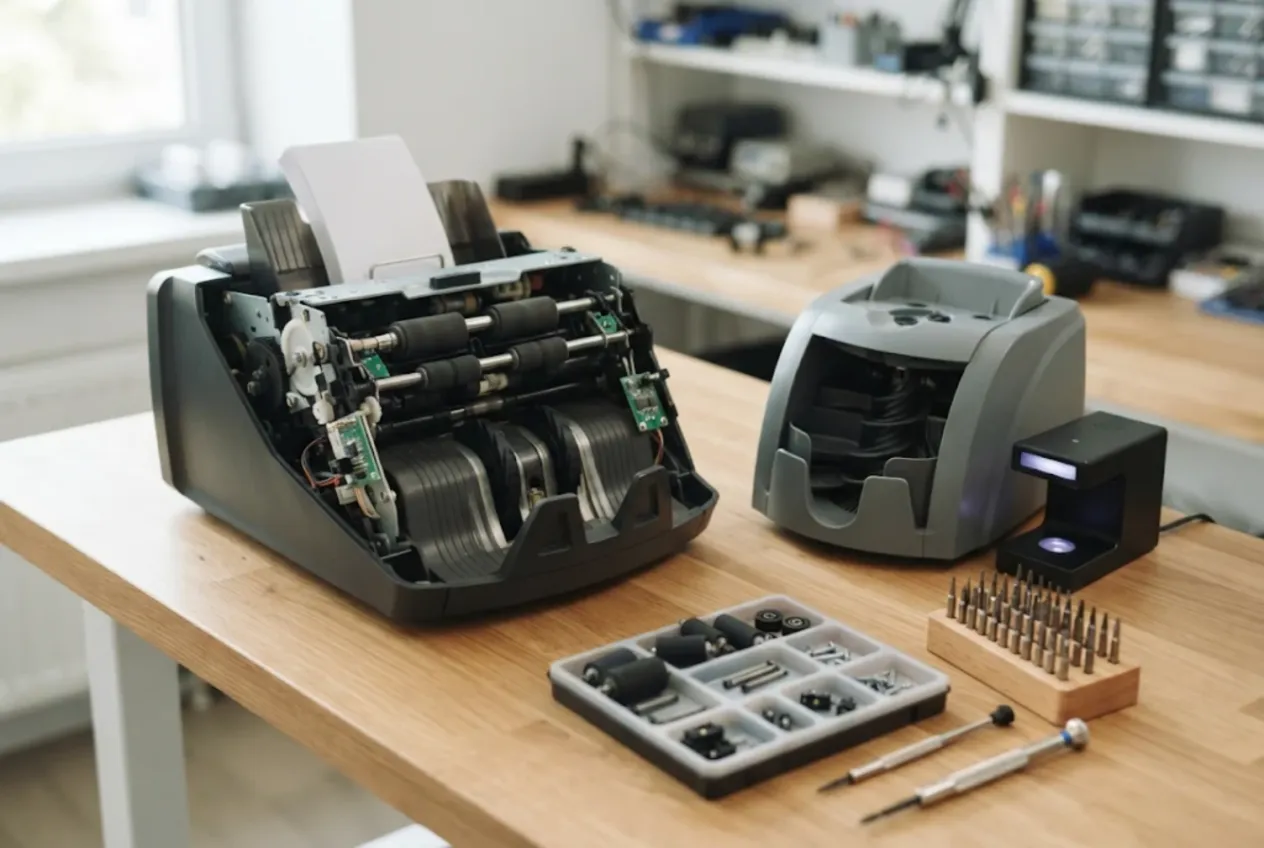
ServiceCenterSoft is repair-tracking software for independent cash handling equipment service: banknote counters and sorters, counterfeit detectors, coin counters and sorters, ATMs, payment kiosks and self-checkout terminals. Every unit gets a job number, a serial number, a due date, an itemised estimate and a full history. It runs in the browser — at the bench in your workshop and on your phone in a bank branch.
Who this is for
Your customers are businesses that handle cash all day: bank branches, bureaux de change, supermarkets and retail chains, fuel stations, casinos and cash offices. When a note counter stops, the queue grows and staff count by hand; when a detector lets a suspect note through, the customer loses money. So they expect speed: same-day intake, a loan unit while theirs is on the bench, and an engineer on site for anything that can’t be carried.
Where things usually slip:
- a loan counter went out to a customer weeks ago, and nobody is sure which one;
- the bank asks what was done to the counter at a particular branch last quarter;
- a note turns up in the transport path and nobody knows where it came from;
- rollers for the most common model run out just as three units come in;
- a chain pays monthly, and reconciling who paid what takes an afternoon of email.
Intake: serial number, condition, no cash
The intake form has device type, model, serial number, the fault in the customer’s words, condition and contents. For cash equipment it pays to write “no cash in unit or cassettes” in the condition field and list power supply, cover, keys and cassettes under contents. Both are printed on the job sheet the customer signs.
If the technician still finds a note or coin inside, it goes into the work log with denomination and date and is handed back at collection. The work log is printed on the work report, so “where did the money go” has a written answer.
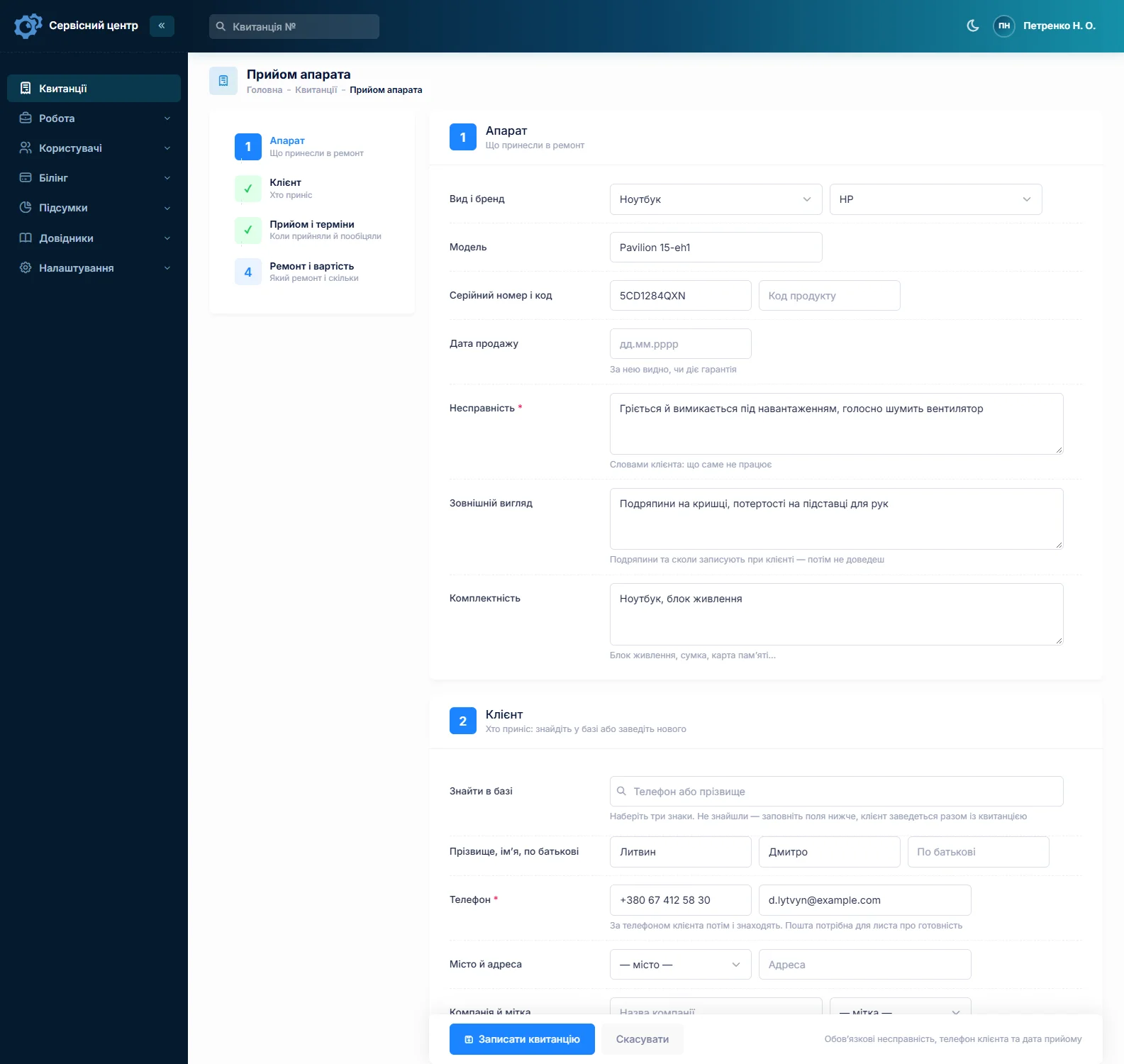
Each device type can carry its own diagnostic fee — detector, desktop counter, sorter, coin counter — shown on the job sheet before any work starts.
Contract customers
There is no service contract module, and we won’t pretend otherwise. What works: tag the customer with a label such as “Contract” and filter the customer list by it. The bank or chain name goes in the “Company” field — different cashiers drop units off, but it is one customer, and searching by company finds every job. Contract terms, branch addresses and who to call before a visit go in the customer’s notes, next to all jobs, payments and the balance owed.
A job can take several payments, and the “unpaid” filter lists units handed back but not paid for. The software prints a job sheet and a work report, not invoices — you raise invoices in your accounting tool. More on the work completion report.
ATM and kiosk site visits
Counters and detectors come to you; ATMs and payment kiosks are serviced where they stand. Add your own repair type, such as “Site visit”, and a “Call-out” line with a price in the work list: it goes on the estimate, and the job list filters by repair type. There is no visit calendar — agree the slot as usual and set the promised date; once it passes, the job turns red and appears under overdue. The “urgent” flag puts a unit at the top of everyone’s attention.
Who is responsible for the cash. ATMs and kiosks usually belong to a bank or an operator, and the owner decides who may access the safe, cassettes and keys. Cash-in-transit is not the service engineer’s job. Requirements for banknote authentication devices used by banks, and how they are tested, are set by the central bank in your country — check with it and with your customer. The software tracks repairs; it does not monitor ATMs or check compliance.
Loan units
There is no loan pool module. The workable approach: the technician notes the loan unit’s model and serial number in the internal notes on the job — customers never see them, and the full-text search finds which customer has which loaner. If you want a signature, add a line under contents, “loan counter issued, S/N …”, and it prints on the job sheet. The same trick for tills and card terminals is described in POS repair software.
Sensors, rollers and currency updates
Most counter repairs come down to worn feed and pick-up rollers, rubber tyres, belts, and dirty or misaligned sensors — UV, magnetic, infrared, double-note detection. Stock is a movement log: goods in with cost and supplier, parts issued to a job as an estimate line, stocktakes. Every item has a minimum level, and the “running low” tile shows what to reorder. A parts request can be emailed to the supplier straight from the job. More on spare parts tracking.
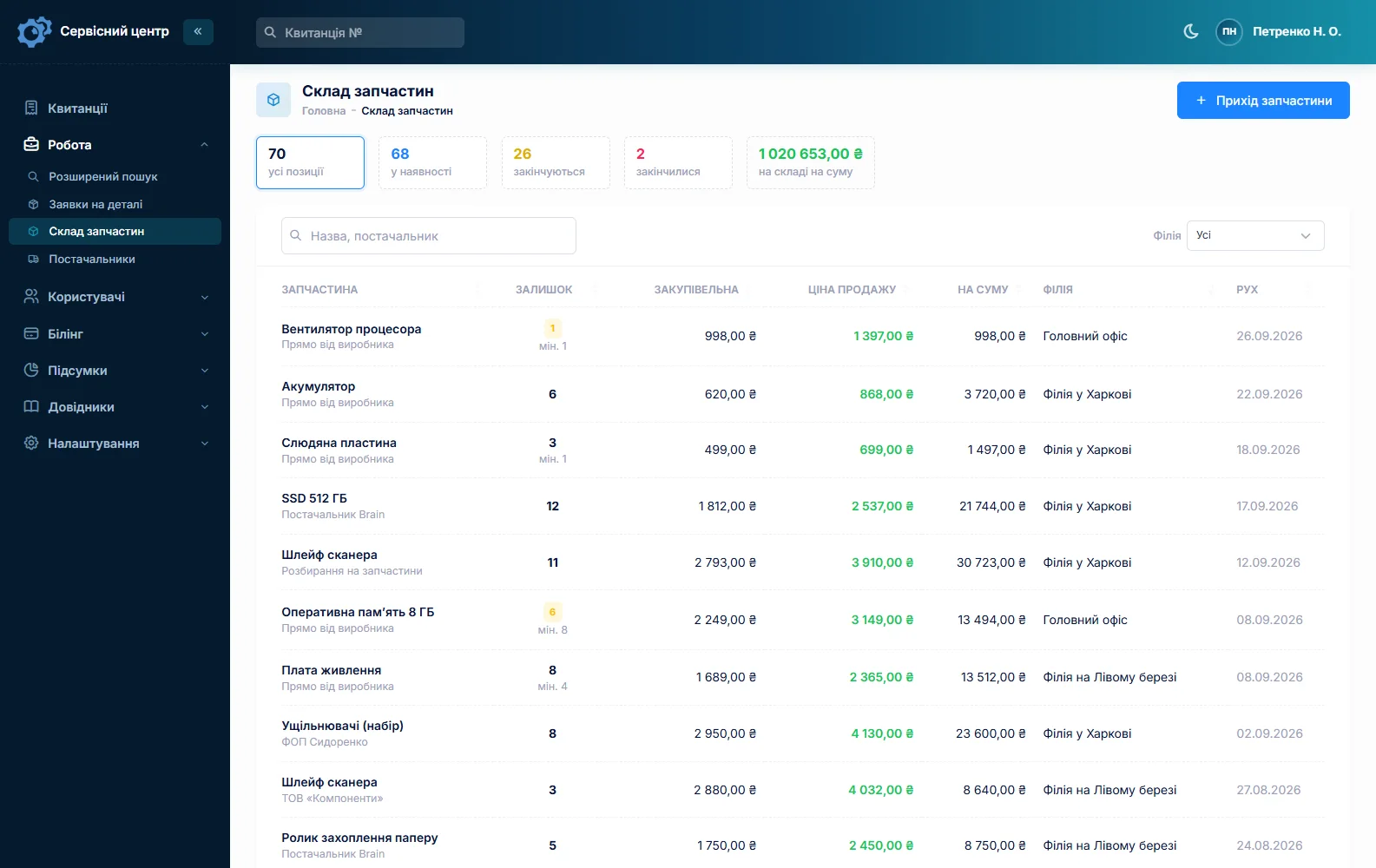
A currency or firmware update for new banknote series is a priced line in your work list. The technician records the installed version and the test result in the work log, and it appears on the report. Preventive maintenance — cleaning sensors and the note path — gets its own repair type, with the next date under recommendations. The software sends no reminders; keep them in your calendar.
Approval and collection
A dropped sorter can cost a large share of a new one to repair. After diagnosis the job moves to “awaiting approval” and the estimate goes out by email or Telegram; the customer sees every line and the total and clicks “I agree” or “I decline”, and the answer is stored with the date. Approved by phone — add it as a comment on the status change. Not worth fixing — “beyond repair”. When it is ready, the customer gets an email or a Telegram message, and finished units show how many days they have been waiting.
Bill validators and coin mechanisms from vending machines are covered in vending machine repair software.
Typical repair prices
A rough guide only — prices vary by region, model and parts: banknote counter service €40–90, counter repair €80–250 plus parts, counterfeit detector repair €30–100, coin counter or sorter €80–220, currency update €30–90, ATM or kiosk call-out €120–400 plus parts. You set your own prices in the work list.
What it does not do
- no service contract module or maintenance reminders;
- no loan pool, visit calendar or ATM monitoring;
- no invoices, photos or file attachments;
- no SMS, mobile app, online payment by customers or supplier integrations.
What it costs
One price for the whole business — no extra charge for staff or branches.
Monthly
Paid every month, cancel whenever you like.
Yearly
Cheaper than paying monthly. Invoice or card payment.
Custom work
Changes tailored to the way you work — hourly, by agreement.
Off-the-shelf not enough — your own forms, roles, reports or workflow? We will build a program for you. How it works
Try it without signing up in the demo: book in a note counter with its serial number, mark “no cash in unit” and print the job sheet.

We are very happy working with servicecentersoft.com: they built everything we asked for, even though our request was unusual, since we deal with medical devices. Everything was done precisely and on the agreed schedule. Thank you for the cooperation — we keep working together.

I tried the ServiceCenterSoft demo and came away with a good impression. The program is simple and easy to understand, yet it has everything you need for the job: customers, repairs, devices, spare parts, statuses and statistics.
I especially liked the dark theme and the responsive design — working from a phone is perfectly comfortable. Another plus is the instant search that works as you type, so you don't have to press a separate "Search" button every time.
You can tell the program was built specifically for service centers rather than being a generic CRM adapted for the repair business. The interface has no unnecessary frills; everything is logical and to the point.
A good, practical tool for the day-to-day work of a service center.

I liked that you get a free 14-day trial and that they are willing to handle my special requests — setting things up exactly the way I need them.
I also liked how payment works. You can simply pay the monthly fee by card online — basically the same as a regular Spotify subscription or any other service. No separate contracts to sign and no invoices to pay manually.
And there's no feeling of strict limits on the number of employees. One service center is one account, and inside it you can organize the work of your technicians and run several branches.
For me this is far more convenient than plans where you have to pay for every single user or keep counting how many employees are working today.

My business is fairly specific, so the program's standard features weren't enough — I needed my own custom fields, my own sorting options and search by additional parameters. The work completion certificate and the printed repair receipt also needed some changes to fit the way we work.
I contacted technical support. To be honest, I expected changes like these to take a long time, but everything was done within a single day. The team quickly understood exactly what we needed, suggested the right solution and did everything properly.
I'd especially like to mention the support: they get straight to the point, with no unnecessary bureaucracy, and they genuinely help instead of just sending you off to read the documentation.
For me this is a big advantage of the program: it isn't just sold "as is" — it can be adapted to how you actually work. Thanks to the team for the quick response and for treating the customer right.
Highly recommended!
In short
- Counters, detectors, sorters, ATMs and kiosks in one job list with serial numbers.
- “No cash” and contents on the signed job sheet; anything found goes in the work log.
- Each bank or chain is one customer with a “Contract” label, notes and balance.
- Site visits: a repair type plus a call-out line.
- Loan units noted on the job; no separate loan pool.
- Sensors and rollers in stock with minimum levels.
- €20 a month for the whole business.
See also
Piano technician software
For piano technicians and piano shops: tunings on site, action regulation, hammers and strings, schools, churches and concert venues as regular accounts, and the full service history of every piano by serial number.
Read moreServer repair software
For businesses repairing servers, storage arrays, switches and routers: companies, hosting firms and ISPs as customers, due dates agreed in contracts, serial numbers of drives and power supplies, spares in stock, RMA returns to the manufacturer.
Read moreStarting your own repair shop: where to begin
For people who can fix phones and laptops and want to work for themselves: what a small repair business needs on day one, the paperwork that protects you from the first customer, and how to run a shop in a country whose language is not your own.
Read moreSee how it works
The demo is open — go in and try it. Ask us anything by email, Telegram or the form on this site.