Furniture repair and upholstery business software
For upholstery, furniture repair and restoration workshops: written condition on the signed job sheet, estimates approved by the customer, deposits for fabric, pickup and delivery as estimate lines, fabric and foam in stock.

ServiceCenterSoft is job-tracking software for upholsterers and furniture repair and restoration workshops: sofas, armchairs, dining chairs, headboards, chests of drawers, antique tables. Every piece becomes a numbered job with its condition, fabric, an itemised estimate, payments, a work log and a full history. It runs in the browser — on the workshop computer, and on your phone when you are looking at a sagging sofa in a customer’s living room.
Who it is for, and where upholstery jobs go wrong
A furniture job is slow and expensive by nature. Reupholstering a sofa means stripping it, new foam and webbing, perhaps new springs, waiting for the fabric, cutting, sewing, rebuilding. Restoring a chest of drawers can take a month of stripping, gluing, colouring and finishing. Meanwhile there are dozens of pieces in the shop, each at a different stage, and every owner asks the same question: “is it ready yet?”
Where time and money usually leak:
- a price was quoted at the home visit, the frame turned out to be cracked under the old cover, and now the customer only remembers the first number;
- a fabric deposit was taken in cash and never written down;
- the customer supplied their own fabric (COM), and a month later nobody knows how many yards came in;
- you ran out of foam halfway through a job;
- a finished armchair has been blocking the aisle for three weeks.
Inspection and intake: get it in writing
A job records the piece and model the way you describe it: “L-shaped sectional, recliner mechanism”, “wingback chair, carved legs”, “bentwood chairs, set of six”. Set up piece types in the device list — sofa, armchair, dining chair, bed, case goods — and give each its own inspection fee if you charge one.
The field that matters most is “Condition”. With the customer present, write down stains and wear on the cover, scratches and chips in the finish, cracked rails, loose joints, signs of woodworm, the state of the mechanism. Under contents list cushions, bolsters, loose covers, legs, drawer keys — and the customer’s own fabric with its yardage and colour. It all prints on the job sheet they sign. Their wishes go in their words: “firmer seat”, “match the curtains”, “keep the original finish where possible”.
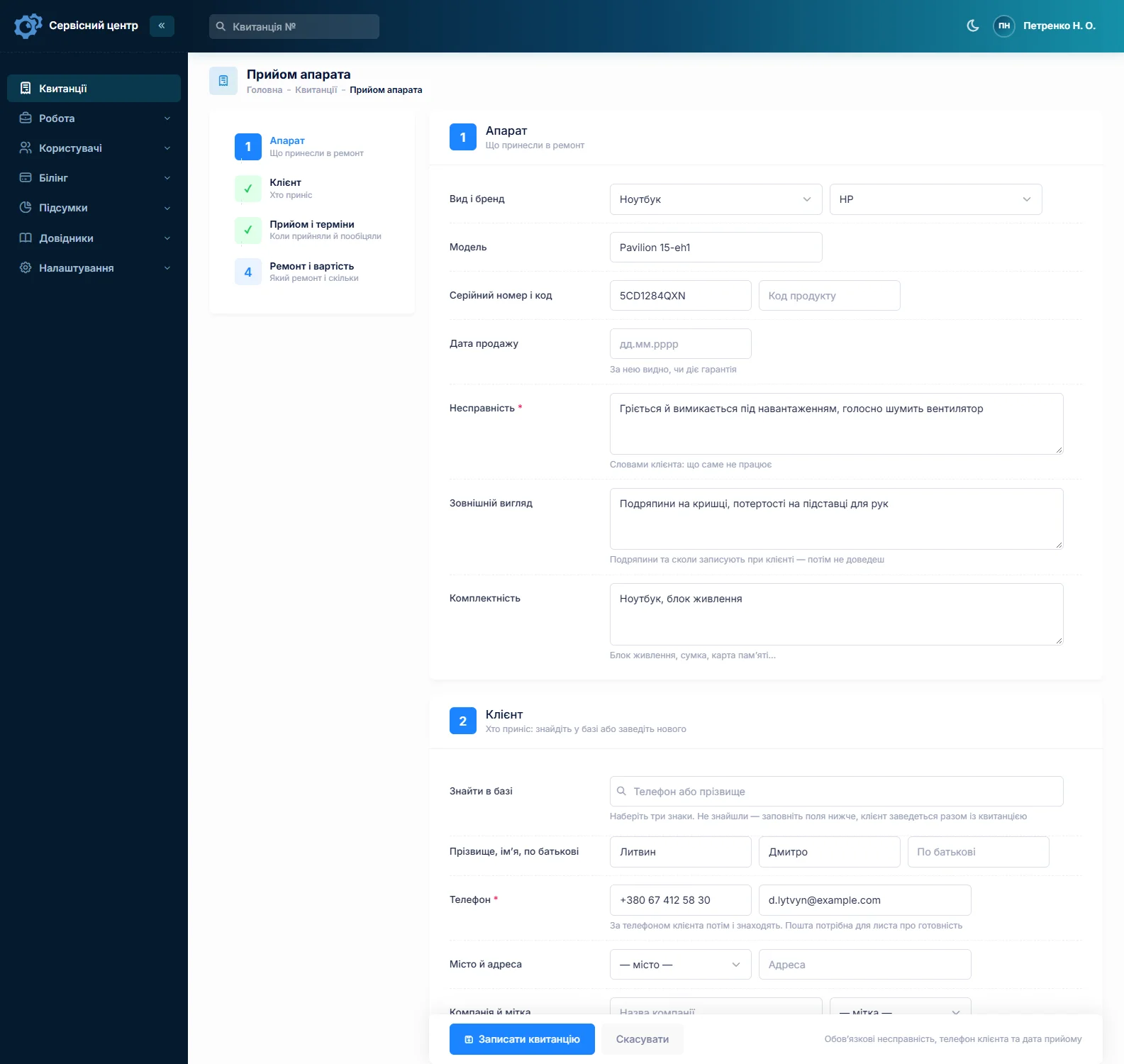
To be honest about photos: you cannot attach one to a job. If you photograph the piece on your phone, note it in the description — the written text above the signature is still what counts. “Notes for the technician” are never shown to the customer: “left rail glued before”, “horsehair stuffing under the cover”.
An estimate the customer actually approves
An upholstery price is only firm after inspection, and a restoration price often only after the strip-down. Put your standard operations into the works list with your prices: strip-down, foam replacement, spring rebuild, mechanism repair, seat reupholstery, sewing loose covers, frame regluing, finish stripping, staining, lacquer or oil. Fabric, foam and hardware are added as lines from stock, each with a quantity.
A button on the job sends the estimate by email or Telegram. The customer opens the link, sees every line and the total, presses “I agree” or “I decline” and can add a comment. The dated answer is stored in the job history. Found something else once the cover came off? Add a line and send the estimate again — the change in total stays in the history too. Agreed by phone? Record it as a comment on the status change.
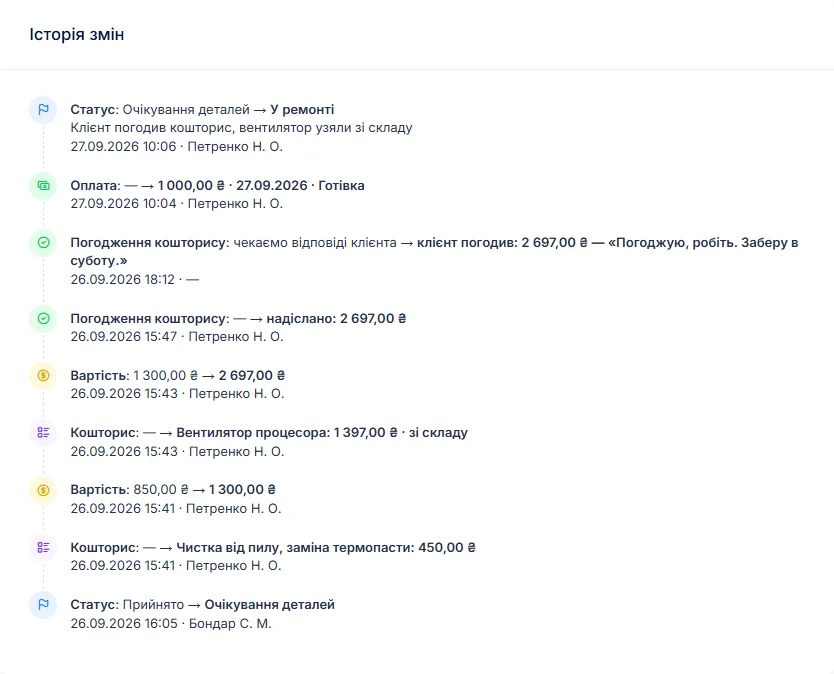
If the customer walks away after a paid inspection, switch the job’s base to “diagnostics only” and the inspection fee is what appears on the document.
Deposits for fabric and hardware
A good upholstery business does not fund the customer’s fabric. A job can have several payments — a deposit on approval, the balance on delivery — and the job shows amount paid and balance due. The “unpaid” filter in the job list shows where money has not come in yet. Put your deposit terms, such as special-order fabric being non-refundable, into the terms printed on the job sheet.
Pickup and delivery as estimate lines
Home visits, pickup, delivery and carrying a sofa up three floors all cost time. In the software they are ordinary estimate lines: “home inspection”, “pickup”, “delivery and placement”. The address lives in the customer record, the promised date on the job, and overdue jobs turn red in the list. There is no dispatch planner or calendar: write the day and time slot in the notes or in a status comment. How other on-site businesses handle this is described on the home appliance service page.
Your workflow as statuses
You define the statuses yourself, each with a colour: “Inspection”, “Awaiting approval”, “Waiting for fabric”, “Strip-down”, “Frame work”, “Upholstery”, “Finishing”, “Ready for delivery”. The job list shows at a glance what stage everything is at, and the “Urgent repair” flag keeps the customer with guests arriving at the weekend in view.
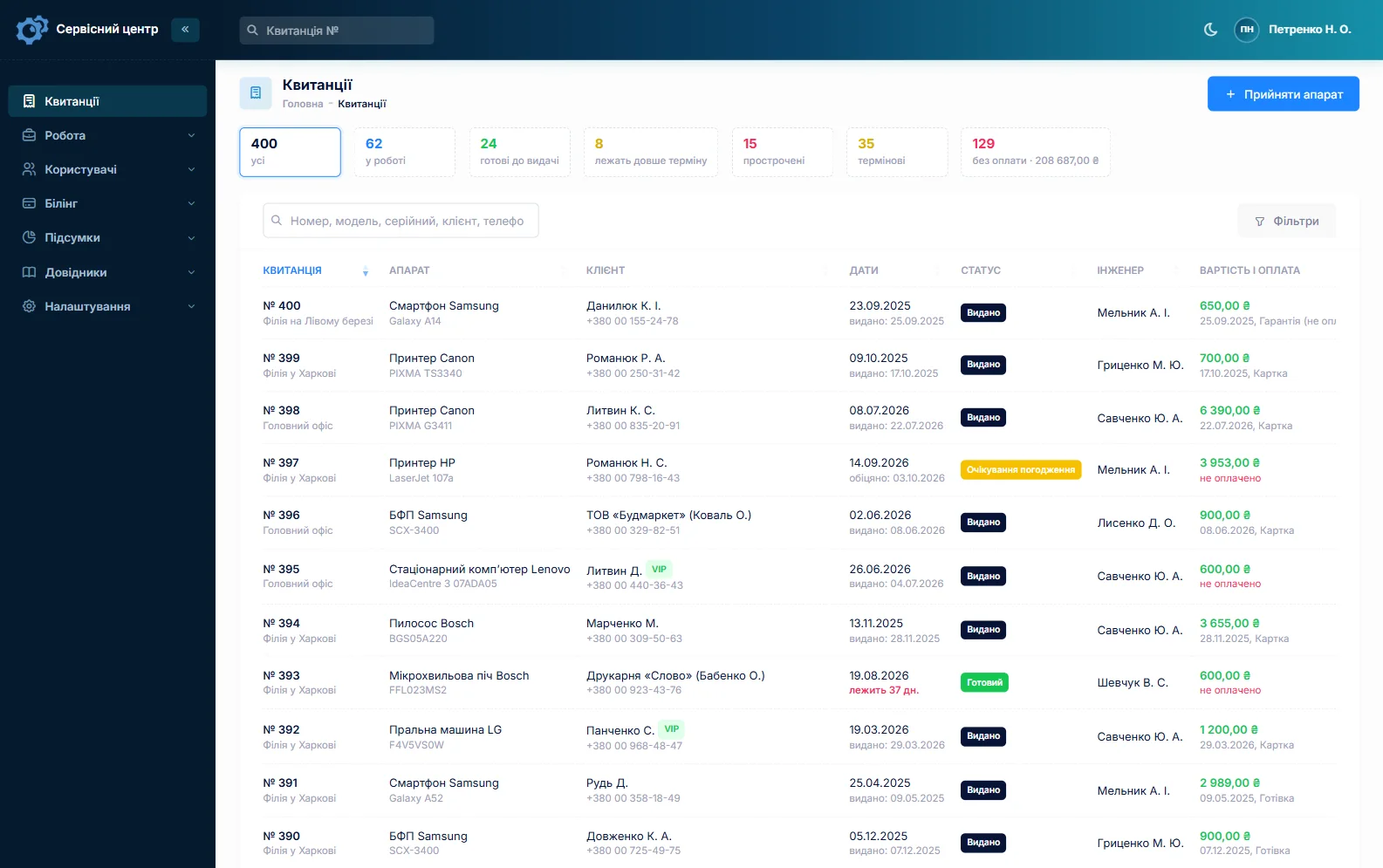
Every estimate line has a technician: one person does the frame, another the upholstery. The period report shows what each one completed, which makes piece-rate pay easy to work out.
Fabric, foam and hardware in stock
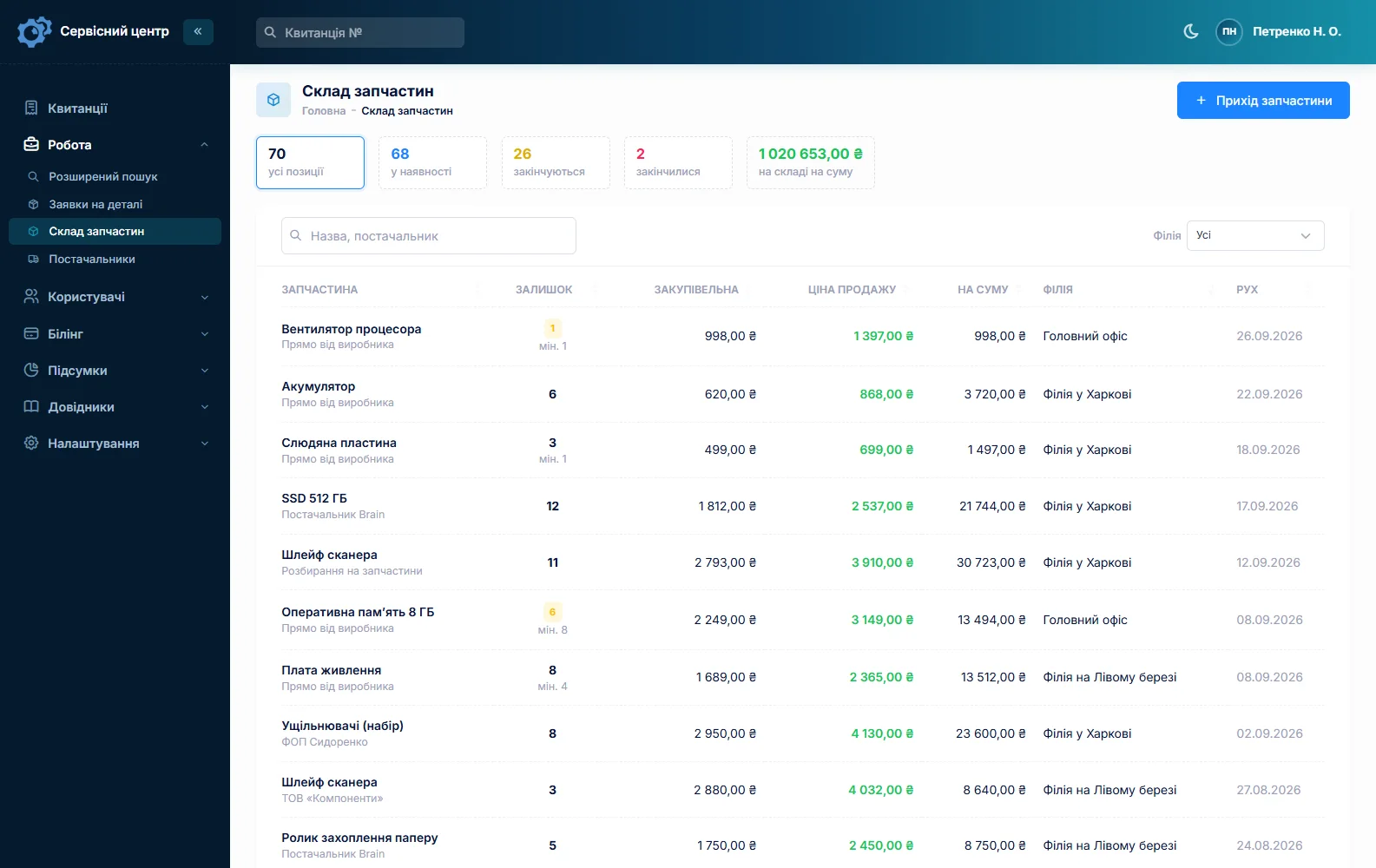
Stock is a movement log: goods in with cost and supplier, materials issued to a job as an estimate line, stocktakes. Quantities are whole numbers, so count fabric by the yard or metre, foam by the sheet, staples by the box, legs and mechanisms by the piece. Each item can have a minimum level, and the “running low” tile reminds you to reorder foam before you need it. Special-order fabric is requested from the job and emailed to the supplier, and the job waits in “Awaiting parts”. More on parts and materials tracking.
Finished pieces take up floor space
Next to every finished piece you can see how many days it has been waiting. Once the free storage period from your settings has passed, a tile gathers the forgotten ones. The ready-for-collection email or Telegram message can be sent again. Put your free storage period, and any storage charge after it, into the terms on the job sheet.
Restaurants, hotels and designers
A restaurant sends in twenty dining chairs: the customer record has a “Company” field, and you can copy a job or book one job with a line “seat reupholstery × 20”. A customer label helps you pick out the interior designers who keep sending you work. Pianos are a different trade (piano repair software), and leather shoes and bags are quick small jobs (shoe repair software).
Typical prices
A rough guide only, labour without materials, depending on region and piece: dining chair seat €40–120, armchair reupholstery €300–800, sofa reupholstery €700–2,000, mechanism repair €80–250, foam replacement in a sofa €200–600, chest of drawers restoration €300–1,200, home inspection €20–60, pickup and delivery €50–200. You set your own prices in the works list.
What it does not do
- photos and file attachments on a job;
- a dispatch planner or calendar;
- fractional stock quantities;
- SMS, a mobile app, online payment by the customer, supplier or carrier integrations.
What it costs
One price for the whole workshop — no extra charge for staff or locations.
Monthly
Paid every month, cancel whenever you like.
Yearly
Cheaper than paying monthly. Invoice or card payment.
Custom work
Changes tailored to the way you work — hourly, by agreement.
Off-the-shelf not enough — your own forms, roles, reports or workflow? We will build a program for you. How it works
Try it without signing up in the demo: book in an armchair, describe the cover, build an estimate with fabric and pickup, send it for approval and record a deposit.

We are very happy working with servicecentersoft.com: they built everything we asked for, even though our request was unusual, since we deal with medical devices. Everything was done precisely and on the agreed schedule. Thank you for the cooperation — we keep working together.

I tried the ServiceCenterSoft demo and came away with a good impression. The program is simple and easy to understand, yet it has everything you need for the job: customers, repairs, devices, spare parts, statuses and statistics.
I especially liked the dark theme and the responsive design — working from a phone is perfectly comfortable. Another plus is the instant search that works as you type, so you don't have to press a separate "Search" button every time.
You can tell the program was built specifically for service centers rather than being a generic CRM adapted for the repair business. The interface has no unnecessary frills; everything is logical and to the point.
A good, practical tool for the day-to-day work of a service center.

I liked that you get a free 14-day trial and that they are willing to handle my special requests — setting things up exactly the way I need them.
I also liked how payment works. You can simply pay the monthly fee by card online — basically the same as a regular Spotify subscription or any other service. No separate contracts to sign and no invoices to pay manually.
And there's no feeling of strict limits on the number of employees. One service center is one account, and inside it you can organize the work of your technicians and run several branches.
For me this is far more convenient than plans where you have to pay for every single user or keep counting how many employees are working today.

My business is fairly specific, so the program's standard features weren't enough — I needed my own custom fields, my own sorting options and search by additional parameters. The work completion certificate and the printed repair receipt also needed some changes to fit the way we work.
I contacted technical support. To be honest, I expected changes like these to take a long time, but everything was done within a single day. The team quickly understood exactly what we needed, suggested the right solution and did everything properly.
I'd especially like to mention the support: they get straight to the point, with no unnecessary bureaucracy, and they genuinely help instead of just sending you off to read the documentation.
For me this is a big advantage of the program: it isn't just sold "as is" — it can be adapted to how you actually work. Thanks to the team for the quick response and for treating the customer right.
Highly recommended!
In short
- Condition and the customer’s own fabric on the signed job sheet.
- Estimates approved by the customer with one click.
- Deposits and balances — several payments per job.
- Pickup and delivery as estimate lines, address in the customer record.
- Fabric, foam and hardware in stock with minimum levels.
- Finished pieces with a storage day counter.
- €20 a month for the whole workshop.
See also
Starting your own repair shop: where to begin
For people who can fix phones and laptops and want to work for themselves: what a small repair business needs on day one, the paperwork that protects you from the first customer, and how to run a shop in a country whose language is not your own.
Read moreSoftware for home appliance service
Contents recorded at intake, warranty at the brand price list, callouts, slow parts and partner shops.
Read morePhone repair shop software
Intake in a minute, screens and batteries tracked, a ready-for-pickup email, output per technician.
Read moreSee how it works
The demo is open — go in and try it. Ask us anything by email, Telegram or the form on this site.