SMD Diode Marking: Cathode Band and Codes Like M7, A7, Z2
Which end of an SMD diode or LED is the cathode, why the print on the body is a manufacturer code rather than a part number, and how to identify a part from code, package and pin count. Verified examples M7, S4, A7, Z2, SMAJ, plus meter checks.
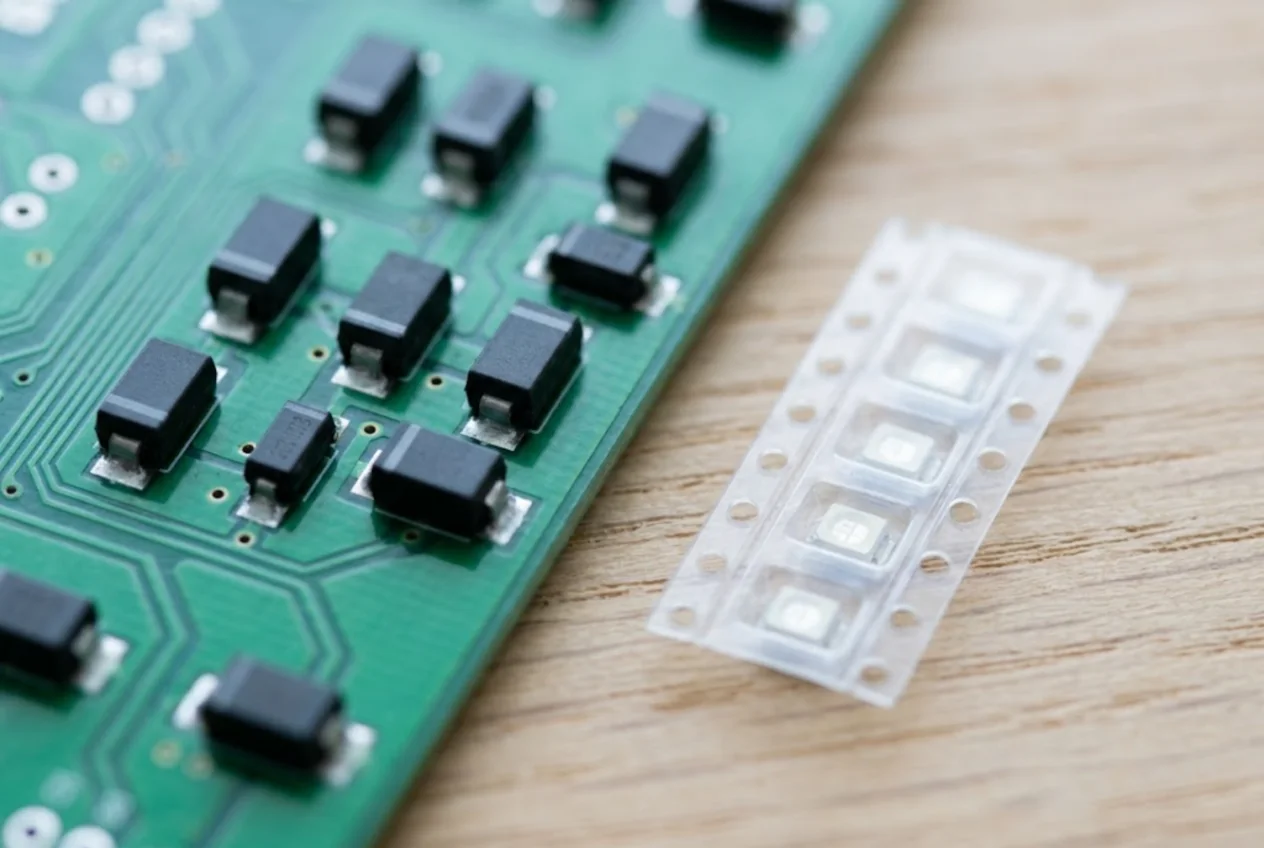
A surface-mount diode usually carries two clues: a band and a short code of two to four characters. The band almost always marks the cathode. The code is not the part number — it is an abbreviation from one manufacturer's own table, such as M7, S4, A7 or Z2. This page covers packages, the band, how to look a code up, Zeners, TVS diodes, LEDs and how to test a diode with a meter when the print is gone.
SMD diode packages
The package narrows things down before you even read the code. Two-terminal parts come as moulded plastic (SOD family, SMA/SMB/SMC) or as glass cylinders (MELF). The three-pin SOT-23 is the same package transistors use and may hold one or two diodes.
| Package | Also called | Body, mm (approx.) | Typical contents |
|---|---|---|---|
| SOD-523 | — | 1.2 × 0.8 | small-signal diodes, Zeners, ESD protection |
| SOD-323 | SC-76 | 1.7 × 1.25 | small-signal, Schottky, Zeners |
| SOD-123 | — | 2.7 × 1.6 | Schottky from a few hundred mA up to about 1 A, Zeners |
| MiniMELF | SOD-80, DO-213AC | 3.5 × Ø1.5 | LL4148, Zeners |
| MELF | DO-213AB | 5.0 × Ø2.5 | rectifiers, Zeners |
| SMA | DO-214AC | 4.3 × 2.6 | 1 A rectifiers (M1…M7), SS1x Schottky, SMAJ TVS |
| SMB | DO-214AA | 4.3 × 3.6 | higher-current rectifiers and Schottky, SMBJ TVS |
| SMC | DO-214AB | 6.9 × 5.9 | power rectifiers, SMCJ TVS |
| SOT-23 | TO-236 | 2.9 × 1.3 | dual diodes (BAV99 etc.), BZX84 Zeners |
Body sizes without leads, rounded. Exact figures are in the package drawing of the datasheet.
The band is the cathode
On two-terminal diodes the band — a light stripe on black plastic, or a coloured ring (often black) on glass MELF parts — sits at the cathode end. In the schematic symbol the cathode is the bar at the tip of the triangle. When the diode conducts, the anode is positive and the cathode negative.
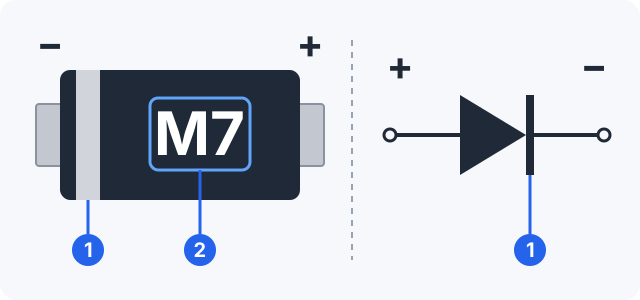
The PCB silkscreen usually marks the cathode pad too, with a line, a corner or a double bar. If the part is already off and the board has no mark, go by the schematic or measure an identical diode nearby.
The code is not the part number
A full part number will not fit on SOD-123 or SOT-23, so each manufacturer prints a short code from its own list. There is no standard: the same code from two makers can be two different parts, and the same part from two makers can carry two different codes. A universal “code to diode” table does not exist, and we do not pretend to give one.
How to look a code up
- Copy the code exactly. Ignore the logo and the date code, which is often a separate character or line.
- Note the package and the number of pins.
- Search an SMD code book or database for “code + package + pin count”. Expect several candidates.
- Open each candidate's datasheet and find the marking column or ordering table. Check the pinout.
- Look at the circuit: a diode next to the inductor of a switching regulator is likely a Schottky, one across the power input is likely a TVS.
No diode found for a SOT-23 code? It may be a transistor — see SMD transistor marking.
Examples checked against datasheets
| Code | Package | Part | Checked with |
|---|---|---|---|
M7 | SMA | 1000 V, 1 A rectifier — same ratings as a 1N4007; the M1…M7 range covers 50 to 1000 V | Diotec, MCC |
S4 | SMA | SS14 Schottky (40 V, 1 A) from Vishay; several other makers print the full SS14 | Vishay, MCC |
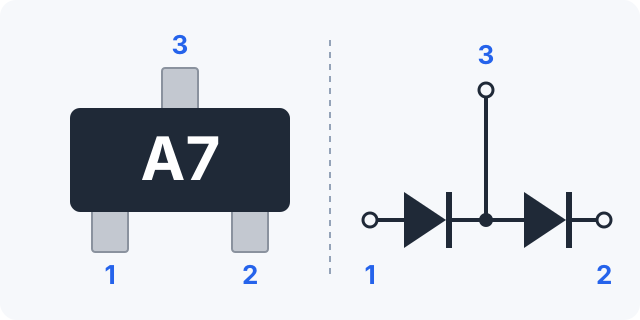
A7 | SOT-23 | BAV99, two diodes in series: pin 1 anode, pin 2 cathode, pin 3 centre tap | onsemi, Nexperia, Multicomp |
Z2 | SOT-23 | BZX84C5V1 Zener, 5.1 V | onsemi, Diodes Inc. |
AE / WE | SMA | SMAJ5.0A (unidirectional) / SMAJ5.0CA (bidirectional) TVS | Vishay, Alpha & Omega |
The SS14 row shows why you need the datasheet: one part, two different prints depending on who made it.
Zener diodes: the BZX84 series
In SOT-23 the most common Zeners belong to the BZX84 series. The letter is the tolerance (C = 5 %, B = 2 %), then the voltage with V as the decimal point: 5V1 = 5.1 V. The body carries a code again. BZX84C5V1 is marked Z2 by both onsemi and Diodes Inc., but BZX84C3V3 is Z14 at onsemi and ZE at Diodes. The 2 % BZX84B5V1 from onsemi is T11. Pinout also comes from the datasheet: onsemi uses pin 1 anode, pin 3 cathode, pin 2 not connected.
Zeners in SOD-123, SOD-323 and MiniMELF use the usual cathode band. A Zener works in reverse: cathode towards the positive rail.
TVS diodes: SMAJ, SMBJ, SMCJ
The SMAJ, SMBJ and SMCJ series sit in SMA, SMB and SMC packages, with typical peak pulse power of 400, 600 and 1500 W. The number is the stand-off voltage: SMAJ5.0A is a 5 V part.
- Suffix
A— unidirectional: the band marks the cathode. - Suffix
CA— bidirectional: no band, polarity does not matter.
The codes differ as well: Vishay marks SMAJ5.0A AE and SMAJ5.0CA WE. A TVS without a band is most likely bidirectional, not worn.
SMD LEDs
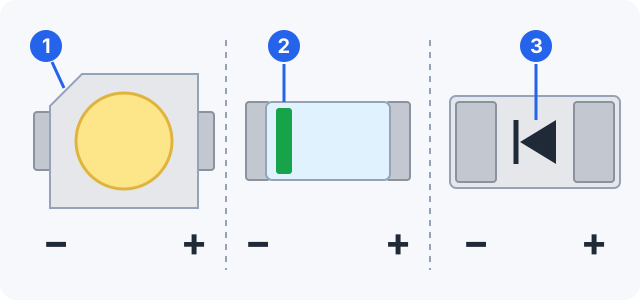
LEDs rarely carry a code, and every maker marks the cathode in its own way: a cut corner, a coloured line or dot on top, a triangle or a “T” on the underside. The drawing shows common variants; trust the datasheet or a meter before soldering.
Testing with a multimeter
In diode mode the meter drives a small current, typically around 1 mA, and displays the forward voltage.
- Red lead on the anode, black on the cathode: a silicon rectifier reads roughly 0.5–0.7 V, a Schottky less, around 0.15–0.4 V. Exact readings depend on the meter and the part.
- Reversed: OL. Near zero both ways means shorted, OL both ways means open.
- Test a BAV99 as two diodes: 1→3 and 3→2.
- A Zener reads like a normal diode forward; its Zener voltage above 2–3 V is beyond a meter — use a bench supply and a resistor.
- A bidirectional TVS of 5 V or more reads OL both ways, which is normal.
- A red LED may glow faintly at about 1.6–2 V; blue and white need around 3 V, and many meters will show OL — that alone does not mean the LED is dead.
In circuit, parallel paths distort readings. If the numbers look odd, lift one end and measure again.
Common mistakes
- Tantalum vs diode. The band on a tantalum capacitor is positive, on a diode it is the cathode. More in SMD capacitor marking.
- Code without package.
A7on SOT-23 andA7on another package are different parts. - Schottky replaced by a standard rectifier. In a switching supply it runs hot and switches off too slowly. The reverse swap is risky too: Schottkys leak more and have lower voltage ratings.
- Tolerance letter ignored. BZX84C and BZX84B have different codes and accuracy.
- Wrong TVS type. Check for the CA suffix and the band.
For ICs, see SMD IC marking; for resistors, SMD resistor marking.
In short
- Band on a diode = cathode (−); band on a tantalum capacitor = positive.
- The print is a manufacturer code; look it up by code, package and pin count, then confirm in the datasheet.
- M7 in SMA: 1000 V, 1 A; A7 in SOT-23: BAV99; Z2: BZX84C5V1 (at the makers checked).
- A TVS without a band is most likely bidirectional (CA).
- Diode mode: silicon ~0.5–0.7 V, Schottky lower; blue and white LEDs may not light.
In ServiceCenterSoft a replaced diode is a line in the repair estimate taken from stock. Stock is kept as a log of receipts and write-offs with on-hand quantities and a minimum level, and parts close to the minimum show up under the “running low” filter. More on spare parts tracking.
Which side of an SMD diode is the cathode?
The banded end. A light stripe on black plastic, or a coloured ring on a glass MELF part, marks the cathode — the negative side when the diode conducts. Do not confuse it with a tantalum capacitor, where the band marks the positive side.
What does M7 on an SMD diode mean?
In an SMA (DO-214AC) package, M7 is a 1000 V, 1 A rectifier with the same ratings as a 1N4007 — Diotec and MCC, for example, mark it this way. The M1…M7 range covers 50 to 1000 V. On a different package the same code may be a different part.
How do I identify a diode from the code on its body?
The code is a manufacturer abbreviation, not the part number, so search by three things: code, package and pin count. An SMD code book gives candidates; the marking column in the datasheet settles it. For example, A7 in SOT-23 is a BAV99 (two diodes in series) at onsemi and Nexperia.
Why does my SMAJ TVS diode have no band?
It is most likely bidirectional, with the CA suffix. Bidirectional parts have no band and no polarity; unidirectional ones (suffix A) have a cathode band. The codes differ too: Vishay marks SMAJ5.0A AE and SMAJ5.0CA WE.
How do I test an SMD diode with a multimeter?
Use diode mode: red lead on the anode, black on the cathode. A silicon rectifier reads roughly 0.5–0.7 V, a Schottky less, around 0.15–0.4 V; reversed, the meter shows OL. Readings vary by meter. Many meters cannot light blue or white LEDs, which alone does not mean they are faulty.
See also
SMD Transistor Marking Codes: SOT-23, SOT-223, SC-70 and SOT-89
Why a SOT-23 carries a short code instead of a part number, how to identify the part from code and package, why manufacturers use different codes, SOT-23 and SOT-223 pinouts, multimeter checks.
Read moreSMD IC Marking: Pin 1, Part Code and Date Code
How to find pin 1 on an SMD IC and which way to count, what the lines on the package mean — logo, shortened part code, date code — how to spot a remarked part and test a chip on the board.
Read moreSMD Resistor Codes: How to Read 103, 4R7 and EIA-96 (01C)
How to read the code on an SMD resistor: 3- and 4-digit codes, R as the decimal point, EIA-96 with the full table, 0 Ω jumpers, case sizes 0201–2512 and in-circuit checks with a multimeter.
Read more