Ski service software for ski and snowboard repair shops
For a ski repair shop or tuning bench: edge sharpening, hot wax, base repair and binding mounting as estimate lines, a promised date before the weekend, binding settings on record, consumables in stock and skis left over after the season.

ServiceCenterSoft is job-tracking software for a ski and snowboard service shop. A pair comes in, you note the base and edges, build an estimate from tune, wax and binding work, hand it back before the weekend — and next season you can see exactly what was done to it. It runs in the browser: on the computer at the counter and on a phone by the tuning bench.
Who it is for
Independent ski tuning shops, the service bench in a ski store, workshops in resort towns, and race-tuning setups that look after a club’s skis. The work is seasonal and bursty: the week before Christmas, half-term, and any Thursday after a good snowfall, when everyone wants their skis “by Saturday”. Then, in spring, a rack of pairs nobody comes back for.
The usual trouble:
- a family drops off four pairs and a board, and at pick-up the poles end up with the wrong skis;
- everything was promised for Saturday, and on Friday evening two pairs have not been touched;
- bindings were remounted, but nobody wrote down the setting or the boot sole length;
- a customer sees a core shot at pick-up and is sure your shop did it;
- wax and P-tex run out in the middle of the busiest week;
- in April there are a dozen pairs whose owners do not answer the phone.
One pair, one job
Each pair of skis — or each board — is its own job. Describe it in the model field so it stands out on the rack: “all-mountain skis, 170 cm, black and orange”, “snowboard 156, camber”. If there is a serial number on the base or topsheet, it goes in its own field, and search finds the job by part of it.
The condition field is for what people argue about later: scratches and core shots on the base, a torn-out edge, delamination, old repairs. The accessories field holds poles, bag, brakes and leashes. Both print on the job sheet the customer signs. You cannot attach a photo to a job; if you photograph the base on your phone, say so in the description.
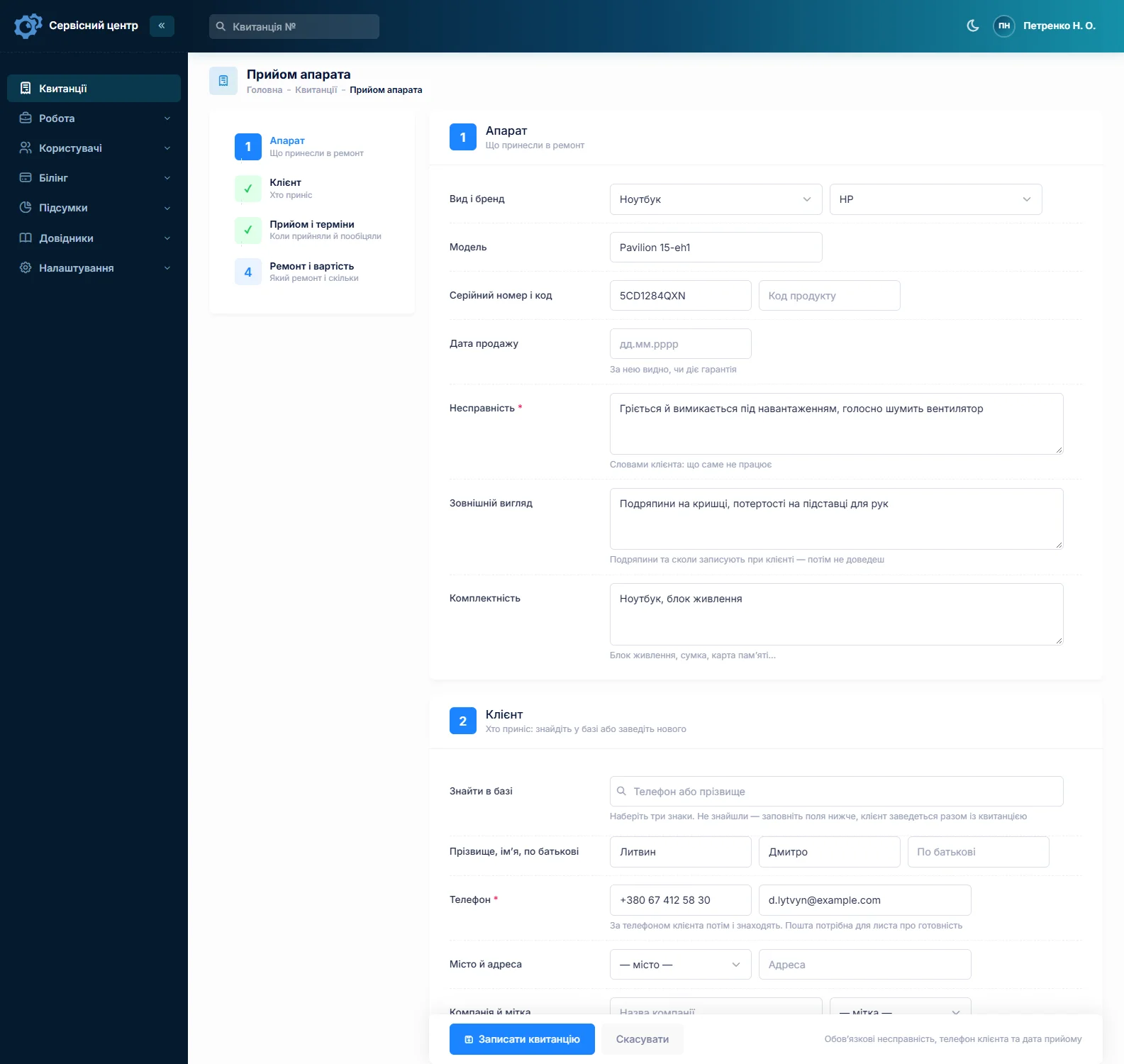
A family or a club team brings several pairs? Copy the job: the customer, device type and fault carry over, the serial number does not. Clubs and ski schools get a company name on the customer card, so all their pairs show up together.
Tunes, edges, base repair and bindings as estimate lines
Set up your standard work in the Works list with your own prices: edge sharpening, hot wax, full tune, P-tex base repair, base weld or patch, binding mounting, binding adjustment, snowboard binding setup. The estimate on each job is built from those lines and from stock items, each with a quantity, so the customer sees what they pay for rather than one word, “service”.
What was done, and with which values, goes in the work log: edge bevels, the structure applied, the release value set and the boot sole length it was set for, stance width and angles on a board. The log prints on the completion certificate together with the estimate, and the “recommendations” field holds advice — check the bindings before the first run, dry the skis after use. There is no skier profile and no binding-setting calculator: you set the value by the manufacturer’s procedure, and the software keeps the record. What counts as a correct setting, and who is responsible for it, is a matter for the manufacturer’s requirements and the applicable standards.
Approve first, then drill
Mounting bindings on new skis cannot be undone — the holes are there. So the estimate goes out before the drill comes out. A button on the job sends it to the customer by email or Telegram; the link shows every line and the total, with “I agree” and “I decline” buttons and room for a comment. The answer and date land in the job history. Not worth fixing the base? The “repair refused” status closes the job, and the reason stays in the log.
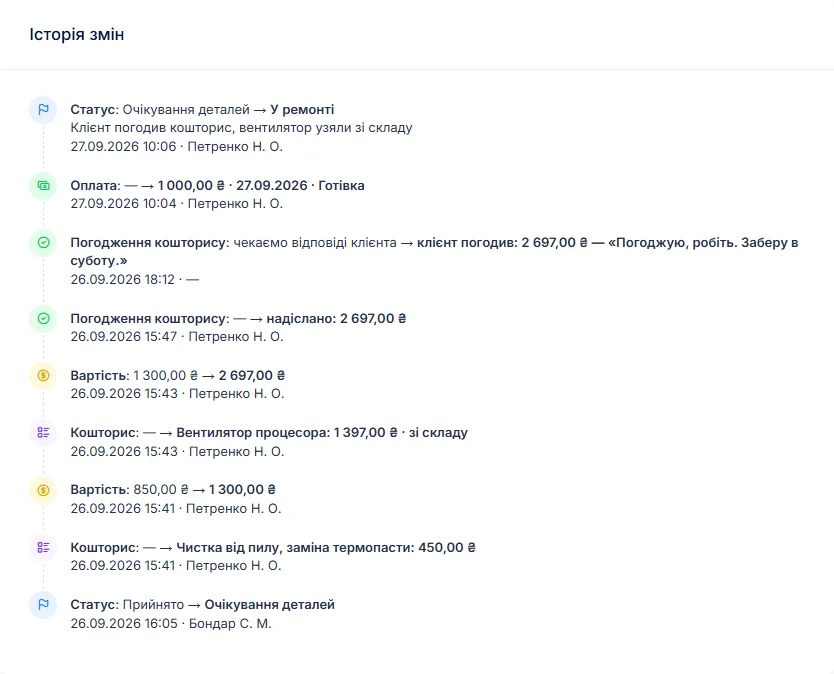
Bindings ordered in for a customer? Take a deposit: a job can have several payments, and the software shows what has been paid and what is still due.
Ready by the weekend
At intake you set a promised date and, when needed, mark the job as urgent. The job list shows what has to be done by Friday, and anything overdue turns red, so on Thursday night you know how many pairs are still waiting for the bench. Create your own colour-coded statuses — “waiting for tune”, “waxing”, “ready” — and switch them from a phone at the bench.
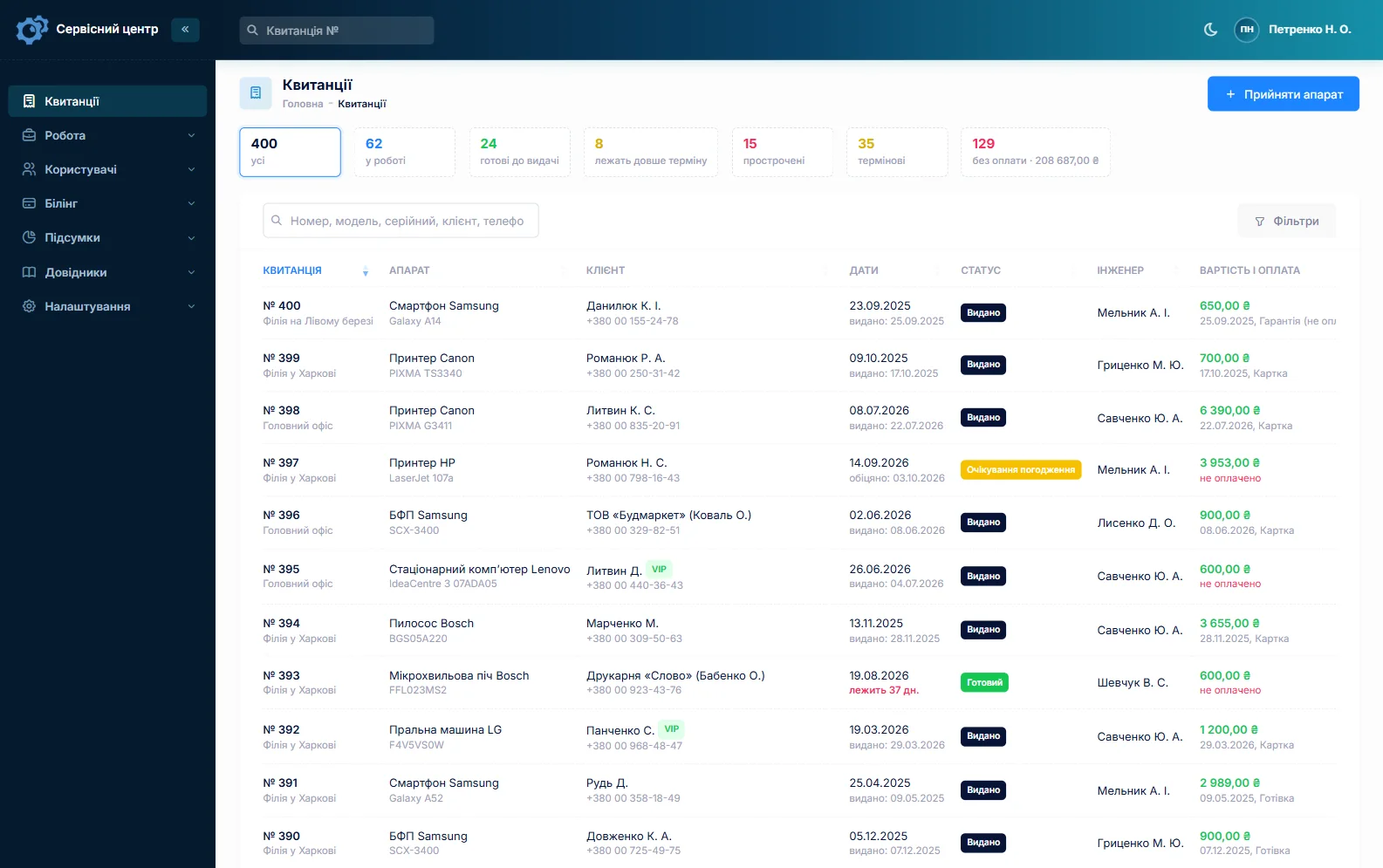
When a pair is ready, a button on the job sends an email or a Telegram message — more on customer notifications. If you take on an extra tech for the winter, every estimate line has a technician, and the report for a period shows who did how much.
Wax, P-tex and screws in stock
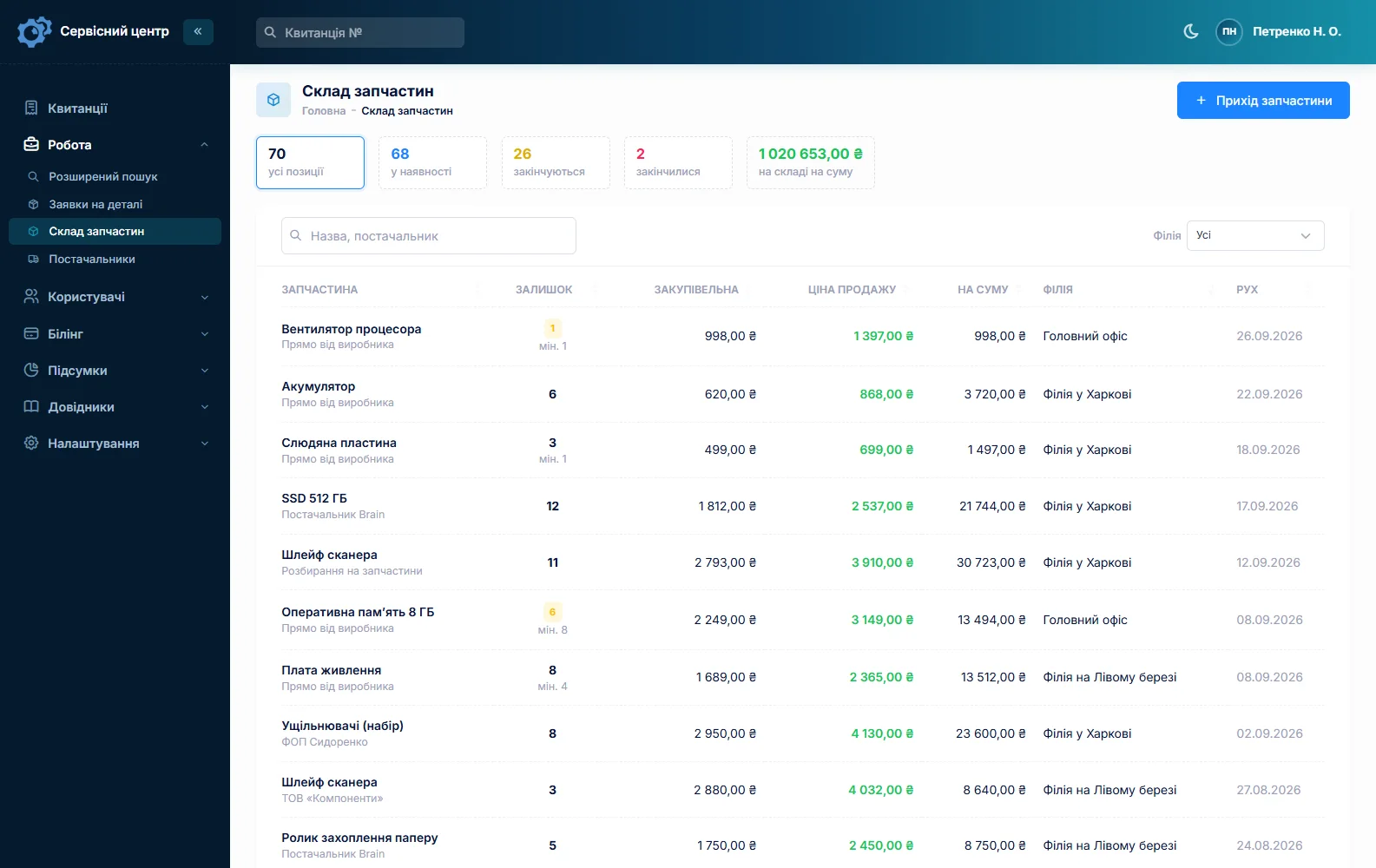
Stock is a ledger: receipts with the purchase price, items used on a job as an estimate line, stocktakes. Quantities are whole numbers, so count wax by the bar, P-tex candles by the piece and binding screws by the pack or piece. Each item has a minimum level, and the “running low” tile reminds you to reorder before the snow, not in the middle of it. More on spare parts tracking.
After the season: unclaimed skis and summer storage
Every finished pair shows how many days it has been waiting. Once the free storage period from your settings runs out, the counter turns red and a “past free storage” tile gathers those pairs. The ready email can be sent again. Put your storage terms and what happens to unclaimed items into the job sheet text, which the customer signs at intake; what you may actually do with someone else’s property is decided by your terms and local law, not by the software.
If you store skis over the summer as a service, that is a job with its own “in storage” status and a “seasonal storage” estimate line, paid up front. There is no separate storage module and no automatic storage fee; write the rack position in the technician notes. Tire storage works the same way — see tire shop software.
Not a rental system
There is no rental and no booking: a rental fleet, daily hire and time-slot booking are different systems. ServiceCenterSoft tracks repairs and servicing of the customer’s own gear. Many ski shops switch to bikes in summer — for that, see bike repair shop software.
What ski service typically costs
A rough guide, not a price list — it depends on country, resort and equipment: edge sharpening €15–30, hot wax €15–30, full tune with stone grind €35–70, P-tex base repair €10–25, base weld or patch €25–50, binding mounting €30–60, binding adjustment €10–25. You set your own prices in the Works list.
What it does not do
- rental, booking, online appointments or a calendar;
- skier profiles or binding-setting calculations;
- a till or a shop for selling gear;
- photos or files on a job, links to suppliers;
- SMS, a mobile app, online payment by the customer.
What it costs
One price for the whole shop — no extra charge for seasonal techs or branches.
Monthly
Paid every month, cancel whenever you like.
Yearly
Cheaper than paying monthly. Invoice or card payment.
Custom work
Changes tailored to the way you work — hourly, by agreement.
Off-the-shelf not enough — your own forms, roles, reports or workflow? We will build a program for you. How it works
Try it without signing up in the demo: book in a pair of skis, build an estimate with a tune and binding mounting, and send it for approval.

We are very happy working with servicecentersoft.com: they built everything we asked for, even though our request was unusual, since we deal with medical devices. Everything was done precisely and on the agreed schedule. Thank you for the cooperation — we keep working together.

I tried the ServiceCenterSoft demo and came away with a good impression. The program is simple and easy to understand, yet it has everything you need for the job: customers, repairs, devices, spare parts, statuses and statistics.
I especially liked the dark theme and the responsive design — working from a phone is perfectly comfortable. Another plus is the instant search that works as you type, so you don't have to press a separate "Search" button every time.
You can tell the program was built specifically for service centers rather than being a generic CRM adapted for the repair business. The interface has no unnecessary frills; everything is logical and to the point.
A good, practical tool for the day-to-day work of a service center.

I liked that you get a free 14-day trial and that they are willing to handle my special requests — setting things up exactly the way I need them.
I also liked how payment works. You can simply pay the monthly fee by card online — basically the same as a regular Spotify subscription or any other service. No separate contracts to sign and no invoices to pay manually.
And there's no feeling of strict limits on the number of employees. One service center is one account, and inside it you can organize the work of your technicians and run several branches.
For me this is far more convenient than plans where you have to pay for every single user or keep counting how many employees are working today.

My business is fairly specific, so the program's standard features weren't enough — I needed my own custom fields, my own sorting options and search by additional parameters. The work completion certificate and the printed repair receipt also needed some changes to fit the way we work.
I contacted technical support. To be honest, I expected changes like these to take a long time, but everything was done within a single day. The team quickly understood exactly what we needed, suggested the right solution and did everything properly.
I'd especially like to mention the support: they get straight to the point, with no unnecessary bureaucracy, and they genuinely help instead of just sending you off to read the documentation.
For me this is a big advantage of the program: it isn't just sold "as is" — it can be adapted to how you actually work. Thanks to the team for the quick response and for treating the customer right.
Highly recommended!
In short
- One pair, one job; base condition and accessories on the signed sheet.
- Tunes, base repair and bindings as estimate lines, settings on the certificate.
- Drill only after the customer clicks “I agree”.
- Promised dates and urgent jobs keep “by the weekend” honest.
- Wax and P-tex in stock with a minimum level.
- Unclaimed pairs in a separate list.
- €20 a month for the whole shop.
See also
Sharpening service software for knives, scissors, saws and tools
For a sharpening business that handles kitchen knives, shears and grooming tools, saw blades, router bits and chains: a batch from a salon or restaurant as one job with “service × quantity” lines, walk-in orders at speed, mail-in orders, regular accounts.
Read moreFurniture repair and upholstery business software
For upholstery, furniture repair and restoration workshops: written condition on the signed job sheet, estimates approved by the customer, deposits for fabric, pickup and delivery as estimate lines, fabric and foam in stock.
Read moreStarting your own repair shop: where to begin
For people who can fix phones and laptops and want to work for themselves: what a small repair business needs on day one, the paperwork that protects you from the first customer, and how to run a shop in a country whose language is not your own.
Read moreSee how it works
The demo is open — go in and try it. Ask us anything by email, Telegram or the form on this site.